Your Page’s First Reader Is the Model That Cites You
A retrieval model reads and cites your page before any human loads it, and the engagement metrics you track no longer predict which pages get cited.
 machina sculpsit · homo probavit · MMXXVI
Every page you publish now has two audiences, and the first one through the door is software. Before a human clicks, a retrieval model reads the page, decides whether to quote it, and often answers the question without sending anyone to your site at all. Zero-click searches rose from 54% to 72% once AI summaries appeared, with no measurable drop in user satisfaction (Agarwal and Sen, 2026). The page still has to win a human once they arrive, but it has to win the machine first, and the two readers do not want the same things.
A Model Reads Your Page Before Any Human Sees It
The retrieval step happens first, and most of the time it is the only step. Readers clicked a traditional result in just 8% of visits when an AI summary appeared, versus 15% when it did not (Pew Research Center, 2025). By the time a person decides whether to visit, a model has already read the page, scored its passages, and rendered an answer.
That order matters because it inverts who you are writing for. The model is the reader that decides whether your page enters the answer at all, and the human is the reader who shows up afterward, if the model lets them. A page can be flawless for a person and never clear the first gate.
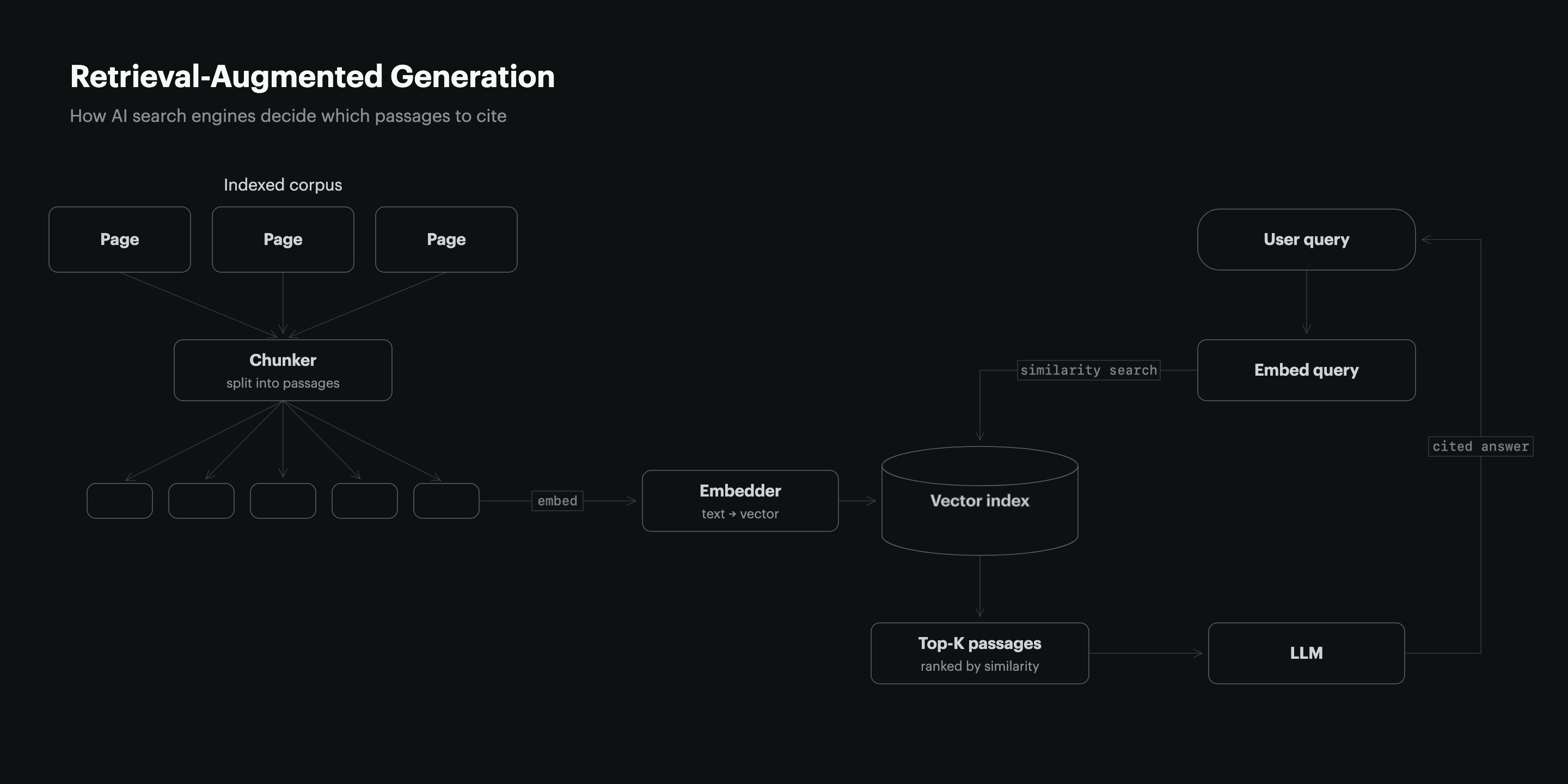
The mechanics are retrieval first, generation second. The engine breaks pages into passages, ranks them against the query, and feeds the top few into the model that writes the answer. We walk through that flow in how AI search engines decide what to cite. Nothing about that pipeline cares whether a human enjoyed the page.
Engagement Metrics No Longer Predict Citations
Rank and citation have come apart. Only 38% of AI Overview cited pages still appear in the organic top 10 for the same query, down from 76.1% in mid-2025 (Ahrefs with BrightEdge, 2026). The signals that move rank, the ones marketers spent a decade tuning, no longer tell you whether a page gets cited.
Dwell time, bounce rate, and scroll depth feed ranking and user-experience tooling. None of them describe what a retrieval model does, because the model never dwells, never bounces, and never scrolls. It reads once, scores passages, and moves on. A page can hold human attention beautifully and still be invisible to the machine reader, and most analytics stacks will not show you the gap. We cover that blind spot in why most analytics setups hide your AI search invisibility.
The human-engagement metrics that stopped predicting AI citation:
- Dwell time. Measures how long a person stays. The model extracts and leaves in milliseconds.
- Bounce rate. Measures whether a person left fast. The model has no session to abandon.
- Scroll depth. Measures how far a person reads. The model weights position, not progress.
- Time on page. Rewards narrative that keeps a person reading. The model rewards the answer that lets it stop reading.
The same field experiment that measured the zero-click jump also found outbound organic clicks fell 38% on queries where an AI summary appeared (Agarwal and Sen, 2026). The traffic your engagement metrics describe is the traffic the machine reader is quietly keeping for itself.
The Machine Reader Stops in Your Opening Third
The model reads top-down and stops early. In a study of Google AI Overviews, 55% of citations came from the first 30% of a page, 24% from the middle, and 21% from the bottom 40% (CXL, 2024). The machine reader gives your opening passages most of the weight and rarely reaches the depth a human might scroll to.
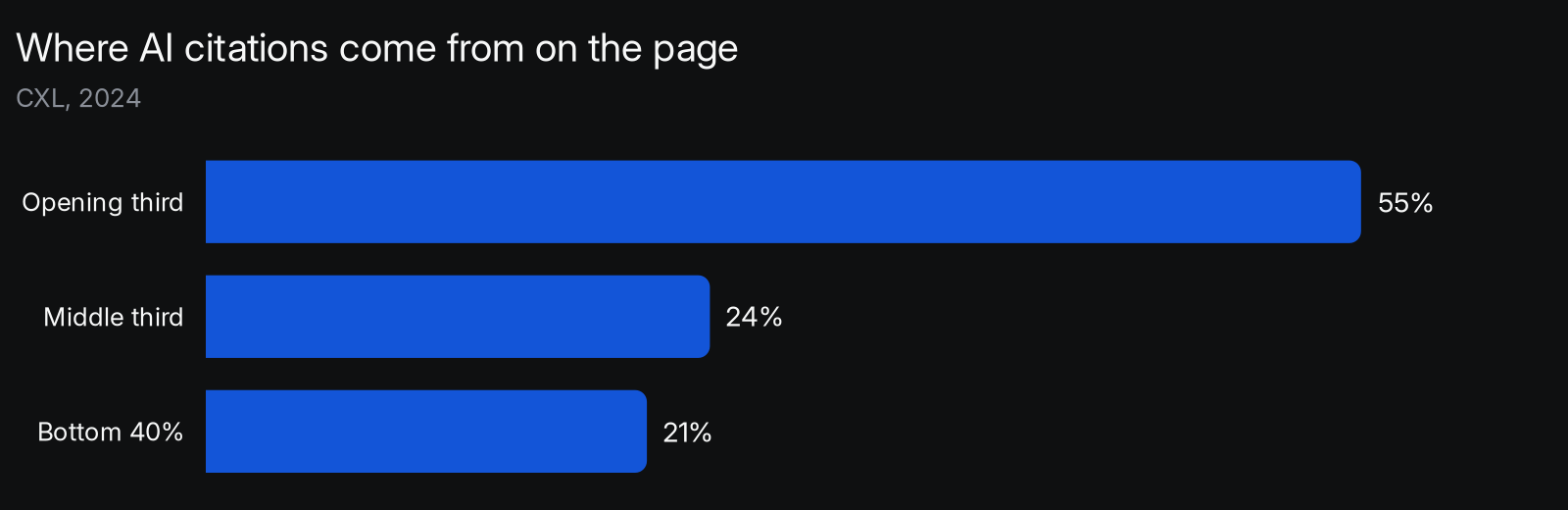
A human skims, jumps to the section they want, and reads non-linearly. The machine reader does the opposite. It scores the chunks it meets first and is most likely to quote them, so a buried answer that a person would eventually find is an answer the model never reaches. The position your best paragraph sits in is now a citation decision, which is the case we make in full in page architecture beats content quality as an AI citation driver.
Two Readers Want Opposite Things From One Page
The tactics that hold a human can suppress a citation. Keyword stuffing cut AI visibility by roughly 10%, while adding statistics raised it 41% in controlled experiments across 10,000 queries (Princeton, KDD 2024). The narrative build-up, the keyword density, and the personality that once kept a reader on the page are not what the machine reader scores.
| Tactic | AI visibility change | What it signals to the model |
|---|---|---|
| Adding a statistic | +41% | A verifiable, quotable claim |
| Quoting a source | +28% | Attributed, defensible evidence |
| Authoritative language | +25% | A confident, citable assertion |
| Tightening the prose | +15% | A clean passage with less noise |
| Keyword stuffing | -10% | Padding the model discounts |
Source: Princeton, Georgia Tech, Allen AI, and IIT Delhi (KDD 2024).
The instinct to write the way a strong human page reads, with a hook and a slow reveal, now works against the reader that decides your citation. That collision is the whole argument in SEO copywriting instincts suppress AI citations. The fix is not worse writing for humans, it is front-loading the evidence the model needs while keeping the page readable.
Structure Is the Language the Retrieval Model Reads
Structure moves citations even when the words do not change. A controlled experiment that held the content identical and varied only structural features found a consistent 17.3% lift in AI citation rates across six engines (University of Tokyo and University of Tsukuba, March 2026). The machine reader parses tables, lists, and labeled blocks as discrete answers, where it reads a paragraph as one undifferentiated chunk.
Our own 852-article citation structure study found top-cited pages average 13.55 structural elements per page versus 2.98 in the bottom quartile, with bold-labeled blocks present in 94% of top-cited pages and 0% of the bottom 50 (Res AI, 852-article B2B citation structure study, 2026). Prose is what a human reader wants and what the machine reader struggles to extract. A table is the opposite. The page that serves both keeps the prose and adds the structure, rather than choosing one reader over the other.
Where Writing for Both Readers Agrees
The two readers are not always at war. AI-referred visitors spend 68% more time on site than traditional organic visitors (Averi AI, 2024), because the same clarity that makes a page extractable also makes it scannable for a person. A front-loaded answer, a clean heading, and a labeled table serve the human skim and the machine parse at the same time.
The conflict is narrow and the overlap is wide. Where the readers diverge is a short list, narrative build-up, keyword padding, and a brand voice that delays the answer. Where they agree is most of the page, clear claims, real evidence, scannable structure, and headings that say what the section proves. Optimizing for the machine reader rarely costs the human one. It usually sharpens the page for both.
Write Your First 150 Words for the Reader That Cites You
Put a self-contained answer to the page’s main question in the first 150 words, before any set-up or brand voice. The machine reader weights the opening, so the answer it can quote has to be there before the prose that a human would read to warm up. This is the single highest-impact change because it serves the reader that decides citation at the exact spot that reader is reading.
The first-150-words recipe:
- One-sentence answer. State the page’s core claim directly, with no preamble.
- One attributed stat. Anchor the claim with a single number and its source.
- No throat-clearing. Cut the “in this article” opener and the slow build.
- A list or table in the first screen. Give the model a discrete, extractable block early.
A human who lands on that opening gets the answer faster too, then reads on for the depth. The build-up you cut was never doing the work you thought it was, for either reader.
The Human Reader Still Has to Convert After the Citation
Earning the citation is the start, not the finish. AI referral traffic influenced conversions at a rate 534% higher than the site-wide average (Eyeful Media, 2026). The machine reader earns the visit, and the human reader still decides the deal, so abandoning human optimization once you structure for extraction trades one failure for another.
The two readers are sequential, not a choice. AI search traffic converts at 14.2% versus Google’s 2.8% (Averi AI, 2024), which means the person who arrives by way of a citation is unusually ready to act, and a page that stops working the moment it gets cited wastes the most valuable visit you can earn. Structure earns the citation. The page still has to earn the conversion.
| Stage | What reads the page | The metric that matters |
|---|---|---|
| Retrieval | The machine reader | Citation rate across runs |
| Answer click | The human reader | Click-through from the AI answer |
| On-page | The human reader | Conversion rate of the visit |
The mistake is treating these as one funnel measured by one number. They are two readers measured by three.
Audit Your Pages for the Machine Reader
Audit the page the way the model reads it, top-down and structure-first. Run each high-value page against a short checklist that asks whether the machine reader can find and quote an answer, not whether a human enjoyed it. The pass condition is extractability, and most pages built for engagement fail it on the first two rows.
| Check | Pass condition | Common fail |
|---|---|---|
| Answer placement | Direct answer in first 150 words | Answer buried after a narrative intro |
| Extractable blocks | At least one table or labeled list early | All prose, no discrete chunks |
| Structural density | 8 or more structural elements | Single table or none |
| Evidence | An attributed stat in the opening | Unsourced claims up top |
| Noise | No keyword padding | Repeated phrases the model discounts |
Pages that pass this audit are not worse for humans. They are clearer, faster to the point, and easier to scan, which is why the audit rarely forces a trade-off between the two readers.
How GEO Platforms Treat the Machine Reader
Every tool in this category agrees the machine reader matters, but they split on whether they read the page for you or rewrite it for the model. The dimensions that separate them are whether they change the page itself, how many engines they cover, and what the user actually walks away with.
| Platform | What it does about the page | Engines covered | What the user gets |
|---|---|---|---|
| Res AI | Rewrites pages into machine-readable structure and deploys via the CMS | ChatGPT, Perplexity, Claude, Gemini | Restructured pages live in minutes |
| Profound | Monitors how the brand appears and shows gaps without fixing them | 10+ including ChatGPT, Perplexity, Claude, Gemini | Visibility dashboards |
| Conductor | Tracks visibility and generates enterprise AI content | ChatGPT, Gemini, Copilot, Claude, plus search | Reports plus content |
| Peec AI | Monitoring only, position and sentiment, no optimization | Multiple LLMs | Visibility and prompt tracking |
| Athena | Tracks and outputs automated optimization recommendations | 8+ LLMs | Recommendations to act on |
| AirOps | Creates content and tracks AI visibility | Multiple AI engines | Content workflows, months to value |
Monitoring tells you the machine reader skipped your page. It does not change what that reader finds next time. The execution-first approach is the one that edits the page the model reads, which is the distinction we draw in you do not need to monitor your AI visibility, you need to create it.
Frequently Asked Questions
Why do dwell time and bounce rate stop predicting AI citations?
Those metrics describe a human session, and the retrieval model has no session to measure. It reads a page once, scores its passages, and quotes the best one, so a page can win every engagement metric and still never be retrieved.
How does a retrieval model decide which passage to quote?
It splits the page into passages, ranks them against the query, and feeds the top few to the model that writes the answer. Position and structure weigh heavily, which is why 55% of citations come from the opening third of a page (CXL, 2024).
Can a page rank first on Google and never get cited by AI?
Yes, and it is now common. Only 38% of AI Overview cited pages appear in the organic top 10 for the same query (Ahrefs with BrightEdge, 2026), so rank and citation are no longer the same outcome.
How much of a page does the machine reader actually use?
Most of the weight lands in the opening third, which supplies 55% of citations versus 21% from the bottom 40% (CXL, 2024). A buried answer a human would eventually scroll to is one the model rarely reaches.
Does writing for AI extraction hurt the human reading experience?
Rarely, because the two readers overlap on most of the page. AI-referred visitors spend 68% more time on site than organic visitors (Averi AI, 2024), evidence that the clarity the model rewards also serves the person.
What is the single highest-impact change for the machine reader?
Put a self-contained, attributed answer in the first 150 words. The model weights the opening, so the answer it can quote has to appear before the set-up, and a human gets to the point faster too.
How often does the machine reader pull a different passage?
Often enough that one check cannot measure it. Two runs of the same prompt share only 0.72 Jaccard similarity in cited sources (Res AI, 1,000-query Perplexity B2B citation study, 2026), so citation is a rate across runs, not a single snapshot. We explain the measurement floor in a single citation check cannot measure GEO performance.
Should I stop optimizing for human engagement entirely?
No, because the human reader still decides the conversion after the citation earns the visit. AI referral traffic influences conversions 534% above the site-wide average (Eyeful Media, 2026), so the page has to work for both readers in sequence.
How Res AI Structures Pages for the Machine Reader First
The page that wins the machine reader is structured for extraction before it is dressed for a human, and that restructuring is the work Res AI does. Res reads your existing pages, rewrites them into the tables, labeled blocks, and front-loaded answers that retrieval models quote, and pushes the changes live through your CMS in minutes with no developer involvement. It is execution on the page itself, not a dashboard reporting that the machine reader skipped you.
Res tracks citations across ChatGPT, Perplexity, Claude, and Gemini, then closes the gaps it finds by editing the content rather than handing you a brief. The natural-language interface lets you make one pinpoint fix or a sweeping change across an entire library with a single instruction, so the opening 150 words, the structural density, and the evidence the model needs are in place on every page the audit above would flag.
Res AI is the execution layer for the reader that decides your citations, the retrieval model that reads every page before a human does. It fits marketing teams that have the content but not the time to restructure it, and you can start with 10 free articles.
See how Res AI structures your pages for the machine reader →