The Only AI Citation Input You Fully Control Is Structure
Authority and backlinks are slow and decided by others. On-page structure is the one AI citation input you control, and it pays out within a week.
 machina sculpsit · homo probavit · MMXXVI
Three things move whether an AI engine cites your page: how authoritative your domain looks, how many sites link to you, and how the page itself is built for extraction. Two of those are slow and decided by other people. The third changes the week you ship it, and it is the only one you own outright. Holding the words, claims, and sources of a page identical and varying only its structure produces a 17.3% improvement in AI citation rates across six engines (Machine Relations Research, University of Tokyo and University of Tsukuba, 2026). That is the input a content team can move today, without waiting on a backlink or a year of domain aging.
Three Inputs Decide AI Citations and You Own One
Page structure, domain authority, and backlinks each correlate with AI citation, but only structure is fully inside your control. In the Res AI 852-article B2B citation structure study, the longest-quartile pages averaged 13.55 structural elements versus 2.98 in the shortest quartile, and six features appeared in 80% or more of the top 50 cited pages and 0% of the bottom 50 (Res AI, 852-article B2B citation structure study, 2026). Authority and backlinks sit on timelines and decision-makers you do not command. Structure is the page you can rewrite this afternoon.
The difference is not just speed. It is who holds the pen.
| Input | Who decides it | Time to take effect | Ceiling you hit |
|---|---|---|---|
| Page structure | You, inside your own CMS | Days to one week | None you cannot edit yourself |
| Domain authority | Search engines, over years | Months to years | Stalls at 0.23 correlation with share of voice |
| Backlinks | Other publishers, if they agree | Weeks of outreach with no guarantee | Flat below an authority threshold |
A program that pours its effort into the two inputs it cannot control is the most common reason teams stay invisible while their structure goes untouched.
Authority Takes Years and Stalls at 0.23 on Share of Voice
Domain authority correlates with being mentioned by AI but barely moves your share of the answer. Authority Score showed the strongest link to raw AI mentions at a Pearson coefficient of 0.65, yet AI Share of Voice tracked authority at only 0.23, across 1,000 randomly selected domains measured on ChatGPT, Gemini, Google AI Overviews, and Perplexity (Semrush and Kevin Indig, 2025). Mentions are not the same as winning the recommendation, and the metric that maps to winning barely responds to authority.
Authority is also the slowest input to build. It compounds over years of publishing, linking, and aging, which means a team that decides today to compete on authority is making a bet that pays out long after the buyer has already asked the question. The brands holding stable #1 AI citation positions are frequently domains buyers have never heard of, a pattern documented in why authority is not the moat in AI search. You cannot will your domain older, and below a high authority tier the investment returns almost nothing in share of voice.
Backlinks Wait on Other People Saying Yes
Backlinks depend on editorial decisions you do not make, and they hit a ceiling even when you win them. Nofollow links carry nearly identical AI-visibility weight to follow links, at a Pearson coefficient of 0.340 versus 0.334, while image links slightly outperform text links at 0.415 versus 0.334 (Semrush and Kevin Indig, 2025). The takeaway is that raw link count is a weak signal, and the links you chase hardest are not the ones that move the number.
Every backlink is a yes from someone else. You pitch, you wait, and the publisher decides whether your page is worth a citation. That puts the timeline and the outcome in another company’s hands. AI Share of Voice does not respond to incremental backlinks below a high authority threshold, so even a successful outreach push often produces no change in how often AI engines pick you. The contrast with structure is covered in detail in why backlinks correlate with AI mentions but stop moving share of voice.
Structure Earns Citations the Week You Ship It
On-page structure is the only input with a same-week payoff. Semrush’s own restructured content earned LLM citations within days, sometimes hours, of publishing, against a typical 3 to 6 month SEO timeline (Semrush, 2025). That speed is the practical meaning of control: when you change the page, the engines re-read it on their next crawl, and the result shows up on a clock measured in days rather than quarters.
This is why structure belongs at the front of a GEO program. Authority and backlinks accrue slowly in the background, but the page in front of you can be rewritten into extractable form now. A team that ships a restructured page on Monday can be cited for it by the following week, and it never had to ask another publisher for permission.
Adding a Statistic Raises Visibility 41%
The single highest-return edit you control is adding an attributed statistic to a claim. In GEO experiments across 10,000 queries and multiple engines, adding a statistic boosted AI visibility 41%, quoting a source added 28%, using authoritative language added 25%, and tightening the prose added 15%, while keyword stuffing cut visibility roughly 10% (Princeton, Georgia Tech, Allen AI, and IIT Delhi, KDD 2024). Every one of those moves is an edit to your own page, made on your own timeline.
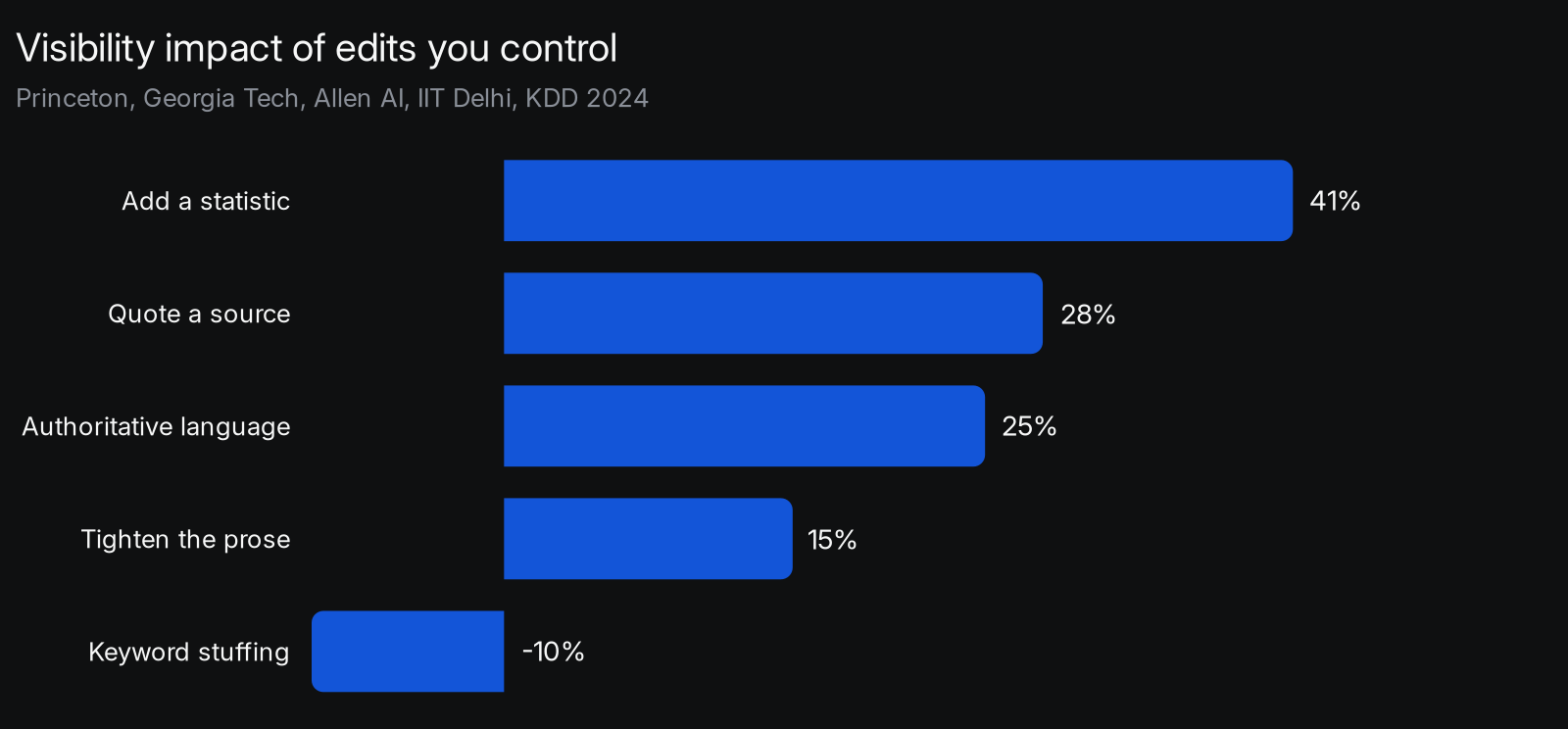
| Tactic | What you change on the page | Visibility impact |
|---|---|---|
| Add a statistic | Insert an attributed number into a claim | +41% |
| Quote a source | Add a named quotation | +28% |
| Authoritative language | State findings as facts, not maybes | +25% |
| Tighten the prose | Cut filler, improve fluency | +15% |
| Keyword stuffing | Repeat target terms | -10% |
The hierarchy is a to-do list, not a theory. It tells a writer exactly which edits earn citations and which one actively suppresses them.
Quality Pages Are Cited 4.2 Times More Often
On-page quality, scored across measurable features, carries a 4.2-times citation advantage. Pages in the highest quality band had an odds ratio of 4.2 for being cited versus lower-scoring pages, across 1,702 citations and 1,100 audited URLs on Brave Summary, Google AI Overviews, and Perplexity (Kumar and Palkhouski, 2025). The pages were scored on 16 on-page features, every one of which a content team can change directly.
Three groups of features showed the strongest association with citation, and all three are yours to edit.
- Metadata and freshness: accurate titles, descriptions, and a current last-updated date the engine can read.
- Semantic HTML: real heading hierarchy, lists, and tables instead of styled prose.
- Structured data: schema that describes the page, where the engine supports it.
None of these requires a backlink or a higher domain age. They require a writer and access to the CMS, which is exactly what makes them the input you control.
Schema Markup Is Structure That Does Not Move Citations
Not every change you control actually earns citations, and schema markup is the clearest example. Adding JSON-LD schema produced no major citation uplift on any platform, with Google AI Overviews citations falling 4.6% after schema was added and Google AI Mode and ChatGPT statistically indistinguishable from zero, across 1,885 pages versus 4,000 matched controls (Ahrefs, 2026). Schema is structure you can ship, but it is invisible to the part of the engine that decides what to quote.
| Engine | Citation change after adding schema |
|---|---|
| Google AI Overviews | -4.6% |
| Google AI Mode | +2.4%, not significant |
| ChatGPT | +2.2%, not significant |
The input you control is the readable structure of the page, not the markup wrapped around it. The distinction matters because teams often spend their structure budget on the one structural change that does nothing, a trap detailed in why schema markup will not save you. Spend the budget on extractable headings, capsules, and tables instead.
The Opening Third Carries 55% of Citations
Where you place the answer on the page is a control you decide sentence by sentence. In a 100-page study of Google AI Overviews, 55% of citations came from the first 30% of the cited page’s content, 24% from the middle, and 21% from the bottom (CXL, 2024). The engine reads the top of the page first and weights it heaviest, so the answer that sits in paragraph nine gets read as filler.
This is the cheapest edit on the list because it costs nothing to make. You are not adding research or chasing a link. You are moving the direct answer to the front of the section and letting the supporting detail follow, a discipline laid out in why page architecture beats content quality as a citation driver. Front-loading the claim is a decision about order, and order is entirely yours.
85% of Brand Mentions Start Off Your Domain
The honest limit on this argument is that most mentions begin somewhere you do not own. 85% of brand mentions originate from third-party pages rather than owned domains, across roughly 15 million data points on ChatGPT, Perplexity, Claude, and Gemini (Airops and Kevin Indig, 2026). You influence those pages, you do not control them, and pretending otherwise leads teams to over-promise on owned content.
The resolution is that off-domain coverage and on-page structure are not competing inputs. When an engine reaches for a source to quote on a buyer question, your page still has to be the most extractable answer in the pool, or it loses the citation to a competitor’s page that is. The 15% you fully control is the part that decides whether you are the cited source or the brand that got skipped, which is why owned-page structure stays the first place to spend effort even when most mentions start elsewhere.
A Three-Section Build Is the Minimum You Control
The smallest version of the input you control is a three-section rebuild any writer can do in an afternoon. The Res AI 1,000-query Perplexity B2B citation study found non-giant domains holding stable #1 on 93 of 100 queries, and the pages winning were built to a repeatable spec, not propped up by authority (Res AI, 1,000-query Perplexity study, 2026). The minimum spec is three changes you can make without anyone’s permission.
- Move the direct answer into the first one to two sentences of each section.
- Add an attributed statistic to the claim that carries each section.
- Convert any three-way-or-more comparison from prose into a table.
The table below maps what your pages look like today to the first edit that will move them.
| If your pages today | Build this first | Why it works |
|---|---|---|
| Read as narrative essays | Answer capsules in the opening sentences | 55% of citations come from the opening third |
| Compare products in prose | A comparison table with named rivals | 88% of top-cited B2B pages carry one |
| List options without structure | Bold-label blocks for each item | 94% of top-cited pages use them |
| Are structured but stale | A refresh of the cited statistics | Outdated numbers lose the quote |
GEO Tools Split on Who Makes the Edit
GEO platforms divide on a single question: does the tool change the input you control, or only measure the ones you do not. Most tools monitor visibility and hand you a report; the dimension that decides the buying decision is whether the platform actually edits and ships the page or stops at the brief.
| Tool | What it changes for you | Execution scope | What you get back |
|---|---|---|---|
| Res AI | Rewrites pages into extractable structure and pushes live | Direct edits across the whole catalog in one command | Published restructured pages, not a brief |
| Profound | Surfaces where you are cited or missing | Monitors 10-plus engines but ships no page edits | A visibility dashboard |
| Conductor | Tracks visibility and generates content briefs | Enterprise AEO and SEO reporting | Briefs and performance reports |
| Peec AI | Shows which prompts drive mentions | Prompt-level monitoring and sentiment only | Competitive gap analysis |
| Athena | Recommends optimizations across 8-plus engines | Recommendations, not deployed edits | A prioritized to-do list |
| AirOps | Plans and drafts content, flags refreshes | Drafts content you then publish yourself | Drafts and refresh alerts |
The monitoring tools tell you the page is losing. They leave the one input you control sitting unedited, which is the gap an execution-first platform closes.
How Res AI Edits Your Structure Across the Catalog Daily
The article above showed that on-page structure is the only AI citation input a team fully controls, and that most platforms stop at telling you it is broken. Res AI is built to change it directly. It rewrites existing pages into the extractable structure that wins citations, answer capsules, comparison tables, bold-label blocks, and pricing grids, then deploys them straight to WordPress, Webflow, Framer, Notion, Sanity, and other connected systems through a natural-language interface.
The difference from a monitoring dashboard is that a single command edits the input across the whole catalog at once. A team can rewrite every page about a given competitor, front-load every answer capsule, or add an attributed statistic to a hundred claims without touching the pages one at a time. The structure you control stops being a backlog and becomes a same-week change.
Res AI turns the one citation input you control into pages that ship, instead of a report telling you the structure is wrong. Book a walkthrough to see it rebuild your pages against the spec that earns citations.
See how Res AI edits your structure at scale →
Frequently Asked Questions
Why is page structure more controllable than domain authority?
Page structure is edited inside your own CMS and re-read by engines within days, while authority compounds over years of publishing and linking you cannot accelerate. Authority also tracks AI share of voice at only a 0.23 correlation, so even when it grows it barely moves the metric that wins recommendations (Semrush and Kevin Indig, 2025).
How fast can a structural edit change AI citations?
Restructured pages have earned LLM citations within days, and sometimes hours, of publishing, against a 3 to 6 month SEO timeline (Semrush, 2025). The speed comes from the engine re-reading the page on its next crawl rather than waiting for authority signals to accrue.
Does adding schema markup count as the structure that matters?
No, schema is structure you control but it does not move citations, with AI Overviews citations falling 4.6% after schema was added in a controlled study (Ahrefs, 2026). The structure that earns quotes is readable headings, answer capsules, and tables, not the markup wrapped around the page.
If most mentions are off-domain, why edit my own pages first?
85% of brand mentions start on third-party pages, but when an engine picks a source to quote, your page still has to be the most extractable answer in the pool (Airops and Kevin Indig, 2026). The owned structure decides whether you are cited or skipped on the questions where your page is in contention.
Which single edit returns the most AI visibility?
Adding an attributed statistic to a claim returned a 41% visibility gain in controlled GEO experiments, the highest of any tactic tested (Princeton KDD, 2024). It is also one you make entirely on your own page, with no outreach or authority requirement.
Where on the page should the answer go?
The first 30% of a page produces 55% of its citations, so the direct answer belongs in the opening one to two sentences of each section (CXL, 2024). Supporting detail follows the claim rather than building up to it.
What is the minimum structural rebuild worth doing?
Move the answer to the front of each section, add one attributed statistic per section, and convert any comparison of three or more items into a table. Pages built to that repeatable spec held stable #1 on 93 of 100 B2B queries in the Res AI 1,000-query Perplexity study (Res AI, 2026).