Six Structural Features Separate AI-Cited B2B Articles from Invisible Ones
We counted the parts of 852 AI-cited B2B pages. Six structural features appear in 80%+ of the top 50 and 0% of the bottom 50, and three outside studies agree.
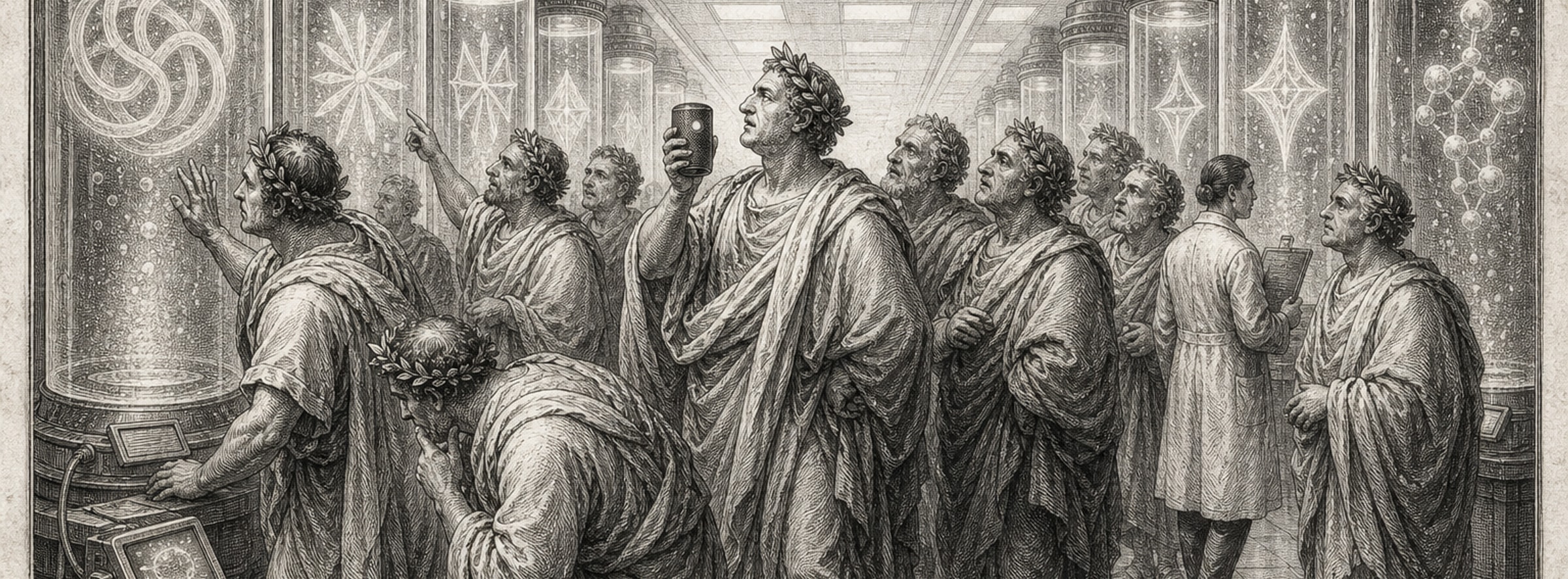 machina sculpsit · homo probavit · MMXXVI
In 1543 Andreas Vesalius put a body on a table in Padua and drew what was actually inside, and Western medicine stopped guessing about anatomy. Content marketing never got its Vesalius. It still argues about whether the writing is good enough, while AI engines quietly sort pages by something the prose has almost nothing to do with: whether the page carries the discrete components an answer engine can lift out and reuse. The buyer stopped searching and started asking, and the next B2B decision now gets made inside an AI answer, so a content program now lives or dies on being the page that answer is built from. We scraped 852 pages that ChatGPT and Perplexity cite at the top of their answers and counted the parts. What separates the cited from the invisible is not a spectrum from good to bad. It is a hard line between pages that have the parts and pages that do not.
Six features split the top 50 cited pages from the bottom
Six structural features appear in 80% or more of the top 50 cited B2B pages and in 0% of the bottom 50 (Res, 852-article B2B citation structure study, 2026). The two groups do not differ by a matter of degree. On the features that gate citation, the top pages carry them and the bottom pages carry none of them at all.
The counting used no model in the loop, only a deterministic regex parser reading the scraped markdown for eleven features. Where the top and bottom pages diverge, they diverge completely.
| Feature | Top 50 | Bottom 50 |
|---|---|---|
| Bold-label product blocks | 94% | 0% |
| Comparison tables | 88% | 0% |
| How-to-choose steps | 86% | 0% |
| Pricing grids | 62% | 0% |
| Product reviews | 58% | 0% |
| Definitions | 42% | 0% |
The gating features share a property, and it is not a stylistic one. None of them is about voice, originality, or taste. Each is a discrete component formatted for extraction: a comparison table has rows and columns a model can lift; a bold-label block separates the product name from its description; a how-to-choose section maps a buyer’s situation to a specific pick. These are the shapes an engine can carry out of the page and drop into an answer. The prose around them is scenery.
Independent studies reach the same structural line
The best-written page does not get cited. The page with the right anatomy does.
Three studies run by other teams, on other corpora, land on the same finding: structure predicts citation and writing quality barely moves it. Citera analyzed roughly 350,000 B2B SaaS articles and found AI-cited pages carry 4.2 attributed statistics and 1.6 expert quotes on average, versus 1.2 and 0.2 for non-cited content, with 64% of cited pages carrying three or more statistics against 29% of typical pages (Citera, 2026 B2B SaaS Content Study).
That is the correlational case, at four hundred times our sample. The causal case comes from a controlled experiment. A University of Tokyo and University of Tsukuba team held the semantic content of a page identical, the same words and claims and sources, and varied only its structural features across six generative engines; structure alone lifted citation rates 17.3% (Machine Relations Research, 2026). A third audit scored 1,100 URLs against sixteen on-page quality pillars and found the highest-structured band had 4.2 times the odds of citation, with semantic HTML and structured-data pillars carrying the strongest association (Kumar and Palkhouski, arXiv, 2025).
The convergence matters because it forecloses the usual objection. A single correlational study invites the response that cited pages are simply better, and structure rides along. The controlled experiment removes that escape: same content, more structure, more citations. The structure is doing the work. There is no auction here and no budget to outspend, so a fifty-person brand and a Fortune 100 get the same hearing, and the page built better wins.
Length is a structural budget, not a quality signal
The longest quartile of articles averages 4.5 times the structural elements of the shortest quartile, 13.55 versus 2.98 per page (Res, 852-article study, 2026). Splitting the corpus into four word-count bands and counting components per page, each band is materially more structured than the one below it, with no plateau at the top.
| Quartile | Word range | Pages | Mean structure |
|---|---|---|---|
| Q1 shortest | 57 to 1,356 | 168 | 2.98 |
| Q2 | 1,359 to 2,385 | 168 | 4.09 |
| Q3 | 2,399 to 3,591 | 168 | 7.06 |
| Q4 longest | 3,598 to 30,106 | 168 | 13.55 |
The floor is roughly 3,500 words, and it is a floor for a mechanical reason. Readers do not need to read that far; the engine does. Below 1,400 words there is not enough room to hold the components that get cited. Each additional thousand words is space for one or two more extractable parts, and the parts are what the engine lifts. This flips the old click-era advice that people do not read long content. People still do not. The engines do, and they reward the pages with the most to carry away.
The listicle template outscores every other article type
Listicles average 11.71 structural elements per page, 2.1 times the next-highest type and 4.4 times the average pain-point essay (Res, 852-article study, 2026). Sorted by type, the listicle is the only format with a structural score well above the corpus median, and the gap is not close.
| Article type | Pages | Mean structure |
|---|---|---|
| Listicle | 191 | 11.71 |
| Comparison | 132 | 5.51 |
| Opinion | 275 | 5.38 |
| How-to | 19 | 4.05 |
| Pain-point | 34 | 2.82 |
| Product page | 9 | 1.33 |
The template wins beyond the pages that call themselves listicles. Score a comparison page against listicle-shaped weights, does it have the table, the product blocks, the how-to-choose, and the ones that adopt that structure score higher and get cited more, even with a comparison headline. The components travel because an engine does not read the label on the article. It reads the page for the shapes it can lift, and the listicle is where those shapes cluster.
Listicles are the only reliable format, which is the problem
Vendors who will not rank themselves get ranked by someone else, and that someone is now a competitor’s content.
The listicle is necessary because it is the one structure AI engines extract from at commercial scale, and dangerous because the structure rewards whichever brand sits at #1 inside it, which is rarely the publisher by default. A previous Res study of 1,000 Perplexity queries found listicles backfire 25.7% of the time: cited, but recommending a competitor instead of the brand that published the page (Res, 1,000-query Perplexity study, 2026).
The easy conclusion from that number was to stop writing listicles. The structural data corrects it. Skip the listicle and you are not cited at all; write one whose structure seats a competitor at the top and the citation goes to the competitor. The 25.7% is not a case against the format. It is the tax on writing the format badly. Publishing a comparison in which you refuse to rank yourself does not read as fairness to an engine. It reads as a page that named a winner, and the winner was not you.
The fix is the harder version of the same job. Write the listicle. Get the six components in. Then make sure every section, the table, the how-to-choose, the bold block at the top, seats the brand at #1 by relevance rather than by alphabetical accident.
The query you target decides the article type for you
The article type an engine returns is set by the query’s search-intent tier. The publisher’s editorial preference does not enter into it. Splitting the 460 queries into four tiers and reading which types the engines actually returned, the pattern is mechanical: broad commercial queries return listicles, vendor-versus-vendor queries return comparisons, pain-point queries return essays.
This is the pipeline the whole study describes. The query picks the type, the type demands a structure, and the structure decides whether the page is cited or invisible. The decision starts at query selection, upstream of the editorial calendar.
| Intent tier | Example query | Types |
|---|---|---|
| Tier 1 broad | best CRM for mid-market | Listicle 55%, opinion 38% |
| Tier 2 use-case | best CRM for complex multi-stakeholder deals | Opinion 51%, listicle 42% |
| Tier 3 pain point | why are deals stalling | Opinion 61%, pain-point 23% |
| Tier 4 vendor vs | HubSpot vs Salesforce | Comparison 75%, opinion 16% |
Pick a tier 4 query and write it as a pain-point essay and the page is structurally invalid for that query, no matter how well argued; the engine does not treat it as a candidate. The most expensive mistake in the pipeline is the first one, choosing the wrong article type for the query, and it is the step most content teams skip.
Nearly half of top-cited B2B pages sell their own product mid-article
46% of the top 50 cited B2B pages carry a vendor self-promotion section embedded in the body, which contradicts the long-standing belief that brand-published content must stay editorially neutral to earn a citation (Res, 852-article study, 2026). Lindy writes a promotion for itself inside its own invoice-automation listicle and gets cited. Userlytics ranks itself at #1 in its own user-testing listicle and gets cited. Half the top-cited pages are quietly selling something. Nobody told the engine, and the engine did not care.
Engines penalize pages that fail the structural bar. Mentioning the publisher is not a failure. A vendor listicle with a real comparison table, real product reviews including the vendor’s own, and a real how-to-choose framework carries a trust signal built on structural completeness. Editorial distance from the brand has nothing to do with it. For the lean content teams who have spent years writing apologetic third-person roundups on the theory that any self-mention disqualifies the page, the data is a permission slip. Name yourself. Rank yourself credibly. Then make the structure complete enough to host the mention.
The bar is reachable for one article and unreachable across a program
Hitting the structural bar is achievable for any single article and effectively impossible across a full query set, because producing six components at 3,500-plus words across 100 to 200 quarterly-refreshed queries exceeds what a small team can do by hand. Orbit Media’s survey of 808 content marketers puts the average blog post at 3 hours 25 minutes and 1,333 words (Orbit Media, 2025), and a structurally complete, 3,500-word, six-component page is several times that job, before any query research, citation audit, or refresh.
Run those inputs across 150 commercial queries and the arithmetic gets grim. The illustration below is not a survey finding; it multiplies the Orbit Media per-post baseline and standard audit and refresh passes out to a full quarterly program, to show the shape of the wall a lean team hits.
| Task | Hours |
|---|---|
| Query selection and tier classification, 150 queries | 20 to 30 |
| Existing-citation audit, which competitor is cited where you are not | 60 to 90 |
| Structural drafting, 150 pages at the full spec | 600 to 1,200 |
| Cross-engine retest after publishing | 80 to 120 |
| Quarterly refresh of the half that lost ground | 300 to 600 |
| Total | 1,060 to 2,040 hours |
That is six to twelve full-time content marketers doing nothing else, and the refresh line is not optional: pages left un-updated for a quarter are three times more likely to lose their citations (Airops and Kevin Indig, 2026). So the lean team splits the difference and picks between depth and coverage. Depth on a few queries beats coverage across the whole set once the coverage drops below the structural floor, because the shallow pages are not cited at all. Everybody already knows this and does it anyway, which is the quiet tragedy of a content calendar built for a channel that stopped counting words a while ago.
Teams cluster around three ways of covering a full query set, and only one clears the bar without the wall above. The axes that decide are how much of the set an approach reaches, how often it refreshes, and where it breaks under load.
| Approach | Coverage | Refresh | Where it breaks |
|---|---|---|---|
| Execution platform | the full set, published daily | continuous, per model update | you still have to name the queries; it will not invent your buyers |
| In-house manual | a handful, done deep | quarterly at best | the workload wall above |
| Freelance or agency | more queries, run shallower | per retainer cycle | the brief ends at publish, before the cross-engine retest |
Questions
Why does the bottom 50 hit 0% on five features at once?
The six gating features are not independent choices. A page with a comparison table almost always also carries product reviews, how-to-choose steps, and bold blocks, because all four belong to the listicle template. The bottom pages are mostly flowing prose with no template, so missing one feature usually means missing all of them. The binary is one template decision, made once.
If structure is the gate, why did your parser find stats in only 2% of top pages?
Because the 852-article parser measured formal, methodology-style citations, a rare format. It did not count the inline attributed stats most cited pages actually use. The independent Citera study measured attributed statistics properly across 350,000 articles and found cited pages carry 4.2 to non-cited pages’ 1.2 (Citera, 2026). Evidence density is a real citation signal; our regex simply counted the wrong flavor of it.
Does the 3,500-word floor mean longer is always better?
Not without limit, but there is no plateau inside this corpus. Q4 pages at 3,598 words and up carry 4.5 times the structural elements of Q1 and nearly twice the quartile below (Res, 852-article study, 2026). Word count is a budget for extractable components. It is not a quality score, which is why the long pages keep winning.
Why does the listicle template transfer to comparisons and how-tos?
Because the components, the table, the reviews, the decision framework, the bold blocks, are extractable regardless of the headline. An engine does not check whether an article calls itself a listicle; it checks whether the page holds the shapes it can lift. A comparison that adopts listicle-style blocks raises its structural score and its citation odds while still reading as a comparison.
What happens if a team picks the wrong query tier for an article?
The article type becomes structurally invalid for the query and the page drops out of citation eligibility no matter how well written it is. A tier 4 vendor-versus-vendor query returned comparisons 75% of the time; writing it as a pain-point essay produces a page the engine does not treat as a candidate. Tier selection is the earliest high-impact decision and the one most teams skip.
Does this hold across engines, or just ChatGPT and Perplexity?
The corpus covers ChatGPT and Perplexity only, sampled in April 2026, so it does not speak to Gemini or Google AI Overviews. Within it, Perplexity’s sonar-pro weighted structure more heavily than ChatGPT, citing pages that averaged 7.52 structural elements versus 6.25 (Res, 852-article study, 2026). A page built for Perplexity’s structural preference tends to earn ChatGPT citations as a secondary effect; the reverse is less reliable.
How fast can one structurally complete page earn its first citation?
Within about a week for a page carrying the full spec, and sometimes with no domain age behind it at all. Fifteen days after launch, Perplexity cited a two-week-old tryres.ai page at #1 for “domain authority in AI citations,” ahead of four older domains, against zero Google clicks across 408 impressions (Res, day-15 launch citation proof, 2026). The cited page carried the template the corpus identifies: a methodology block, a multi-row comparison table, eight to nine FAQ entries, third-party citations throughout.
Methodology
Corpus. 460 B2B search queries across 115 product categories and four search-intent tiers. For each query, the single top-cited URL was collected from ChatGPT and Perplexity: 919 URL records, 887 unique, 852 successfully scraped (96%), 672 retained after dropping pure-informational and zero-structure scrapes.
Sources. ChatGPT via gpt-4o-search-preview and Perplexity via sonar-pro, each asked for the single most-cited article per query. Collected April 2026, ChatGPT and Perplexity only.
Structural counter. A deterministic regex parser on the scraped markdown, eleven features per page (tables, FAQ, comparisons, definitions, takeaways, methodology, how-to steps, pricing grids, bold-label blocks, product reviews, stats with attribution), no model in the counting loop.
Limitations. Scrape quality varies and flattens some HTML tables to prose; roughly 22% of unique URLs return zero structure and are filtered. One top URL per query per engine, a broader top-3 sample would strengthen the signal at three to five times the cost. The article-type classifier is heuristic, smoke-tested near 90%. One snapshot in time; top-cited URLs move as engines update. B2B SaaS only.
How Res builds the six-feature spec across your query set daily
The teams losing these citations are not writing worse than the teams winning them; they are running a word-count content calendar against engines that stopped counting words. Flooding the same calendar with more AI-written pages loses too, because the engines were built to see through volume, and they keep rewarding the one input a machine cannot fake: a person who knows what is true and lays the evidence out where it can be lifted. A dashboard that watches your visibility climb moves nothing; the published page does. Res closes the gap on your own library: it monitors your core buyer queries daily, reads which competitor is cited on each where you are not, and publishes the missing structure, the comparison table, the how-to-choose, the pricing grid, the brand seated at #1, straight to your CMS. A page restructures in about 30 seconds of machine time; a human signs every page before it ships, so the clock you watch is your own review. The bar that takes a lean team six to twelve full-time marketers to hold is the bar Res holds for you, at the cadence the engines reward.
The record moves fast once the structure is right. One Res client published 76 articles in six weeks from a standing start; measured in both engines, 43% became the #1 answer in AI search and 28% took the #1 result on Google, above Microsoft, Gartner, IBM, Anthropic, and OpenAI on the questions that pay.
Res builds the structure AI engines cite, on the queries where a competitor is seated at #1 in your place, and publishes it to the CMS you already run. Engagements are custom, and the first ten articles are free.