We Ran 1,000 Queries on Perplexity. Your Listicle Is Helping Your Competitors.
1,000 queries across 100 B2B topics on Perplexity. Listicles backfire 25.7% of the time. Comparisons backfire 2.9%. The format you write matters.
 machina sculpsit · homo probavit · MMXXVI
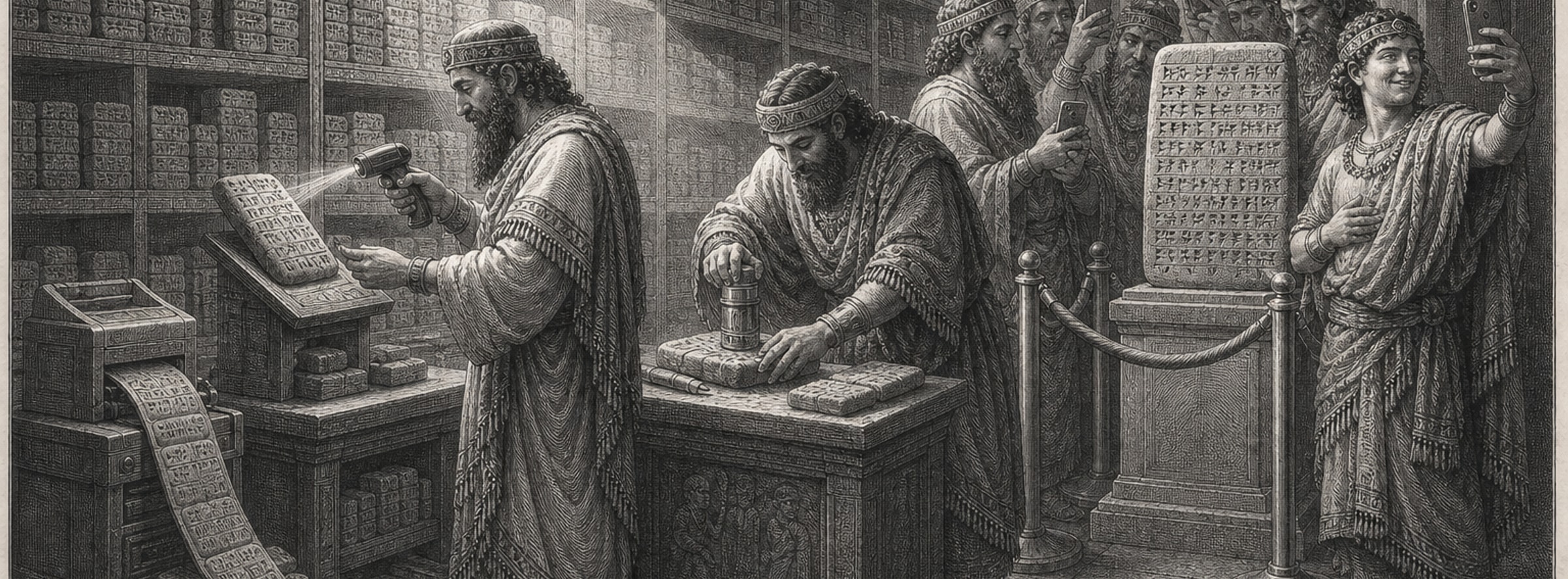
The oldest writing humans ever made is not poetry or scripture. It is a list of how many sheep somebody owned. We invented writing, more or less, to keep a better tally, and four thousand years later the list is still the most dependable format on the internet. Here is the problem: it now works for the other guy. We ran 100 B2B software queries through Perplexity’s Sonar API, ten times each, and logged every citation and every recommendation across all 1,000 answers. When a listicle got cited, the engine recommended a competitor ahead of the company that published it 25.7% of the time. Your content gets used. Your competitor gets the deal.
Getting cited is not getting recommended
A citation is not a vote. Across our runs, a cited listicle pointed the reader toward a competitor 190 times, and every one of those was a page recommending against the company that built it. Being quoted felt like a win. It was not.
The engines split apart two things SEO taught us to treat as one. Getting cited means the model pulled a fact off your page. Getting recommended means the model named you as the answer. On a listicle those come apart: the engine quotes the list you built, then hands the recommendation to whoever your own page ranked well. Getting recommended is the outcome that pays, and a citation that names someone else does not get you there.
The engine turns your list into a menu and reorders it
Your own list, read as a menu the engine reorders.
The reason a listicle backfires is mechanical. A structured list hands the engine a clean set of options, and the retrieval step reads that set as a menu and reorders it against signals you do not control: third-party review scores, where each brand gets mentioned elsewhere, how much category authority it carries. You built the menu. The engine picks off it.
That is why the backfire is baked into the format, not the topic. The moment your page lays out five brands in a tidy, extractable list, you have handed the model everything it needs to rank them by its own lights and none of the say over how. A page that argues for one product, or pits two head to head, never hands that menu over in the first place.
Salesforce loses its own queries and wins inside everyone else’s
Salesforce sits on both sides of the backfire. Our runs cited its own content 94 times and caught rival listicles recommending Salesforce 41 more, so it feeds the recommendation engine almost as often as it loses to it.
| Brand | Times cited | Times recommended |
|---|---|---|
| Salesforce | 94 | 41 |
| Monday.com | 70 | 38 |
| Zendesk | 60 | 14 |
| HubSpot | 44 | 17 |
| Gong | 41 | 1 |
Gong is the counter-example. It shows up as somebody else’s accidental recommendation exactly once, yet it holds #1 on its own evaluation and comparison queries in every single run. All of Gong’s content sits inside one category, revenue intelligence, so it hands the engine no open menu to reorder. Salesforce spreads across categories it does not always own, and it pays for the sprawl. Big enough to make every list. Big enough to lose half of them.
Half of every backfire hands a buyer straight to a rival
A citation you paid to produce, recommending the other guy.
A backfire inside your own category costs real money. Of the 190 we logged, 86 handed the recommendation to a direct competitor, while the other 104 were content plays where the author wrote outside its category to chase traffic. The direct half is the one that stings, because the buyer on the other end is usually already decided: 69% have switched to a vendor they did not plan on based on an AI chatbot’s guidance, and 51% now open their software research in a chatbot before a search engine (G2, 2026).
| Backfire type | Instances | Share |
|---|---|---|
| Direct competitor | 86 | 45% |
| Content play | 104 | 55% |
The content-play half is softer, and honestly mostly fine. When Monday.com publishes “best AI sales tools” to catch adjacent traffic and the engine cites it but points at Salesforce, Monday.com still banked the citation and was never trying to win that query. Which half you land in decides what to do. Inside your own category, a backfire is a real loss. Outside it, a citation still carries brand value even when the recommendation walks.
The format you publish decides the risk
Nothing else on the page moves the backfire number as far as the format does. Alternatives posts backfired 85% of the time in our data, discovery listicles 25.7%, head-to-head comparisons 2.9%, and single-product evaluations 0%.
A “[Competitor] alternatives” page is the worst thing you can build here, because it is a menu made entirely of your rivals and the engine picks from it on outside signals. A comparison pins two named brands against each other, and an evaluation talks about one product, so neither hands over a list to shuffle. Structure earns the citation, and a listicle spends its structure building a menu the engine hands to your competitor. The industry keeps buying the listicle anyway: 87% of content marketers are raising budgets and one in four now call LLMs their primary audience (Clutch and Conductor, 2026), and most of that money still goes to the one format with an 85% failure mode.
The backfire runs worst where a few brands own the reviews
Backfire is not spread evenly across the market. Customer success queries backfired 51.2% of the time in our data while security and dev tools backfired 0%, and the split tracks one thing: who owns the review sites in each vertical.
| Vertical | Backfire rate | Queries |
|---|---|---|
| Customer success | 51.2% | 8 |
| CRM and sales | 26.0% | 15 |
| Marketing | 15.0% | 12 |
| AI and ML | 14.0% | 15 |
| PM and collaboration | 10.0% | 10 |
| Finance | 10.0% | 8 |
| Data | 2.5% | 8 |
| Security | 0.0% | 8 |
| Dev tools | 0.0% | 8 |
Zendesk and Intercom own the review profiles in customer success, so any listicle there gets cited and then hands the recommendation to whichever brand carries the strongest third-party signal. The technical verticals go the other way. In security and dev tools, Perplexity leans on documentation and vendor pages instead of roundups, so there is no menu to reorder and nothing to backfire. In every vertical, the brands that own the review sites are the ones the engine ends up recommending.
But the top slot is winnable, and usually up for grabs
Here is the good news. The top slot barely moves once someone owns it: the same brand held #1 in at least 7 of 10 runs on 75 of 100 queries, and on 25 more, no brand held it at all. The field below churns. The top of it does not.
A query surfaces 8.2 different brands across ten runs, and only 3.1 show up every single time, with a run-to-run overlap of 0.72. This is not a Perplexity quirk. Don’t just take our word for it: Profound found 40% to 60% of the domains cited in AI answers change month over month (Profound, 2026), and Airops found only 30% of brands survive from one answer to the next (Airops and Kevin Indig, 2026). So the answer reshuffles constantly while the #1 recommendation holds, which makes it the one position worth fighting for. The 25 open queries are the easiest fights of all, because nobody is defending them yet.
| Metric | Value |
|---|---|
| Same #1 in 7+ of 10 runs | 75 of 100 queries |
| Unique brands across 10 runs | 8.2 |
| Brands in all 10 runs | 3.1 |
| Run-to-run overlap (Jaccard) | 0.72 |
Structure is how small brands out-cite the giants
Size is not what earns the citation. In our data, independent blogs and publications supplied 82.0% of Perplexity’s citations, against 5.9% from vendor sites and 5.8% from review platforms, and a single well-built page can out-rank a giant on nothing but how cleanly the engine can read it.
A structured vendor page on outbound sales tools got cited over and over in our runs on none of Forbes’s authority, purely because the engine could parse it cheaply and quote it right: categorized sections, feature comparisons, a source on every claim. That is the break from SEO, and the research backs it: adding statistics to a page lifted AI visibility 41% in Princeton’s experiments, the biggest single move they measured, while keyword stuffing cut it (Princeton KDD, 2024). We proved it on ourselves. Our own site was fifteen days old, with almost no backlinks and single-digit traffic, when it took #1 on “domain authority in AI citations” using this exact template.
| Query | #1 domain | Runs at #1 |
|---|---|---|
| 6sense vs Demandbase vs Bombora | 6sense | 10 / 10 |
| Gong vs Chorus vs Clari | Gong | 10 / 10 |
| Outreach vs Salesloft vs Apollo | Outreach | 10 / 10 |
| Highspot vs Seismic | Highspot | 10 / 10 |
| top product management tools 2026 | Asana | 9 / 10 |
Even this picture is partial, because the API only shows part of what gets cited. Reddit was cited zero times across all 1,000 answers, which would be shocking if you did not know the consumer Perplexity product cites it constantly. The Sonar API strips Reddit out, behind Reddit’s paid licensing wall, and that wall is not fixed. Reddit signed a $60 million-a-year deal with Google in February 2024, and by July 2026 the Wall Street Journal had it weighing whether to tighten or cut that access, which knocked the stock down 8% in a day. It also licenses to OpenAI while suing Perplexity and Anthropic for scraping without a deal. One forum, licensed to Google, in court against Perplexity, invisible through the API in between, and every party in that chain found a way to bill for it. Measure through one API and you see part of the picture, and only 11% of cited domains overlap between ChatGPT and Perplexity to begin with (Averi, 2026).
So write the format the query is actually asking for
Does this page give the engine a reason to recommend someone else?
So the move is simple: match the format to what the query wants, because that choice moved the backfire risk further than anything else we measured. A vendor-versus-vendor query wants a comparison, a single-product query wants an evaluation, and an alternatives query wants neither.
- Vendor versus vendor: write a comparison page. 2.9% backfire, because the head-to-head framing leaves no third brand to substitute.
- Single-product evaluation: write an evaluation page. 0% backfire, because one product gives the engine no menu to reorder.
- “[Competitor] alternatives”: do not write the alternatives listicle. 85% backfire, because you are building the exact menu your rival gets picked from.
- Broad category discovery: write a comparison or a how-to-choose page unless you are the clear leader, where a listicle is viable but still risky at 25.7%.
- An open query with no stable #1: build there first. Once earned, the top slot holds on 75 of 100 queries.
- An existing listicle: restructure it rather than republish. A comparison table dropped into the page cuts the backfire risk without a full rewrite.
| Format | Backfire risk | Control you keep | Recommendation |
|---|---|---|---|
| Comparison and evaluation | 0% to 2.9% | high | invest here, lowest risk |
| Discovery listicle | 25.7% | low | restructure into a comparison |
| Alternatives listicle | 85% | lowest | replace with an evaluation |
The brands winning in our data all made the same move. They stopped publishing tidy lists of their competitors and started writing content that puts their own product forward as the answer to one specific question, leaving the engine nothing to reorder. The black box is winnable, and it is just as winnable for a fifty-person startup as a Fortune 100, which is the part the backfire number keeps proving. The list still works. It just works for whoever built the better page.
Questions
Why does Perplexity cite a brand’s own content and still recommend a competitor?
Perplexity treats a cited page as raw material to extract from, and your editorial preference does not get a say. When a listicle hands it five brands in a clean format, the retrieval step pulls them out and reranks them on third-party signals, and the author loses control of the order the second there is a menu to pick from.
How many runs per query do I need before I trust a #1 position?
Ten runs is the floor for a signal, and 60 to 100 is the standard for a production program. With a run-to-run overlap of 0.72, roughly a quarter of the response changes each time, so a single check cannot tell you whether the top slot is stable or a fluke.
Why did Reddit appear zero times when Perplexity is known for citing it?
The Sonar API strips the Reddit citations that show up in the consumer product, because Reddit gates that data behind paid licensing. Any tool measuring through the API sees a Reddit-free landscape, and with Reddit renegotiating even its Google deal in 2026, that landscape is a moving target.
Why did customer success backfire at 51% when security backfired at 0%?
Backfire concentrates wherever a few brands own the review platforms, and Zendesk and Intercom own customer success on G2 and the aggregators. Technical verticals lean on documentation instead of roundups, so there is no menu for the engine to reorder in the first place.
Why are the 25 open queries a bigger prize than an entrenched giant’s?
An open query has no brand holding #1 at 70% consistency, which means the position is sitting there unclaimed. A company with well-structured comparison and evaluation content can lock in the top slot on an open query in weeks, and the top slot then holds in 75 of 100 cases.
Does a content-play backfire actually hurt if I still got cited?
It depends which side of your category line the content sits on. Writing outside your category for traffic still earns brand value from the citation, but writing a listicle inside your own category is training the engine to recommend a rival off your own page.
How does this compare to ChatGPT?
This study is Perplexity only, and only 11% of domains are cited by both engines (Averi, 2026), so the specific percentages will not carry over. The listicle-backfire pattern should, because it is a property of any structured menu the engine can reorder, and it does not depend on one engine’s index.
Is a listicle with 50 items safer than one with 10?
No, because the backfire comes from the menu itself, and length does not change that. A 50-brand list just gives the engine 50 candidates to rank on outside signals instead of 10, and the only real fix is moving off the listicle format for the queries that matter.
Methodology
Query selection: 100 B2B software queries spanning discovery (“best X tools”), comparison (“X vs Y”), evaluation (“is X worth it”), and alternatives (“X alternatives”), across 10 verticals: AI, CRM, customer success, data, dev tools, finance, HR, marketing, project management, and security. Vertical samples ranged from 8 to 15 queries.
Execution: Each query ran 10 times through Perplexity’s Sonar API at temperature 0.7 to account for non-deterministic responses. The dataset is 1,000 answers carrying 7,629 citations across 739 unique domains, with every citation, brand mention, position, and ownership match logged.
Backfire metric: A backfire is recorded when a brand’s own content is cited as a source but the response recommends competing brands ahead of the content owner, matched by cited URL to brand domain. Direct-competitor backfires (the owner competes in the category) are separated from content-play backfires (the owner writes in adjacent categories for traffic).
Limitations: This is a Perplexity measurement, and backfire rates may differ on ChatGPT, Claude, and Gemini. The Sonar API omits Reddit citations that appear in the consumer product, so the source mix reflects the API surface rather than what end users see. Vertical samples are uneven, and temperature 0.7 introduces controlled variance.
How Res builds the low-backfire formats at machine speed
The backfire is a format problem, and the two formats that fix it, comparison and evaluation, are the two Res is built to produce. Res generates a citation-ready comparison or evaluation page from a single topic in about 60 seconds of machine time, grounded in your brand voice and the page currently winning the citation, and it rewrites an existing listicle into a comparison in about 30 seconds, so a page that has been quietly feeding a competitor stops. The clock you actually watch is your own review; the agent’s runs in seconds.
The same loop finds these openings for you. Res watches the prompts your buyers actually run across ChatGPT, Perplexity, Claude, and Gemini, flags the queries where you get cited but not recommended, and writes the format that closes the gap. That is execution: content in, recommendations out, and no dashboard in the middle admiring the problem. Execution beats monitoring, and units beat impressions. You cannot out-machine the machine, and more pages will not save you. The models recommend from the permanent record, so the only real fix is to publish a better one. Proof over claims, so here is ours: one Res client published 76 articles in six weeks from a standing start, and 43% became the #1 answer in AI search while 28% took #1 on Google, above Microsoft, Gartner, IBM, Anthropic, and OpenAI on the questions that pay.
Res AI turns the listicle that recommends your competitor into the comparison that recommends you. The first 10 articles are on us, and published content can start showing up in AI answers within days.