Authority Is Not the Moat in AI Search
Non-giant domains hold stable #1 on 93 of 100 B2B AI citation queries. Domain authority predicts almost nothing about AI retrieval.
 machina sculpsit · homo probavit · MMXXVI
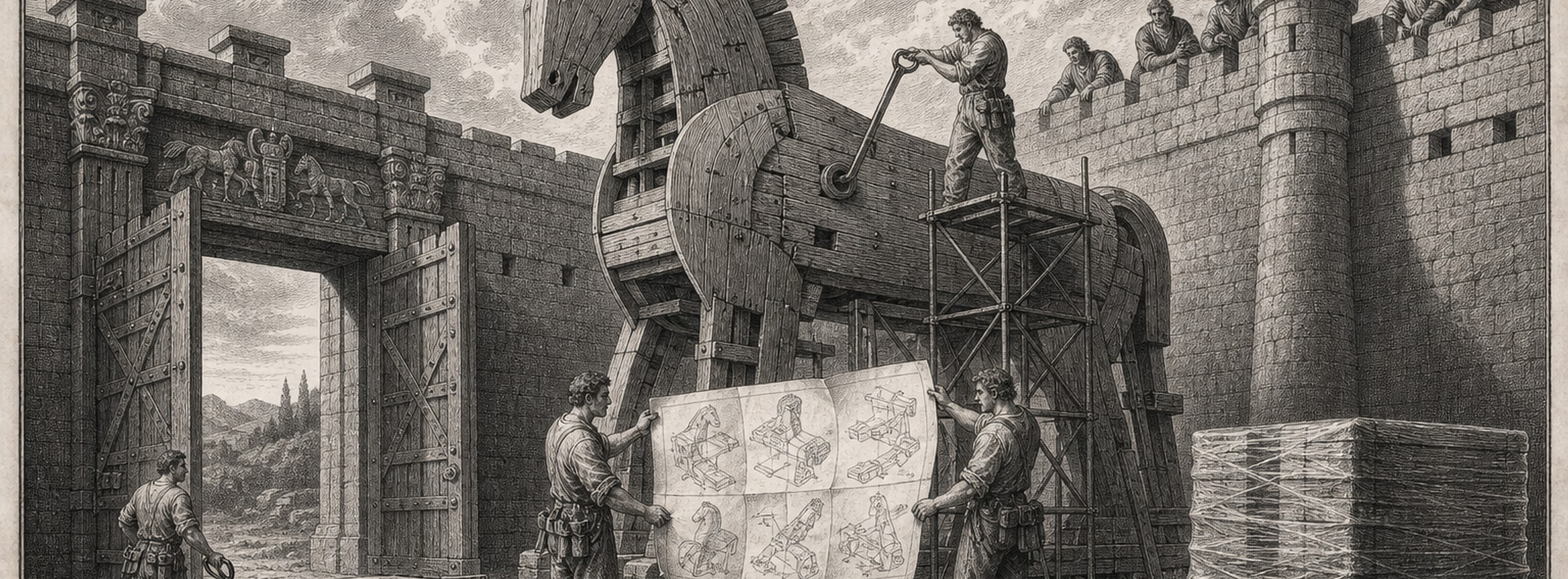
The buyer stopped searching and started asking. The next B2B purchase gets decided inside an AI answer instead of a page of ten blue links, and the name that answer returns is the one that gets bought. A moat is the oldest idea in strategy, and France built the grandest one ever poured: the Maginot Line, a decade of concrete sunk deep enough that no army could cross it. In the spring of 1940 the German army simply drove around it. In AI search the moat is supposed to be authority, the backlinks and domain age a Fortune 500 spends a decade accumulating. It is holding up about as well. Domains most buyers have never heard of hold the #1 AI citation on nearly every commercial query, and the giants are losing to them.
Non-giant domains win 93 of 100 B2B AI citation queries
Domain authority does not predict the citation.
Run 100 B2B buyer queries ten times each on Perplexity Sonar and the result barely varies by vertical: non-giant domains hold the stable #1 on every CRM query (15 of 15) and every marketing query (12 of 12), and on 14 of 15 AI-tools queries (Res, 1,000-query Perplexity study, 2026). A domain qualifies as stable #1 if it holds the top slot in at least 5 of 10 runs. Nothing on the list is a longtail scrap. These are “best CRM for enterprise,” “best AI chatbot platforms for B2B,” “top content marketing platforms.” The brands with the deepest backlink profiles and the oldest domains are losing citation after citation, and the losses are spread across every vertical in the study.
AI search runs no auction and offers no budget to outspend, so a fifty-person startup and a Fortune 100 get the same hearing, and the more complete answer wins. An answer engine returns a short list of names, often one, and in this study nearly every one of those names belonged to a domain nobody benchmarked against. Giants hold #1 on exactly 4 of the 100 queries. The identity of those four winners turns out to be the most important detail in the study, and it makes the picture even worse for incumbents.
ZoomInfo loses its own pricing query to scrupp.com
scrupp.com holds #1 on “ZoomInfo vs Apollo vs Lusha pricing” in all 10 of 10 runs (Res, 1,000-query Perplexity study, 2026). Not ZoomInfo. Not Apollo. scrupp.com is a lead-scraping Chrome extension most B2B marketers have never seen, and it owns the exact query ZoomInfo’s own buyers type when they are comparing prices against a direct competitor. The same thing happens in every category the study touched.
| Buyer query | #1 domain | Runs at #1 |
|---|---|---|
| ZoomInfo vs Apollo vs Lusha pricing | scrupp.com | 10 / 10 |
| 6sense vs Demandbase vs Bombora | salesmotion.io | 10 / 10 |
| Gong vs Chorus vs Clari | aimadefor.com | 10 / 10 |
| Okta vs Microsoft Entra vs Ping Identity | frontegg.com | 10 / 10 |
| Vercel vs Netlify vs Cloudflare Pages | ai-infra-link.com | 10 / 10 |
| HubSpot vs Marketo vs Pardot | marcloudconsulting.com | 10 / 10 |
The Vercel row is the tell. Vercel and Cloudflare each land in roughly 40 of the citation slots across ten runs on “Vercel vs Netlify vs Cloudflare Pages,” so both are in the pool at similar rates. Neither holds #1. ai-infra-link.com holds it on every run. Two well-funded platforms, one that coined the category and one that runs a global CDN, tie each other in citation volume and both lose the top slot to a third-party comparison page. scrupp.com and ai-infra-link.com have the same thing going for them: each one built the page that actually answers the question. Entire agencies sell authority building as a line item. A Chrome extension didn’t buy any.
The only four queries giants win all go to G2 or Capterra
Giants hold stable #1 on exactly 4 queries, and every one goes to a review aggregator rather than a brand domain (Res, 1,000-query Perplexity study, 2026). The four: “Rippling reviews 2026” (G2), “CrowdStrike reviews 2026” (Capterra), “dbt reviews 2026” (G2), and “best ETL tools for modern data stack” (G2). No major brand’s own domain holds #1 on a single query in the study. When an incumbent appears to win, an aggregator is winning on its behalf.
That is not a template a brand can copy. ZoomInfo cannot become G2. Salesforce cannot become Capterra. A review site wins review queries because a buyer trusts it precisely where a vendor is grading its own homework, and G2 and Capterra also carry thousands of structured review rows per category, exactly the kind of material an engine lifts. A brand page cannot take that seat no matter how old its domain gets. Every other query type, comparison and discovery and evaluation and pain-point, is won by a domain nobody benchmarked against. The four exceptions make the 93 look stronger, and they fence off the one query type where copying the winner is impossible.
Structure predicts the citation, authority predicts almost nothing
Structure earns the citation, not authority.
Six structural features appear in 80% to 94% of the top 50 cited pages in the corpus and in 0% of the bottom 50 (Res, 852-article B2B citation structure study, 2026). A page either carries these elements or it sits at the bottom of the citation pile; there is almost nothing in between.
| Feature | Top 50 | Bottom 50 |
|---|---|---|
| Bold-label product blocks | 94% | 0% |
| Comparison tables | 88% | 0% |
| How-to-choose steps | 86% | 0% |
| Pricing grids | 62% | 0% |
| Product reviews | 58% | 0% |
| Definitions | 42% | 0% |
Score the most-cited domains against that spec and the ranking comes out upside down from what a marketer would expect. The highest structural scores belong to small vendor blogs, while the aggregators that win review queries sit near the bottom: a review site wins on buyer trust and does not need tables to stay there.
userlytics.com, a usability-testing vendor whose site most CMOs have never opened, out-structures forbes.com and every review aggregator in the set. stitchflow.com averages 20.3 structural elements per cited article; most enterprise content teams ship pages that score below three (Res, 1,000-query study, 2026). The gap comes down to how many comparison tables, product reviews, how-to-choose frameworks, and FAQ sections are on the page. Word count is a proxy for the same thing: pages in the top word-count quartile carry 4.5 times the structural elements of the bottom quartile (Res, 852-article study, 2026). A 5,000-word essay with no tables and no FAQ still scores near zero. The floor is 3,500 words of structure, not 3,500 words of prose.
The winners built the spec before anyone called it GEO
The brands winning AI citation did not run a GEO program. They wrote for a technical buyer who asks precise questions, and that habit happened to produce exactly the tables, FAQs, and how-to-choose sections AI engines extract. ChatGPT now refers about 10% of new Vercel signups, up from under 1% in October 2024 (Vercel, June 2025): a 10x channel in six months, off documentation and comparison content that already hit the spec.
Tally, a bootstrapped form builder, made ChatGPT its #1 acquisition channel at 8,000 new users a week, on comparison pages against Typeform it had published for years (Justin Hammond, July 8, 2025). Typeform has the bigger budget, the deeper backlinks, and the brand; it is losing its own product-comparison queries to a competitor with none of that. In HR, Rippling scored 89 to ADP’s 84 in Trakkr’s April AI consensus, though the gap has narrowed from 26 points in January as ADP finally ships the spec (Trakkr AI Consensus Report, April 2026). ADP has run payroll since Truman was in the White House, and all that history left it five points behind a company younger than the iPhone. The window stays open only until the incumbent notices, and ADP’s 90-day catch-up is what noticing looks like.
We ran the smallest test we could on ourselves. We launched Res on a domain fifteen days old with almost no backlinks and shipped two structurally complete articles, the one you are reading and a companion piece, Every Brand That Won AI Search Tested Their Way There. By day fifteen, Perplexity cited this article at #1 for the query “domain authority in AI citations,” ahead of PRLog, DigitalStrategyForce, DigitalApplied, and Chudi, while Google Search Console logged 408 impressions and zero clicks (Res, day-15 launch citation proof, 2026).
The minimum viable build is three sections
Widen out from the top 50 pages to all 672 cited articles in the corpus and only three sections still appear in more than half: a comparison table (80%), a FAQ (84%), and a how-to-choose framework (54%) (Res, 852-article study, 2026). A page that carries all three is structurally competitive with the top quartile. For a team rebuilding one existing article, the build is those three, in order.
- Comparison table in the front half. Columns are evaluation criteria, rows are products; three to five of each is enough. AI engines lift a table as a discrete, citable unit where prose comparisons are invisible, and 68% of top-cited pages place the table in the first or second quartile of the article (Res, 852-article study, 2026).
- FAQ near the end. Engines pull question-answer pairs almost verbatim, so a five-question FAQ turns one article into five independently citable units. Write each answer as one or two self-contained sentences that hold up with the surrounding context stripped away, because that is exactly how an engine uses them.
- How-to-choose framework in the middle. Three to six rules that map a buyer’s situation to a specific pick. This is the section most incumbent content omits, because it requires taking a position on competitors rather than describing features.
A page with all three and 3,500-plus words sits in the structural top quartile. The incumbents, on the queries they are losing, do not.
How to choose which pages to rebuild first
Not every underperforming page is worth the rebuild; the question is which one wins the most citations for the least effort. The paths sort cleanly, and only one of them is open to a brand.
| Approach | Cost | Engine rewards | Who runs it |
|---|---|---|---|
| The structural spec | 4 to 8 hours per page | comparison, evaluation, pricing, and discovery queries | any domain, including 15-day-old ones |
| Domain authority | a decade of backlinks | almost nothing in AI answers | no brand, on authority alone |
| Review aggregation | being G2 or Capterra | review-type queries only | aggregators, not brands |
Inside the spec path, prioritize by the first rule that fires. If a query already has a stable non-giant #1, rebuild it first: that win is proof the query is takeable without authority. If your page on the query carries fewer than three of the six features, rebuild rather than polish; adding a missing table wins more citations than improving the prose. If the page is under 1,400 words, rebuild rather than extend, since the full spec will not fit in that word count. If a query is a review-type query G2 or Capterra holds, skip it; that slot is won on buyer trust a brand page cannot fake. You come out with a ranked rebuild list instead of a single guess. At four to eight hours a page, a mid-size catalog reworks in weeks, not the decade a backlink program would need to move the same queries.
Questions
Does any of traditional SEO authority carry over to AI citation?
Some of it, weakly. Brand-mention density across the web and recency of updates carry over; backlink profile and domain age barely matter when an engine picks its answers, which is why non-giant domains hold the stable #1 on 93 of 100 B2B queries (Res, 1,000-query study, 2026).
How long must a new domain exist before an engine will cite it?
There is no minimum age; a domain registered last month can be cited next month once its pages are indexed. The only real wait is indexing, which typically takes two to six weeks for a page with a handful of inbound links.
When does a structurally complete page stop being enough?
Once two or more competitors publish complete pages on the same query, structure stops being the differentiator and the engine falls back on brand-mention density and freshness. The window where a complete page wins alone is the window before incumbents notice and copy the same structure.
What happens when an incumbent finally ships the spec?
They usually retake the citation within two to six weeks, because they also carry the brand-mention density a small domain lacks. The retake is fast because the only thing the incumbent ever lacked was the page itself; the mentions and the trust were sitting there waiting for it.
Does publishing more structured articles compound?
Partially. Each article earns citations on its own prompt family, so the direct effect is additive, ten articles on ten families, not a hundred; the indirect compounding comes from brand mentions, where Semrush’s own restructured content nearly tripled its AI share of voice from 13% to 32% in a month (Semrush, October 2025).
Do review sites like G2 make brand pages pointless on comparison queries?
No. G2 and Capterra win only the review-type queries; every comparison, evaluation, and pricing query in the study went to a brand or third-party page (Res, 1,000-query study, 2026). Aggregators own the seat labeled reviews, and nothing else.
How do you get leadership to fund this while the brand metrics still look fine?
Skip the pitch and run the substitution: take three of your most valuable queries, ask ChatGPT and Perplexity who is cited, and name the competitor. For most leadership, watching a scrupp.com equivalent win their own pricing query is more persuasive than any visibility chart.
How Res builds the spec across the queries you are losing
The incumbents losing these queries are not short on resources. They are running a content workflow built for Google, four to six articles a month of prose, and that workflow does not produce the tables and FAQs engines extract. Flooding the same catalog with more AI-generated pages loses too; the models were built to see through volume, and they keep rewarding the one input they cannot manufacture, a person who knows what is true and says it plainly. And if your program today is mostly watching a visibility dashboard, that is its own problem.
Res closes the gap on your own catalog: it polls citation status across ChatGPT and Perplexity, finds the buyer queries where a domain nobody benchmarked against holds #1, reads what that page built, and publishes a structurally complete comparison, evaluation, or pricing article straight to your CMS. A page restructures in about 30 seconds of machine time; a human signs every page before it ships, so the clock you watch is your own review.
Skip the three-year authority program. Build what the incumbents refused to build, on the queries where they are already losing.
Speed is the part nobody believes until they watch it. One Res client published 76 articles in six weeks from a standing start; measured in both engines, 43% became the #1 answer in AI search and 28% took the #1 result on Google, above Microsoft, Gartner, IBM, Anthropic, and OpenAI on the questions that pay.
Res is the fifteen-day playbook run as a service, on the buyer queries where incumbents are losing to sites nobody has heard of. Engagements are custom, and the first ten articles are free.