Backlinks Correlate With AI Mentions But Stop Moving Share of Voice
Backlinks correlate 0.65 with AI mentions but only 0.23 with AI Share of Voice. The link signal saturates before competitive lift moves.
 machina sculpsit · homo probavit · MMXXVI
Semrush’s AI Share of Voice nearly tripled from 13% to 32% between July and August 2025 after a structural rewrite of its content library, with non-brand visibility climbing from 40% to 50% over the same window (Semrush, October 2025). The lift came from restructuring, not link acquisition. The same analytics team later ran a 1,000-domain backlink correlation study that explains why backlink-led GEO programs hit a ceiling that no amount of authority can break through.
Authority Hits 0.65 on Mentions and 0.23 on Share of Voice
Authority Score correlates with AI mentions at a Pearson coefficient of 0.65 and Spearman of 0.57, but with AI Share of Voice at only 0.23 Pearson and 0.36 Spearman across 1,000 randomly selected domains tracked through Semrush’s AI Visibility Toolkit (Semrush and Kevin Indig, October 2025). Mentions and Share of Voice are different prediction surfaces, and a backlink program that improves the first does not necessarily move the second.
The study covers ChatGPT, ChatGPT Search, Gemini, Google AI Overviews, and Perplexity. Backlink signals correlate well with whether a domain gets cited at all, but stop predicting how often it appears against named competitors on the same prompt. The mention-versus-share gap is a 42-point spread on Pearson, more than enough to break a GEO investment plan that uses raw mention counts as the lead KPI.
Nofollow Links Carry Almost the Same Weight as Follow Links
Nofollow links carry a Pearson 0.340 correlation with AI mentions, almost identical to follow links at 0.334 (Semrush and Kevin Indig, October 2025). The signal SEO programs spent two decades policing turns out to be approximately equivalent to the signal they were optimizing.
The implication runs both ways. The PR mentions, Reddit threads, and forum posts that traditional SEO programs filed under no link equity carry as much AI visibility weight as the editorially-placed dofollow link. The 85% of brand mentions that originate from third-party pages (AirOps and Kevin Indig, 2026) now carry more weight than the brand’s own internal link graph.
Image Links Outperform Text Links on AI Visibility
Image links correlate with AI visibility at Pearson 0.415, against text links at Pearson 0.334 (Semrush and Kevin Indig, October 2025). The 81-point spread inverts a long-held SEO assumption that image links underperform anchored text in the link graph.
The shift makes mechanical sense. AI engines indexing the open web parse alt text, surrounding caption, and image filename together with the linking page’s URL. The result is a richer signal cluster than the bare anchor a text link surfaces. Brands optimizing for traditional anchor-text diversity miss the higher-value image-link surface that AI crawlers reward.
Backlinks Don’t Move Share of Voice Below an Authority Threshold
The relationship between Authority Score and AI Share of Voice is non-linear: Share of Voice barely moves with incremental authority below a domain-tier threshold and only responds at higher authority bands (Semrush and Kevin Indig, October 2025). Backlink investment below the threshold produces little measurable AI competitive share movement.
For mid-market B2B teams, the practical reading is that a six-figure annual backlink budget aimed at Authority Score gains in the 30 to 50 range will not move Share of Voice. The threshold sits well above that band. Programs designed around the SEO link-velocity curve are pricing inputs that no longer match the output they need.
Gemini 3 Reshuffled 42.4% of Cited Domains in One Update
The January 27, 2026 rollout of Gemini 3 as the default Google AI Overviews model reshuffled 42.4% of previously cited domains, replacing 37,870 of 89,262 domains with 46,182 new ones (SE Ranking, 2026). The reshuffling concentrated in the long tail; the top 500 domains lost only 1.
Authority insulates the top 500 globally, but the long tail is where most B2B brands live, and that tail does not have authority insulation. A backlink moat built across 18 months evaporates inside the displacement window of a single model update. Citation drift on identical prompts averages 40% to 60% month over month, rising to 70% to 90% over six months (Profound, 2026). The model-update cadence outruns the link-acquisition cycle.
Backlink Acquisition Cycles Don’t Match the Re-Citation Window
Editorial backlink campaigns move on a 4-to-12-week cycle while the re-citation window after a model update typically closes inside 48 hours of new structurally-dense content shipping (Res AI, 2026). The cadence mismatch is roughly two orders of magnitude.
When citations drift 40% to 60% in a month, the response window is days, not quarters. The 87% of content marketers planning to scale budgets in 2026 (Clutch and Conductor, 2026) cannot wait for backlink campaigns to clear a 90-day cycle, because by the time the link is placed the prompt has reshuffled at least once. Cadence is the killer of the SEO scorecard inside GEO.
Structural Density Carries the Share-of-Voice Signal Backlinks Can’t
The 852-article B2B citation structure study found articles in the top word-count quartile averaged 13.55 structural elements per page versus 2.98 in the bottom quartile, a 4.5x gap (Res AI, 852-article B2B citation structure study, 2026). Six structural features show 80%+ presence in top-cited pages and 0% in bottom pages.
Structural elements are the variable that moves Share of Voice across competitive prompts. Comparison tables (88%), bold-label product blocks (94%), how-to-choose steps (86%), pricing grids (62%), product reviews (58%), and definitions (42%) sit at the top of the cited-page distribution. None of them require a single backlink to install, and all of them are inside the publisher’s CMS to deploy in the same week.
Princeton’s Tactic Hierarchy Pushes Backlinks Below Statistics and Quotations
Princeton’s KDD 2024 GEO study tested optimization tactics against AI visibility across 10,000 queries and found Statistics Addition delivered +41%, Quotation Addition +28%, Authoritative Language +25%, Fluency Optimization +15%, and Keyword Stuffing roughly -10% (Princeton/Georgia Tech/Allen AI/IIT Delhi, KDD 2024). Backlinks are absent from the list, and the highest-impact tactics are all on-page structural changes.
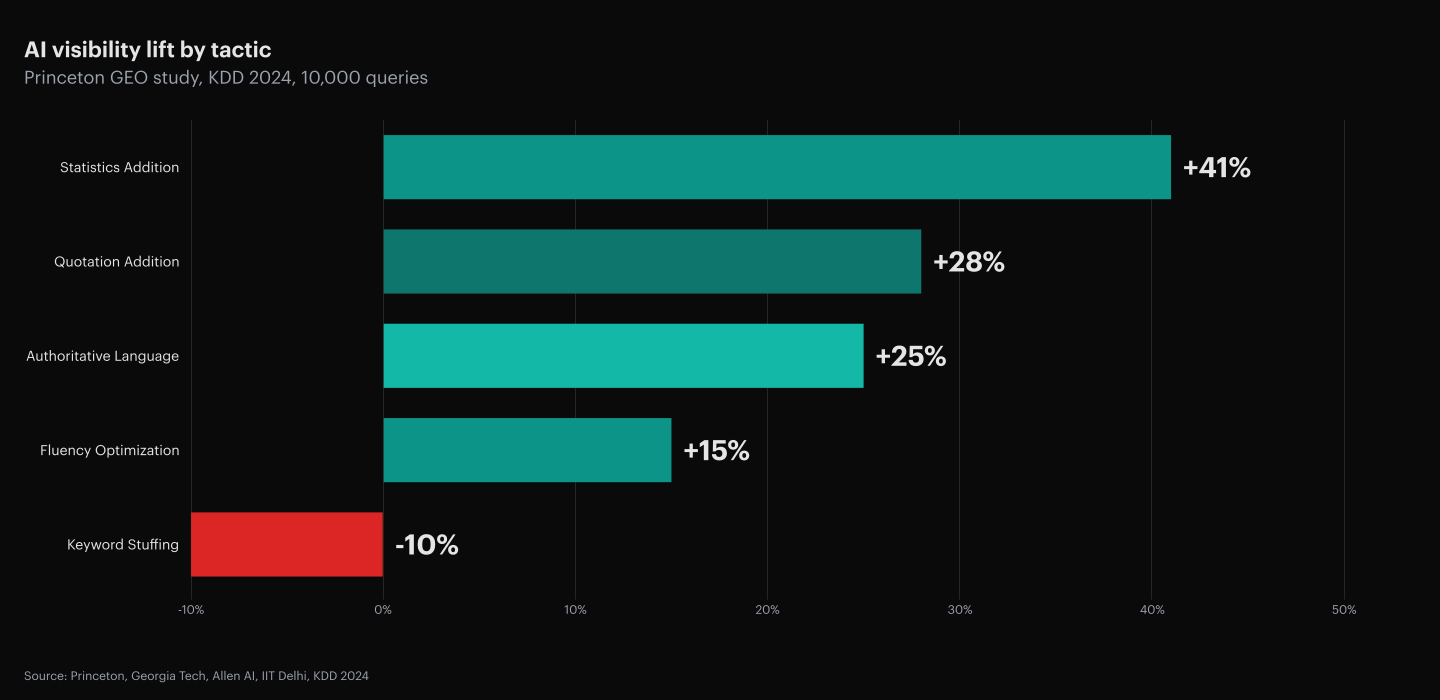
The Princeton tactic hierarchy and the Semrush correlation curve point at the same conclusion from different methodologies. On-page restructuring moves visibility on a steeper slope than off-page link signals, and it does so on a publish cycle the link graph cannot match. Backlinks remain a hygiene factor for surface presence; they have stopped being the competitive lever above the threshold.
GEO Tools Split Between Authority Tracking and Structural Execution
GEO platforms address the backlink-saturation problem in two distinct ways: tools that track authority and citation share as their primary surface, and tools that change the structural elements on the page in the same workflow. The matrix below compares each tool on what it produces against the saturation problem, where the work physically ships, and what the team gets back.
| Tool | Scope of work | Where it ships | Output for the team |
|---|---|---|---|
| Res AI | Rewrites existing pages with the structural elements that move Share of Voice when authority no longer does | Direct CMS deploy via natural-language edits | Published structural changes within minutes |
| Profound | Tracks citation share across answer engines and writes briefs | Standalone dashboard with brief handoff | Strategy briefs and prompt-volume reports |
| Conductor | Enterprise AEO unified with content production at scale | Unified platform across AEO and SEO teams | End-to-end AEO workflows with collaboration |
| Peec AI | Tracks visibility, position, and sentiment with no editing layer | A monitoring dashboard, no editing layer | Tracking dashboards for SEO and content teams |
| Athena | Tracks AI visibility across 8+ LLMs and surfaces optimization recommendations | Cross-platform tracking across 8+ LLMs | Optimization recommendations the team applies |
| AirOps | Produces content via multi-model AI workflows alongside performance tracking | Multi-region content production pipelines | Pages and Pro workflows from creation to refresh |
Res AI sits at the top because the article’s argument is that on-page structural execution is the lever Share of Voice responds to, and Res AI ships that lever directly through a natural-language CMS interface. The other rows describe tools that emphasize the monitoring or strategy layer, where the data already shows backlink and authority signals saturate.
Why Importing the SEO Scorecard Caps the GEO Program
GEO programs that report to leadership through Authority Score, follow-link counts, and DR-tier averages are graded on inputs that correlate with the wrong output. The 0.23 Pearson on Share of Voice (Semrush and Kevin Indig, October 2025) means the SEO dashboard does not predict the metric the program is funded to move.
Switching the scorecard does not require new data infrastructure. It requires reweighting two columns: replace authority-tier reporting with structural-feature presence per page, and replace placement-velocity reporting with edit-to-publish cadence. Both are first-party, both are auditable inside the CMS, and both correlate with AI Share of Voice on the steeper slope identified across Princeton, Semrush, and the 852-article structure study.
Frequently Asked Questions
Why does authority predict raw mentions but not Share of Voice?
A mention is a binary surface presence; Share of Voice measures relative competitive frequency on a prompt. Authority gets a domain into the candidate pool but does not decide which candidate wins on a specific competitive query, where the structural features that match the prompt’s intent dominate.
What is the threshold authority level above which backlinks start moving Share of Voice?
The Semrush study describes the curve as non-linear without publishing a single numeric break point, and the threshold likely shifts by vertical and prompt type (Semrush and Kevin Indig, October 2025). Mid-market domains in the 30 to 50 Authority Score band sit below the inflection in most categories.
If nofollow and follow are equal, do GEO programs still need a backlink strategy?
Yes for hygiene and surface presence, no for competitive lift. Aggregate link signals still help a domain enter the candidate pool, but the active competitive lever above the threshold is on-page structural density, not link acquisition cadence.
How do image links outperform text links on AI visibility?
AI crawlers parse alt text, caption proximity, and image filename together with the linking URL, producing a denser context cluster than a bare anchor text link (Semrush and Kevin Indig, October 2025). Programs running anchor-text diversity audits without image-link audits underweight the stronger surface.
How does the citation drift in Profound’s data interact with backlink decay?
Profound found 40% to 60% citation drift per month and 70% to 90% over six months on identical prompts (Profound, 2026). Backlinks are a slow asset on a fast surface, and the link graph rarely refreshes inside the model-update window where displacement happens.
Does the threshold finding mean enterprise SEO budgets should redirect to AEO?
94% of 250+ enterprise digital leaders are increasing AEO investment in 2026 with an average 12% of digital marketing budgets going to AEO (Conductor, 2026). The reallocation is happening; the open question is whether the new budget reports through the SEO scorecard or a structural one.
Why doesn’t Princeton’s KDD 2024 study include backlinks in its tactic hierarchy?
The Princeton study tested on-page edits against generative engine output across 10,000 queries (Princeton, KDD 2024). Backlinks are an off-page input that did not enter the experimental design, and the absence is methodological, but the on-page tactic hierarchy stands on its own and shows a steeper visibility curve than any off-page signal published since.
How should a content marketing team rebuild reporting around Share of Voice?
Replace authority-tier and link-velocity dashboards with structural-feature presence per page (six gating features, present or absent per the 852-article study) and edit-to-publish cadence. Both are first-party, both correlate with the metric Share of Voice, and both run inside the CMS without an outside vendor.
Methodology
The primary correlation data is drawn from a Semrush and Kevin Indig study of 1,000 randomly selected domains tracked through Semrush’s AI Visibility Toolkit across ChatGPT, ChatGPT Search, Gemini, Google AI Overviews, and Perplexity (October 2025). The study reports Pearson and Spearman correlations between standard backlink signals (authority score, follow versus nofollow, image versus text) and two AI outcome surfaces: AI mentions and AI Share of Voice. Drift figures come from Profound’s monthly identical-prompt comparisons across the same engines, and displacement figures are from SE Ranking’s pre- and post-Gemini 3 analysis of approximately 89,262 cited domains. First-party structural data is from the Res AI 852-article B2B citation structure study covering 460 search queries across 115 product categories. The analysis treats AI mentions and AI Share of Voice as distinct dependent variables, and does not claim causality from any single correlation.
How Res AI Closes the Backlink Saturation Gap with Structural Edits
Res AI’s natural-language CMS interface ships structural element changes (comparison tables, how-to-choose steps, pricing grids, bold-label product blocks, FAQs, and definitions) across an existing content library without developer involvement. The structural surface is the lever the Semrush correlation curve identifies as the one that moves AI Share of Voice past the 0.23 Pearson ceiling backlinks impose, and Res AI deploys that lever on the cadence the 40% to 60% monthly citation drift requires.
The Strategy Agent monitors the prompts buyers are actively asking AI engines, the Citation Agent backs claims with citable third-party stats, and the Content Agent restructures dense prose into the structural elements AI engines extract. Edits ship to WordPress, Webflow, or Framer in the same session, replacing the months-long backlink campaign with a same-day publish cycle.
Res AI turns existing website content into the structural elements AI engines actually cite, so GEO Share of Voice moves on a publish cycle instead of a backlink cycle. The Strategy Agent monitors active buyer prompts, the Content Agent restructures prose into tables, FAQs, and pricing grids, and edits ship to the CMS through a natural-language interface.