Most Analytics Setups Hide Your AI Search Invisibility
Default analytics setups do not segment AI referrers, hiding a channel that converts 534% above the site-wide average in B2B portfolios.
 machina sculpsit · homo probavit · MMXXVI
Enterprise marketing leaders are pouring money into a channel most of them cannot measure inside their existing dashboard. 94% of enterprise digital leaders plan to increase AEO and GEO investment in 2026 (Conductor, 2026), yet default analytics setups do not segment AI referrers as a distinct channel. That gap means most content teams are making GEO decisions from a dashboard view that quietly treats their single most valuable traffic source as noise.
AI Referral Traffic Converts 534% Above the Site Average
AI referral traffic from ChatGPT, Gemini, Claude, and Perplexity influences conversion events at a rate 534% higher than the site-wide average across a portfolio of B2B companies (Eyeful Media, 2026). That spread is an order-of-magnitude gap between AI visitors and every other segment, sitting inside an analytics tool that does not identify the channel separately by default.
The same study tracked AI referral traffic growth of 190% year over year across the last 90 days of measurement. The channel is small in absolute volume but economically denser than any other acquisition path most B2B companies operate. A content team that cannot isolate this segment is averaging their highest-converting visitors into the baseline and losing the signal.
AI Visits to US Retail Grew 393% in Q1 2026
Adobe Digital Index measurement of generative-AI-sourced traffic to US retail sites found AI-driven visits rose 393% year over year in Q1 2026, with March 2026 alone up 269% YoY (Adobe Analytics, 2026). AI referral conversion rate flipped from 38% below non-AI channels in March 2025 to 42% above non-AI in March 2026, an 80-point swing in twelve months.
The volume and the value moved together, but most analytics deployments held the same default channel mapping through the entire swing. The retail teams that read their dashboards in March 2025 saw AI referrals as underperforming noise, priced accordingly, and kept optimizing for Google. Twelve months later, the same dashboard view shows a 42% premium that the default report still does not surface as a separate channel.
96% of B2B Companies Are Invisible in Early-Stage AI Discovery
Inaugural benchmarking of 70 B2B companies across discovery, evaluation, and purchase-stage generative AI queries found 96% are invisible in early-stage AI-driven buyer discovery (2X AI Innovation Lab, 2026). Only 4.3% maintain a healthy discovery funnel where their brand appears in early-stage buyer questions.
The report describes the rest as operating an inverted funnel where the brand surfaces only in late-stage queries where the buyer already knows the name. That is the worst of both worlds. The AI channel delivers the highest-converting visitor on the site, but the brand only catches the visitors who were already coming anyway. An analytics setup that does not segment the channel cannot distinguish between the 4.3% outcome and the 95.7% outcome because both show up in the same undifferentiated referral bucket.
Search Referrals to US Publishers Dropped 38% in Twelve Months
Global Google search traffic to publishers dropped by a third in the year to November 2025, with US publishers down 38% and European publishers down 17% (Reuters Institute and Chartbeat, 2026). Referrals from Google Discover fell 21% year over year, and respondents forecast search-engine traffic to publishers will decline 43% on average over the next three years.
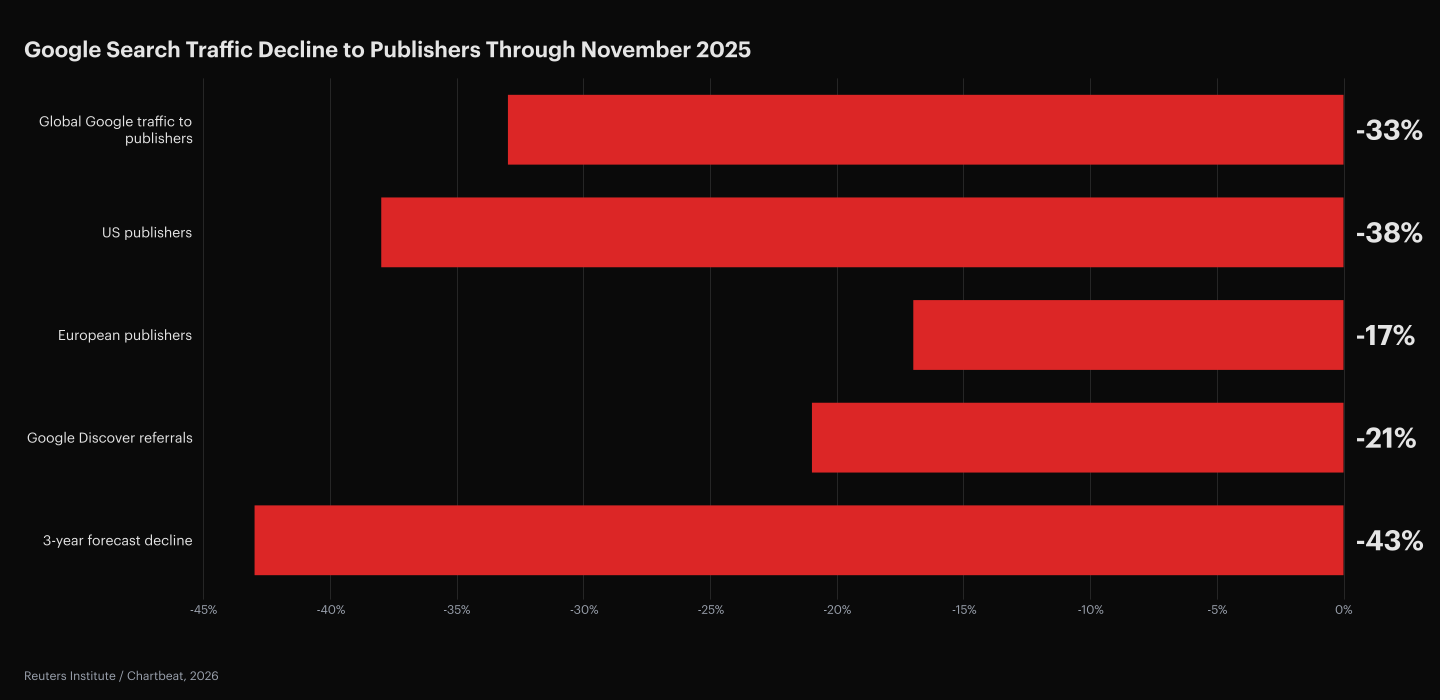
The signal that most analytics dashboards do render clearly is the decline side of the shift. Organic search is shrinking visibly, month over month, on every standard report. The growth side of the shift, the AI referral channel replacing that traffic, is not rendered at all in the default view. A content team looking at a default GA4 dashboard sees one side of the substitution and makes cut decisions based on half the picture.
The substitution is observable on a 15-day-old domain. Tryres.ai logged 408 Google impressions and 0 clicks at average position 9.9 in its first 15 days, while Perplexity cited the site at #1 on “domain authority in AI citations” and quoted its 93-of-100 methodology verbatim with full attribution (Res AI, day-15 launch citation proof, 2026). A Google Search Console dashboard tells the team the launch failed; a segmented AI referral view tells the team it landed on a different surface entirely.
AI Search Visitors Carry 4.4 Times the Conversion Value of Organic
In a study of more than 500 high-value digital marketing and SEO topics, the average AI search visitor is 4.4x as valuable as the average organic search visit measured by conversion rate (Semrush, 2025). The same study projected AI search visitors will surpass traditional search by early 2028, sooner if Google defaults to AI Mode.
| Channel | Relative Conversion Value | Source |
|---|---|---|
| AI search referrals (B2B portfolio, 534% above baseline) | 6.3x | Eyeful Media, 2026 |
| AI search (Semrush high-value topics vs organic) | 4.4x | Semrush, 2025 |
| AI visitors (Averi AI, 14.2% vs 2.8% Google) | 5.1x | Averi AI, 2024 |
| AI-referral conversion vs non-AI (retail, Q1 2026) | 1.42x | Adobe Analytics, 2026 |
The exact multiplier depends on industry and measurement window, but four independent studies in under two years all land inside the same direction and order of magnitude. The risk of leaving AI channels unsegmented is not a measurement rounding error. It is a structural undercount of the single highest-value channel on the site.
Default Analytics Require Manual Filters to Surface AI Referrals
Averi AI's measurement of the 14.2% AI search visitor conversion rate versus 2.8% for Google required filtering GA4 engagement rate specifically for chatgpt.com, perplexity.ai, and gemini.google.com (Averi AI, 2024). The finding is not visible in a default channel report. It requires a custom filter every analyst has to build manually.
Eyeful Media reported the same setup constraint when measuring 190% AI referral growth across their B2B portfolio (Eyeful Media, 2026). The number was only legible after custom segmentation. In a standard GA4 default channel grouping, referrals from AI chatbots land in generic Referral or Unassigned categories and are never surfaced as a distinct channel in Acquisition or Conversions reports. Teams running quarterly reviews against the default view miss the channel entirely.
Single-Prompt Citation Checks Match Less Than 1% of the Time
Prompting ChatGPT and Google's AI 100 times each to recommend brands or products, there is less than a 1-in-100 chance of receiving an identical brand list in any two responses (SparkToro, 2024). Claude was slightly more consistent but still under 1%.
Many content teams compensate for analytics blindness by running a handful of prompt checks and declaring the brand cited or not cited. That substitution does not work. A single citation check cannot measure GEO performance because the distribution is too wide for a single-run conclusion. The result is two measurement gaps compounding: a dashboard that does not segment AI referrals, and a prompt check that samples a citation process with less than 1% run-to-run agreement. Teams that rely on either signal alone miss the movement happening in the channel, and teams that rely on both miss it twice. Analytics segmentation has to carry most of the measurement weight because the prompt surface itself is too noisy to anchor a business decision.
The Measurement Gap Delays Response to a Shrinking Discovery Window
42.4% of previously cited AI Overview domains were displaced in a single Gemini 3 model update on January 27, 2026 (SE Ranking, 2026). The top 500 domains remained stable, but the long tail reshuffled in one release, replacing 37,870 cited domains with 46,182 new ones.
The displacement window matters because it is shorter than most content teams' measurement and response cycle. A team running quarterly reviews against a default dashboard does not see AI referrals move, does not identify the displaced pages, and brief an agency to write replacements weeks after the re-citation window has closed. Analytics invisibility extends the response cycle past the point where the intervention matters.
Segmenting AI Referrers Requires UTM Tagging or Custom Channel Groups
Three configuration steps close most of the measurement gap on existing GA4 deployments. Create a custom channel group that matches referral sources containing chatgpt, perplexity, gemini, claude, copilot, and grok domains. Enforce UTM medium tagging of ai on any links placed inside AI answer surfaces (ChatGPT search results, Perplexity citations) when a team has control. Segment conversion reports by the new channel group so quarterly business reviews show AI separately from generic Referral.
The setup is not technically hard. The blocker is that it requires a team to know they have the problem before they can fix it, and the default dashboard actively obscures the problem. Most organizations will not discover the gap until a competitor with segmented reporting publishes an internal case study claiming an order-of-magnitude conversion premium and the first team has no equivalent measurement to compare.
Frequently Asked Questions
How does a content team tell whether AI referrals are already segmented in GA4?
Open the Acquisition > Traffic Acquisition report in GA4 and filter Session default channel group for a category named AI or similar. If none exists, the deployment is using default channel groupings and AI referrers are being bucketed into Referral or Unassigned (Averi AI, 2024).
Why does single-prompt citation monitoring not substitute for analytics segmentation?
Prompt monitoring measures whether the brand name appears in a response, not whether a buyer who saw that response reached the site and converted. The gap between mention and outcome is the conversion premium itself, which sits in GA4 rather than in a prompt log (Eyeful Media, 2026).
How long does it take for AI referral segmentation to produce a reliable conversion read?
Most B2B teams will have statistical significance on AI-segmented conversion rates inside 30 to 60 days of clean tagging, earlier if the site runs enough monthly conversions to populate a smaller-volume channel. Adobe tracked an 80-point conversion flip inside twelve months of measurement (Adobe Analytics, 2026).
Why do AI referrer domains appear inconsistently across analytics tools?
Each AI platform handles outbound links differently: some strip referrers, some rewrite them, some use a mix. ChatGPT referrals can appear under chatgpt.com, openai.com, or Direct depending on the user's client (Pew Research Center, 2025).
What causes AI visitors to convert higher than organic search?
AI visitors arrive with an intent already refined by a multi-turn conversation, which removes most of the top-of-funnel filtering organic search performs. 69% of B2B buyers reported choosing a different vendor than initially planned based on AI chatbot guidance, meaning the visit itself is a late-stage signal (G2, 2026).
How does the measurement gap compound the content investment mistake?
A team that cannot see AI channel performance keeps optimizing for the declining channel instead of the growing one. 87% of content marketers plan to increase budgets in 2026, but only one in four has restructured programs for LLM audiences (Clutch and Conductor, 2026).
Why is AI referral volume smaller but more economically valuable?
AI platforms filter low-intent traffic before the click happens. Pew Research found users clicked a traditional result in just 8% of visits when an AI summary appeared, meaning the clicks that do land are pre-qualified by the AI engine (Pew Research Center, 2025).
How do enterprise teams retrofit AI channel tracking onto existing dashboards?
The fastest retrofit is a GA4 custom channel group matching AI referrer domains, then a duplicate filter on the primary conversion report. Enterprises averaging 12% of total digital marketing budget on AEO and GEO already have the business case to justify the analytics work (Conductor, 2026).
How Res AI Closes the Invisibility Gap Through Restructuring
The measurement gap this article exposes has a specific solution: restructure the content so citation happens, and the analytics signal follows. Res AI is a Generative Engine Optimization platform that connects to an existing CMS through a natural-language interface and rewrites pages into the structural components AI engines extract, with no developer work.
Res AI's 852-article B2B citation structure study identified six structural features present in 94% of top-cited pages and 0% of bottom-cited pages (Res AI, 852-article B2B citation structure study, 2026). The Citation Agent runs a research pipeline to back claims with citable stats, the Content Agent converts prose into bold label blocks, comparison tables, and FAQ blocks, and the Strategy Agent monitors which prompts buyers are asking. Publishing is direct, not a brief handed to an agency after the re-citation window has closed.
Res AI rebuilds content into the structural components AI engines cite so the channel your analytics cannot yet see starts delivering traffic you can measure. The agents edit and deploy directly to your existing CMS through a natural-language interface, with no developer involvement.