SEO Copywriting Instincts Suppress AI Citation Rates
Princeton KDD 2024 found statistics boost AI visibility 41% while keyword stuffing cuts it. The SEO reflex is a structural liability in AI search.
 machina sculpsit · homo probavit · MMXXVI
SEO copywriting is an instinct, not a toolkit. A decade of rewarding keyword density, pulling H2s toward the target term, and packing topic-relevant words into every paragraph has built a reflex that generative engines do not reward and often penalize. The Princeton GEO study found that adding statistics to content boosts AI visibility by 41% while keyword stuffing reduces it, making the most entrenched SEO habit a structural liability in AI search (Princeton/Georgia Tech/Allen AI/IIT Delhi, KDD 2024).
Keyword Stuffing Cuts AI Visibility by Around 10%
Keyword stuffing, the default SEO instinct of loading a page with target terms, cut AI visibility by around 10% in large-scale GEO experiments (Princeton GEO study, KDD 2024). The drop is not a rounding error. It is the dataset’s clearest signal that raw term density is anti-correlated with the tactics generative engines reward when selecting passages to quote.
The Princeton team tested optimization tactics across 10,000 queries on GEO-bench, comparing Position-Adjusted Word Count across engines including Perplexity. Every tactic that nudged content toward higher evidence density raised visibility. Every tactic that nudged it toward higher term density lowered visibility. Most SEO workflows still target a 1% to 3% keyword density range, and content scoring tools penalize drafts that fall below it. The default editorial guardrail encodes the single worst tactic in the study as a required state.
The split is not an editor versus editor debate. It is two optimization systems pointing in opposite directions for the same article. Teams running SEO and GEO as one workflow are asking writers to satisfy scoring tools that reward the exact behavior their AI citation goals require them to avoid.
Adding Statistics Boosts AI Visibility by 41%
Adding statistics to content boosted visibility in generative engine responses by 41% across Princeton’s GEO-bench experiments (Princeton/Georgia Tech/Allen AI/IIT Delhi, KDD 2024). The inverse of keyword stuffing is not lower density. It is denser evidence.
The study ranked five content tactics by their AI visibility impact. The spread between the best and worst tactic is 44 percentage points, which is not a tuning decision; it is a direction choice.
| Tactic | AI Visibility Impact | Source |
|---|---|---|
| Statistics Addition | +41% | Princeton KDD, 2024 |
| Quotation Addition | +28% | Princeton KDD, 2024 |
| Authoritative Language | +25% | Princeton KDD, 2024 |
| Fluency Optimization | +15% | Princeton KDD, 2024 |
| Keyword Stuffing | -3% | Princeton KDD, 2024 |
Every sentence is a budgeted asset. A line spent repeating the target phrase is a line not spent attributing a number to a named source. SEO copywriting was trained to spend that budget on repetition. GEO rewards the opposite spend. This is why the same writer, producing the same word count on the same topic, can land in the top citation band or the bottom one depending on which system’s instincts they follow.
Bold Label Blocks Appear in 94% of Top-Cited B2B Pages
Bold label blocks, the pattern of a bold entity name followed by Best for, Pricing, Pros, and Cons tags, appear in 94% of the top 50 cited B2B pages and 0% of the bottom 50 (852-article B2B citation structure study, Res AI, 2026). The feature is the cleanest binary in the dataset.
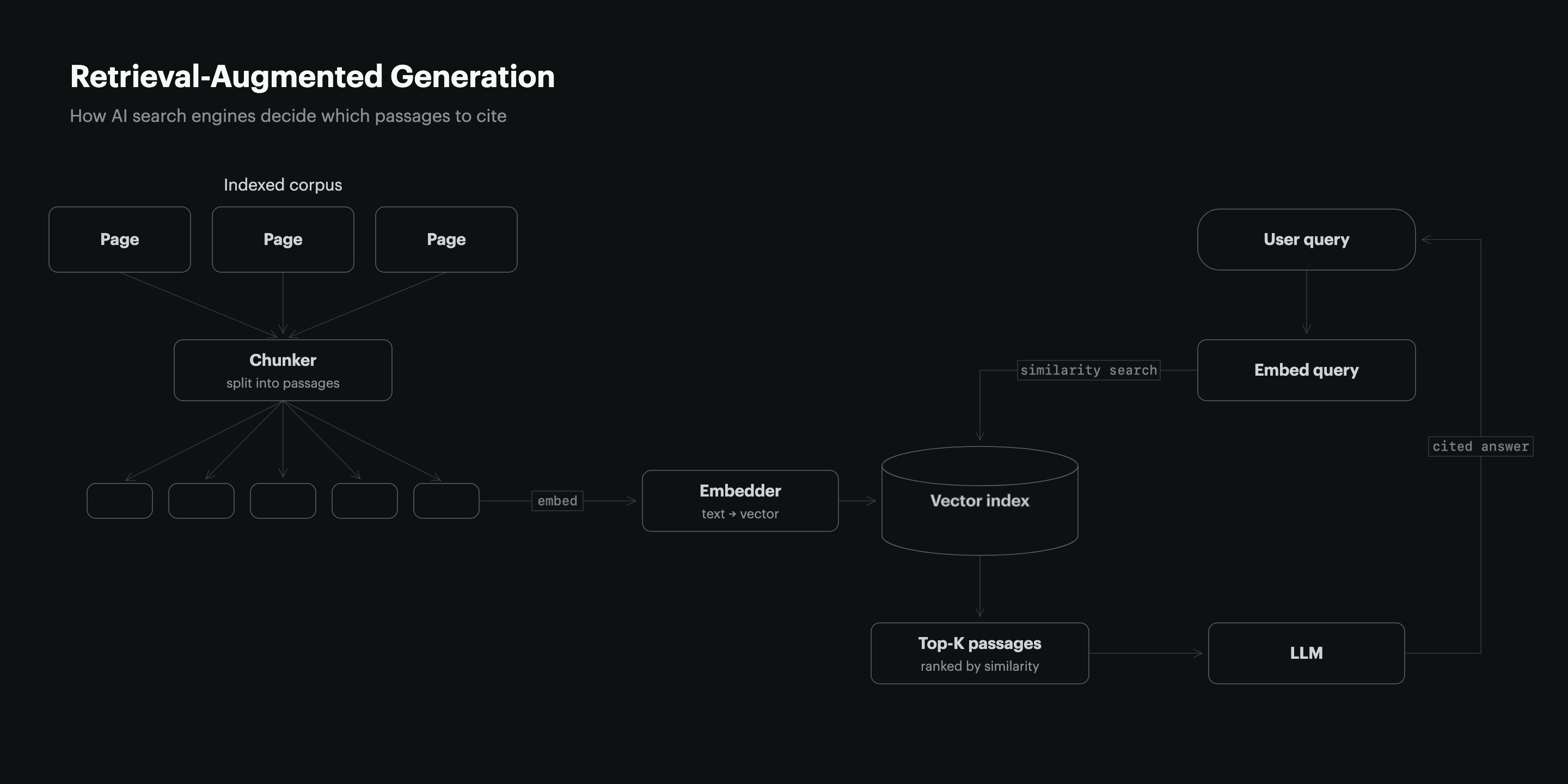
SEO copywriting treats bold as a visual emphasis tool for the human reader. Generative engines chunk content around labeled scaffolds when deciding what to extract; bold labels act as passage anchors. An article can carry the same facts in prose form and never surface in an AI Overview because the retrieval step never cleanly chunks it. The 94-to-0 split is not a preference; it is the structural bar a page has to clear to be retrievable at all.
Comparison Tables Appear in 88% of Top-Cited Pages
Comparison tables appear in 88% of the top 50 cited B2B pages and 0% of the bottom 50 (Res AI, 852-article B2B citation structure study, 2026). Prose paragraphs with three or more dimensions get compressed in AI retrieval. Tables get quoted verbatim.
The SEO instinct is to write comparison content as a flowing paragraph because paragraphs are easier to optimize for keyword density and reading grade. That instinct costs citations twice: once because tables outperform prose at extraction, and again because the prose form encourages keyword repetition that pushes the page further down the relevance ranking generative engines use. Converting three existing prose paragraphs into a single comparison table is usually the largest single-edit citation lift available on a B2B article.
The First 30% of the Page Earns 55% of Citations
In a 100-page study of Google AI Overviews, 55% of citations came from the first 30% of cited page content, with 24% from the middle third and 21% from the bottom 40% (CXL, 2024). The opening third is the citation battleground; classic SEO copywriting buries the evidence inside it.
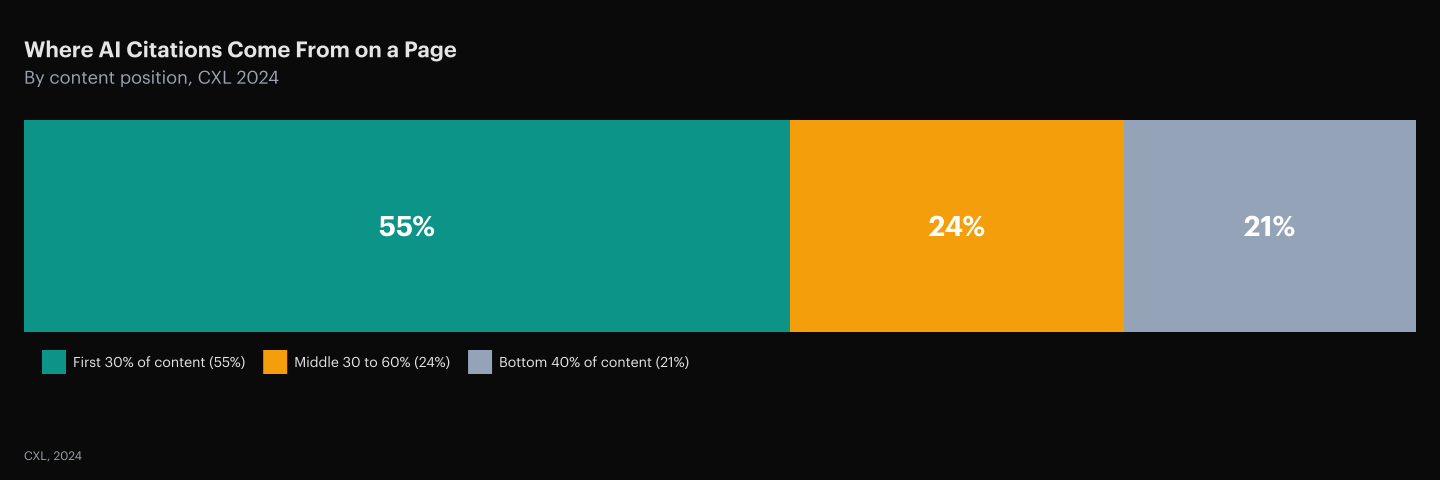
SEO articles are trained to warm up the reader before delivering the argument. The intro previews the topic. The first section sets context. The stat lands in section three. Generative engines never read section three. They chunk the first third, rank those chunks, and extract. An article that saves its best stat for the payoff earns a citation distribution inverted from the one it needed. The four-edit restructuring framework, pull the lead stat forward, rewrite H2s into claims with numbers, convert each H2’s first sentence into an answer capsule, and promote one table into the opening third, rewrites an SEO-arc article into a citation-ready one without changing the argument. Full mechanics are covered in page architecture beats content quality as an AI citation driver.
Longest Articles Average 4.5x More Structural Elements
Articles in the longest quartile of the 852-article study average 4.5 times more structural elements per page than articles in the shortest quartile (Res AI, 852-article B2B citation structure study, 2026). Length is not the driver; the headroom it creates for tables, labeled blocks, and extractable scaffolds is.
The quartile numbers are blunt. Q1 articles (57 to 1,356 words) average 2.98 structural elements per page. Q4 articles (3,598 to 30,106 words) average 13.55. SEO copywriting often hits a target word count by padding prose: filler transitions, restated context, softer evidence. That length is structurally invisible. It raises the SEO score and leaves the citation score unchanged. The 852-article study’s cleanest takeaway is that the top-cited band earned its position through structural density, not prose length, and the bottom band lost despite hitting comparable word counts through pure prose expansion. Shared mechanics are documented in the six structural features that separate AI-cited B2B articles from invisible ones.
The same structural-over-SEO dynamic shows up at the smallest possible scale on tryres.ai itself. Fifteen days after launch with two articles built to the structural template, Perplexity cites tryres.ai at #1 for “domain authority in AI citations” ahead of PRLog, DigitalStrategyForce, DigitalApplied, and Chudi, against 0 Google clicks across 408 impressions in the same window (Res AI, day-15 launch citation proof, 2026). Methodology block, multi-row comparison table, 8 to 9 FAQ entries, third-party citations on every claim; no SEO authority involved.
Monitoring Platforms Report the Gap, Execution Platforms Close It
Every GEO platform on the market sees the keyword-density gap in the same 852-article pattern; the vendors split on whether they hand the editorial team a brief or close the gap directly inside the CMS. The matrix below compares each platform on what it produces against the keyword-to-structure conversion, where the work physically ships, and what the team gets back.
| Platform | Scope of work | Where it ships | Output for the team |
|---|---|---|---|
| Res AI | Rewrites keyword-dense prose into structural elements that AI engines extract | Direct CMS deploy via natural-language edits | Published structural changes within minutes |
| Profound | Monitors brand presence and produces marketing-agent briefs | Standalone dashboard with brief handoff | Strategy briefs and prompt-volume reports |
| Conductor | Enterprise AEO data unified with content production | Unified platform across AEO and SEO teams | End-to-end AEO workflows with collaboration |
| Peec AI | Tracks visibility, position, and sentiment with no editing layer | A monitoring dashboard, no editing layer | Tracking dashboards for SEO and content teams |
| Athena | Tracks AI visibility across 8+ LLMs and surfaces optimization recommendations | Cross-platform tracking across 8+ LLMs | Optimization recommendations the team applies |
| AirOps | Produces content via multi-model AI workflows | Multi-region content production pipelines | Pages and Pro workflows from creation to refresh |
The two gaps that matter for SEO-instinct articles are structural editing scope and the interface through which it runs. Monitoring-first vendors surface which pages are failing; the content team then writes or briefs a replacement. Execution-first vendors edit the prose in place. The same 10-article restructuring pass takes six to eight weeks in a brief-plus-agency model and hours in a natural-language CMS editing model, which decides whether the conversion runs once a quarter or once a week.
Frequently Asked Questions
Why does keyword density hurt AI citation when both SEO and GEO reward topical relevance?
Topical relevance is a shared target; term repetition is an SEO-specific proxy for it. Generative engines measure relevance through evidence density and structural signals, so repeating the target phrase inflates the SEO signal without raising the GEO one and in fact cuts AI visibility by around 10% (Princeton GEO study, KDD 2024).
Can a page rank for SEO and still lose in AI search?
Yes, and it is the common case for B2B libraries written before 2024. The 852-article study found 0% of the bottom 50 AI-cited pages contained the structural features present in 94% of the top 50, and many of those bottom pages were ranking organically for the same queries (Res AI, 852-article B2B citation structure study, 2026).
Is there a safe keyword density range for GEO?
There is no density target in the GEO literature because density is not how generative engines score relevance. The practical guidance is to write the natural phrasing a practitioner would use, then spend the sentence budget on attributed statistics, which delivered the +41% visibility lift in Princeton’s dataset (Princeton KDD, 2024).
How long does it take to convert a keyword-optimized article into a citation-ready one?
The structural conversion, pulling the lead stat forward, rewriting H2s into claims, and converting paragraphs into tables and labeled blocks, takes 30 to 90 minutes of editorial work per article by hand. Execution-first GEO platforms run the same pass inside the connected CMS in minutes per article because the edits are template-driven against a known structural target.
Should a content team stop SEO optimization entirely?
No. SEO traffic still matters and the structural tactics that win AI citations, tables, answer capsules, and attributed statistics, also earn featured snippets and improve dwell time on organic landings. The change is dropping keyword density as an editorial KPI and adopting structural density in its place.
Why do 86% of SEO professionals use AI tools yet still write keyword-dense content?
Because most AI SEO tools were built to accelerate the previous optimization target, not to replace it. Over 86% of SEO professionals use AI SEO tools for strategy and content development (Sybrid, 2025), and the bulk of those tools scored drafts for keyword coverage, grade level, and readability, all of which remain orthogonal to AI citation performance.
Do generative engines actively penalize keyword density or simply overlook it?
Both. The Princeton dataset measured a negative visibility delta for keyword-stuffed passages, not a zero, which means stuffed content is ranked lower than unstuffed equivalents on the same query (Princeton KDD, 2024). The penalty is small per page, but it compounds across a library, and it combines with the missed lift from evidence-rich tactics.
What is the fastest single edit to improve an SEO article’s AI citation odds?
Convert the first sentence under the opening H2 into a 40-to-80-word answer capsule with one specific number and a named source. The opening third of the page earns 55% of AI Overview citations (CXL, 2024), so the single edit that most reliably moves a page into the citation band is rewriting the first passage the engine actually chunks.
How Res AI Converts SEO Prose Into 6 Extractable Structures
The 44-point direction gap between keyword stuffing and statistics addition is a publishing-time problem, not a strategy debate. Every SEO-optimized article in a library sits below the structural bar generative engines reward, and no brief, audit, or dashboard closes the gap until someone rewrites the prose into the six features documented in the 852-article study: bold label blocks, comparison tables, how-to-choose steps, pricing grids, product reviews, and definitions. Res AI runs the conversion directly against the connected CMS through a natural-language interface, so the same editorial team that wrote the keyword-dense draft can request the structural pass without coding, briefs, or agency handoff.
The platform connects to WordPress, Webflow, Framer, and Contentful, and edits existing posts in place rather than generating new drafts an agency has to rewrite later. A prompt like “convert the comparison section of every article tagged CRM into a 5-column table with bold entity names and Best for tags” runs across the tagged library and stages a diff per article for editorial approval. Res AI’s pricing is custom, scoped to each client’s library size and budget, with no fixed tiers or per-page caps, so a mid-sized library’s full restructuring pass fits inside a single model-update window.
Every edit is tracked against the monitoring layer so the team can see which articles crossed into the top citation band after the structural pass. That turns the keyword-density-to-structural-density conversion into a measured, repeatable cycle rather than a one-time cleanup.
Res AI restructures the keyword-optimized articles already in your CMS into pages generative engines quote, converting prose into tables, bold-labeled blocks, FAQs, and front-loaded answer capsules without rewriting the argument. The platform runs the conversion through a natural-language interface directly against WordPress, Webflow, Framer, and Contentful, with custom pricing scoped to each client’s library size and budget.