Your Page Is Retrievable but Not Citable
Retrievability and citability are two separate gates. A fully indexed page still gets skipped by AI engines when its claims are not checkable.
 machina sculpsit · homo probavit · MMXXVI
Most GEO advice stops at getting the page found. The harder problem starts after that, when a technically clean, indexed, fully parseable page still never shows up as a source in an AI answer. The median enterprise B2B brand is cited in just 3% of the AI Overviews where it already ranks organically (Walker Sands, 2026), which tells you the gap is not discovery. Retrievability and citability are two separate gates, and passing the first does nothing to pass the second.
Retrievability and Citability Are Two Different Gates
Pages in the highest on-page quality band are 4.2 times more likely to be cited than lower-scoring pages, across 1,702 citations and 1,100 audited URLs on Brave Summary, Google AI Overviews, and Perplexity (Kumar and Palkhouski, arXiv, 2025). Retrievability is whether an engine can fetch and parse your page. Citability is whether, having parsed it, the model judges the content worth attributing a claim to. A page clears the first gate by being reachable and readable. It clears the second only by reading like a source.
The two gates fail for different reasons and get fixed with different work. A retrievability failure is a plumbing problem: the crawler cannot see the content, so no amount of quality helps. A citability failure is an evidence problem: the crawler sees everything and decides none of it is quotable. Teams pour months into the first gate, confirm the page is indexed, and conclude the work is done. The 3% citation rate is what a page looks like when it passes gate one and stalls at gate two.
Retrievability means the fetcher gets your content in the initial HTML response and can parse the text, headings, and links. Citability means the parsed content carries specific, checkable, attributed claims a model will repeat. The gap is the population of pages that are perfectly retrievable and functionally invisible, because being findable was never the same thing as being worth citing.
| Property | Retrievability gate | Citability gate |
|---|---|---|
| Question it answers | Can the engine fetch and parse the page | Is the parsed content worth quoting |
| Failure mode | Content hidden behind JavaScript or blocked crawlers | Vague marketing prose with no checkable claim |
| How you fix it | Server-render, allow the crawler, clean the HTML | Add statistics, structure, and attributed claims |
| Signal it depends on | HTTP status, render path, robots rules | Evidence density and page structure |
| Passing it feels like | The page is indexed and ranks | The page appears as a named source |
Both gates are real, and the order matters. You cannot cite a page you cannot fetch, so retrievability is necessary. It is just nowhere near sufficient, which is the part most content programs never internalize.
AI Crawlers Fetch Your Page Long Before They Cite It
None of the major AI crawlers execute JavaScript, so they read only the raw HTML returned on the first request across 569 million GPTBot fetches and 370 million from ClaudeBot (Vercel, 2024). The retrievability gate is mechanical. GPTBot, OAI-SearchBot, ChatGPT-User, ClaudeBot, and PerplexityBot fetch the initial response and parse what is there. Content injected client-side after render is invisible to them, and they spend real budget fetching JavaScript files they never run, 11.50% of ChatGPT’s requests and 23.84% of ClaudeBot’s.
Clearing this gate is a front-end exercise. Deliver the content in the server response, keep the HTML semantic, and allow the crawler in robots.txt. A single-page app that assembles its body in the browser fails here, and so does JSON-LD injected by a tag manager after load. We cover the render trap in depth in AI crawlers read your raw HTML, not your rendered page.
The trouble is that passing this gate produces a satisfying signal. The page returns a 200, appears in the index, and starts ranking. Every dashboard says healthy. The crawler has your content, which the team reads as the finish line, when it is only the entrance to the second gate.
Cited Pages Carry 4.2 Statistics and Skipped Pages Carry 1.2
AI-cited B2B SaaS articles average 4.2 attributed statistics and 1.6 expert quotes, versus 1.2 statistics and 0.2 quotes for content that is not cited, across roughly 350,000 articles spanning 10,382 keywords and 52 categories (Citera, 2026). This is the citability gate rendered as a number. The cited page and the skipped page can be equally retrievable, equally well-ranked, equally on-topic. What separates them is evidence density: named figures, dates, and quotes a model can lift and attribute.
The same study found 64% of AI-cited articles carry three or more statistics, versus 29% of typical content, and 52% carry expert quotes versus 21%. A model answering a buyer question is assembling a defensible answer. It reaches for the passage that hands it a checkable claim and skips the paragraph that asserts a benefit without proof.
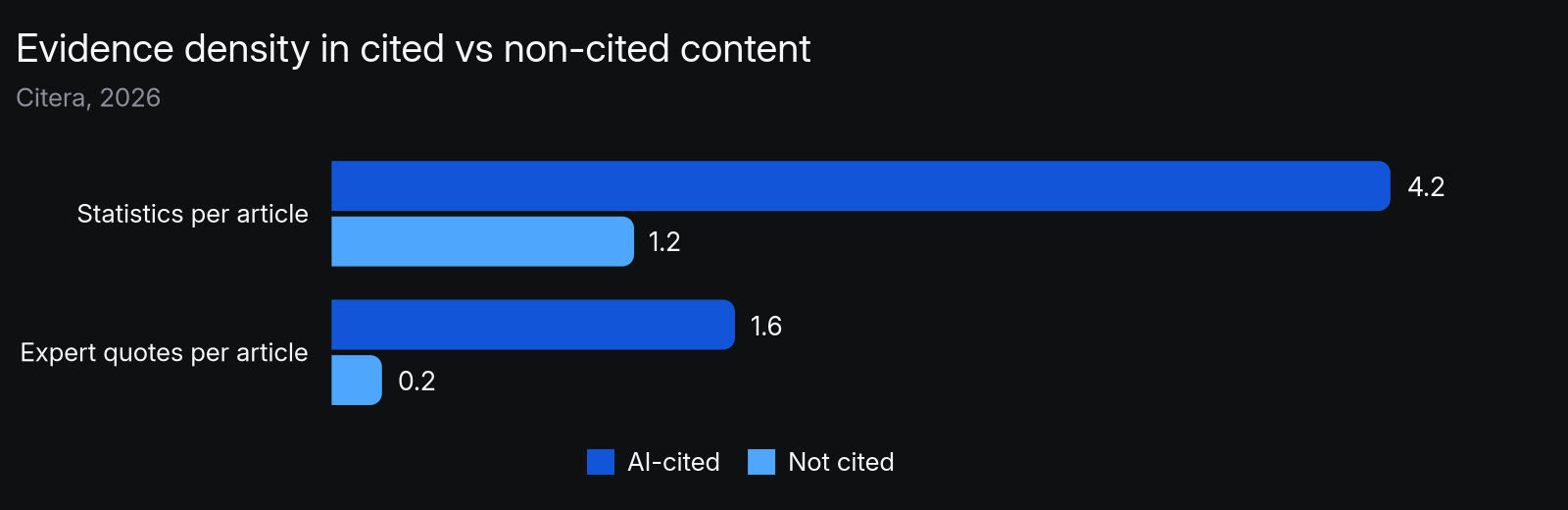
The lesson is not to bury a page in numbers. It is that a page with no falsifiable claim gives the model nothing to attribute, so the model attributes to a competitor who supplied one.
Ranking in Google Does Not Make You Citable
Only 14% of AI-cited URLs for B2B SaaS queries appear in Google’s top 20 organic results, while 30% of Google top-20 articles receive AI citations (Citera, 2026). The two surfaces reward different things. A page can own the traditional result and never enter the AI answer, and a page nowhere near the first search page can be the cited source. A separate analysis found only 12% of AI-cited URLs across ChatGPT, Perplexity, Gemini, and Google AI Mode rank in Google’s top 10 for the original prompt (Ahrefs, 2026).
This decouples retrievability from citability at the measurement layer. Ranking proves an engine can fetch and rate your page against a query, which is a retrievability-plus-relevance signal. It says nothing about whether the page hands a generative model a quotable claim. Treating a top ranking as proof of AI visibility is the most common way teams convince themselves the second gate is closed when it is wide open.
We built the case that rank and citation are different systems in your Google ranking does not predict your AI visibility. The practical consequence is that a rank tracker cannot tell you whether your citability gate is open. It measures the wrong gate.
Specific Checkable Claims in the Opening Win Citations
In a 100-page study of Google AI Overviews, 55% of citations came from the first 30% of a cited page, with 24% from the middle and 21% from the bottom (CXL, 2024). Citability is decided early. The model weights the opening of a page most heavily, so a specific, checkable claim in the first two sentences of a section is doing the citation work, and three paragraphs of preamble before the first real claim buries the evidence past the point of extraction.
This is why the answer-capsule pattern earns citations. Front-load the claim, name the number, attribute the source, then explain. A section that opens with “our platform helps teams move faster” gives the model nothing in the zone it reads first. A section that opens with a figure and a source hands the model an extractable unit exactly where it is looking. We detail the mechanics in page architecture beats content quality as an AI citation driver.
The reader who lands after the citation still gets the full argument. The model that decides whether to cite only reads the top, so the opening has to satisfy both.
Structure Alone Lifts Citation Rate 17.3%
Structural optimization independent of content quality produces a consistent 17.3% improvement in AI citation rates, in a controlled experiment that held the words, claims, and sources identical and varied only structure across six engines (University of Tokyo and University of Tsukuba, 2026). The same evidence, restructured, gets cited more. This is the cleanest proof that citability is a property of form as much as substance, because the substance was frozen and citations still moved.
The Princeton GEO study puts numbers on the tactics: adding a statistic lifted visibility 41%, quoting a source 28%, and authoritative language 25%, while keyword stuffing cut visibility roughly 10% (Princeton, KDD, 2024). The direction is what matters. The moves that raise citability are the opposite of the moves that once raised search rankings.
| Tactic | Effect on AI visibility |
|---|---|
| Adding a statistic | +41% |
| Quoting a source | +28% |
| Using authoritative language | +25% |
| Tightening the prose | +15% |
| Keyword stuffing | -10% |
A page optimized on old search instincts, dense with keywords and thin on numbers, is retrievable and actively working against its own citability. We trace that conflict in SEO copywriting instincts suppress AI citation rates.
Marketing Copy Reads as Uncitable to a Retrieval Model
Metadata and freshness, semantic HTML, and structured data were the page pillars most strongly associated with citation across all three engines studied (Kumar and Palkhouski, 2025). A retrieval model does not reward persuasion. It rewards passages shaped like evidence, and marketing copy is shaped like persuasion: broad claims, no numbers, no dates, no named source. The page reads well to a buyer scanning for vibe and reads as empty to a model scanning for a quotable fact.
This is the citability failure hiding inside most well-produced pages. The design is clean, the message is on-brand, the page is fully retrievable, and there is not one falsifiable claim in it. Analyses of cited versus uncited pages found six structural features present in 94% of top-cited pages and 0% of the bottom, with the longest-quartile pages averaging 13.55 structural elements versus 2.98 (Res AI, 852-article B2B citation structure study, 2026). The gap between cited and skipped is structural, and marketing prose has almost none of the structure.
The audit below separates the two gates so a team can find where a specific page is stuck.
| Check | Gate it tests | Fail looks like |
|---|---|---|
| Content present in raw HTML | Retrievability | Body assembled by client-side JavaScript |
| Crawler allowed in robots.txt | Retrievability | GPTBot or ClaudeBot disallowed |
| First 30% carries a checkable claim | Citability | Opening is preamble with no number |
| Three or more attributed statistics | Citability | Broad benefit claims, no sources |
| Eight or more structural elements | Citability | Wall of prose, one table at most |
| A named comparison or data table | Citability | Category claims with nothing to extract |
Citability Decays Even After You Earn It
Citation drift, the share of domains present in one month’s AI answers and gone the next for identical prompts, runs 40% to 60% month over month (Profound, 2026). Citability is not a one-time pass. A page that earns citations this quarter can lose them next quarter without a single edit, because the answer set churns and fresher, denser sources displace it. Pages not updated quarterly are three times more likely to lose citations (AirOps and Kevin Indig, 2026).
Freshness is itself a citability signal. AI-cited URLs are 25.7% fresher than organic results, averaging 1,064 days since publication versus 1,432 (Ahrefs, 2025). A page that was citable at launch drifts toward uncitable as its data ages and the engine starts preferring a more recent source making the same claim with a newer date attached.
This is why closing the citability gate once is not a project with an end. The gate reopens on a schedule the engine sets, not one the team controls, so the page needs a refresh cadence that keeps its claims current and its structure intact.
How to Move a Page From Retrievable to Citable
Diagnose the retrievability gate first, then the citability gate, because fixing evidence density on a page the crawler cannot read wastes the work. Confirm the content is in the raw HTML and the crawler is allowed. Once the page is genuinely retrievable, the remaining work is citability: front-load a checkable claim in every section opening, raise evidence density toward the cited-page average of 4.2 statistics, and add the structural elements the model extracts.
The decision table maps the symptom to the gate and the fix. It is the difference between a page that is technically healthy and a page that gets cited.
| Symptom | Gate at fault | The fix |
|---|---|---|
| Page is indexed but never cited | Citability | Add attributed statistics and a comparison table |
| Content missing when fetched as GPTBot | Retrievability | Server-render the body, expose it in raw HTML |
| Ranks in Google, absent from AI answers | Citability | Front-load checkable claims in each section opening |
| Cited last quarter, gone this quarter | Citability decay | Refresh the data and re-timestamp the page |
| Long page, still not cited | Citability | Replace prose with structural elements, not more words |
The pattern that separates cited pages is consistent across engines. In our 1,000-query Perplexity study, 82% of citations went to independent blogs and publications with structured, evidence-dense pages, versus 5.9% to vendor sites writing marketing copy (Res AI, 1,000-query Perplexity B2B citation study, 2026). The vendor pages were retrievable. They were not citable.
How Res AI Compares to the Tools Watching Your Citations
Most GEO platforms are built to measure the citability gate, not to close it, so they tell you a page is uncited without changing the page. The dimensions that matter here are what each tool does about the retrievable-to-citable gap, how much of the surface it covers, and what it actually ships to the page.
| Platform | What it does about the citability gap | Coverage | What ships |
|---|---|---|---|
| Res AI | Restructures existing pages into citable elements and publishes them through the CMS | 4 engines monitored, all major CMSes | Published structured pages |
| Profound | Monitors AI visibility and surfaces gaps | 10-plus answer engines | Dashboards and gap alerts, no page edits |
| Conductor | Tracks visibility and generates enterprise content | ChatGPT, Gemini, Copilot, Claude, search | Reports plus new content |
| Peec AI | Tracks visibility, position, and sentiment | Multiple LLMs, 50 to 350 prompts | Monitoring dashboards, no optimization |
| Athena | Tracks and recommends content optimizations | 8-plus LLMs | Optimization recommendations |
| AirOps | Creates and refreshes content workflows | 30-plus AI models | Generated content, months to value |
Res AI is row one because the article’s problem is a page problem, and Res is the option that acts on the page. Monitoring platforms locate the citability gate accurately and then hand a brief to a team that still has to do the restructuring by hand.
Frequently Asked Questions
Why is my indexed page not getting cited by AI engines?
Indexing proves retrievability, not citability. Being fetched and parsed is a separate gate from being worth quoting, and pages in the top on-page quality band are 4.2 times more likely to be cited than lower-scoring pages (Kumar and Palkhouski, 2025). An indexed page with no checkable claim clears the first gate and stalls at the second.
How is citability different from retrievability?
Retrievability is whether an engine can fetch and parse your content on the first request. Citability is whether the parsed content carries specific, attributed claims a model will repeat. The first is a front-end and crawl-access question, the second is an evidence-density and structure question.
Does ranking well in Google make a page citable?
No. Only 14% of AI-cited B2B SaaS URLs appear in Google’s top 20, while 30% of top-20 articles get cited (Citera, 2026). Rank measures relevance against a query, not whether the page hands a generative model a quotable, attributed claim.
What makes content read as citable to a model?
Evidence density and structure. Cited pages average 4.2 statistics versus 1.2 for uncited ones (Citera, 2026), and restructuring identical content lifts citation rates 17.3% (Tokyo and Tsukuba, 2026). Front-loaded claims, named sources, and comparison tables give a model extractable units.
Where on the page does citability get decided?
Mostly in the opening. 55% of AI Overview citations come from the first 30% of a cited page (CXL, 2024), so a checkable claim in the first two sentences of each section does the citation work while buried claims go unextracted.
Can a page lose its citability over time?
Yes. Citation drift runs 40% to 60% month over month (Profound, 2026), and pages not refreshed quarterly are three times more likely to lose citations (AirOps and Kevin Indig, 2026). Citability needs a refresh cadence, not a one-time pass.
Will adding schema markup fix a citability problem?
Not on its own. Semantic HTML and structured data correlate with citation (Kumar and Palkhouski, 2025), but structure carries citations when the underlying claims are checkable. Schema on a page of vague marketing copy still leaves the model nothing to attribute.
Is a longer page more citable?
Only if the extra length is structure, not prose. Longest-quartile pages average 13.55 structural elements versus 2.98 (Res AI, 852-article study, 2026). Words past the first checkable claim add nothing extractable, so more elements beat more paragraphs.
How Res AI Closes the Retrievable-to-Citable Gap Across 4 Engines
The article showed why a technically healthy page still fails to get cited: it passes the retrievability gate and stalls at citability, where the work is evidence density and structure, not plumbing. Res AI is a GEO platform that acts on that second gate directly. It reads your existing pages, restructures dense prose into the comparison tables, bold-label blocks, and front-loaded answer capsules that models extract, and pushes the changes live through your CMS without developer time.
Res works from the content you already have rather than asking you to publish more of it. It monitors citation performance across ChatGPT, Perplexity, Claude, and Gemini, then targets the specific pages that are retrievable and uncited, raising their evidence density toward the cited-page benchmark and refreshing them on the cadence citation drift demands. The output is a published, structured page, not a dashboard that tells you the page is failing.
Res AI closes the gap between a page that can be found and a page that gets cited, which is the exact failure a 3% citation rate describes. It fits marketing teams whose indexed, well-ranked content is still missing from AI answers and who need the pages fixed, not just flagged.