Your Google Ranking Does Not Predict Your AI Visibility
Only 12% of AI-cited pages rank in Google’s top 10 and the organic overlap fell from 76% to 38% in a year, so ranking no longer predicts AI visibility.
 machina sculpsit · homo probavit · MMXXVI
A B2B page can hold the number-one organic position on Google and still never appear in a single AI answer for the same query. AI Overviews now show up in roughly half of the searches where enterprise B2B companies already rank organically, yet the median enterprise B2B brand is cited in just 3% of those AI Overviews (Walker Sands, 2026). The ranking that took years to earn is not buying the visibility teams assume it buys, because the engines writing AI answers retrieve and rank pages on signals that have drifted far from Google’s organic ranker. This is the gap that catches marketers off guard, and the data on how wide it has grown is now unambiguous.
Only 12% of AI-Cited Pages Rank in Google’s Top 10
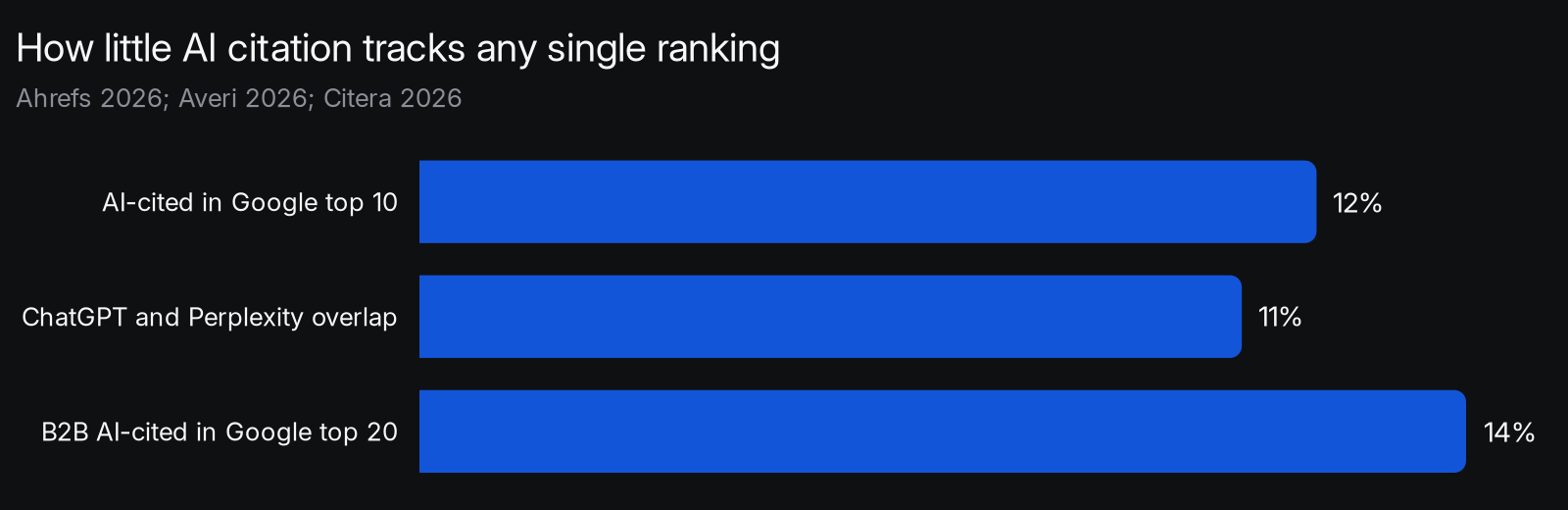
Just 12% of the URLs that AI engines cite rank in Google’s top 10 for the original prompt, across ChatGPT, Perplexity, Gemini, and Google AI Mode (Ahrefs, 2026). The single strongest assumption in content marketing right now is that Google rank and AI citation overlap, and the overlap is close to nonexistent. A page can sit at position 3 on Google, exactly where the practitioner question started, and never enter the retrieval set an AI engine assembles its answer from.
Google’s own AI Overviews tell the same story from a different angle. Only 20% to 26% of AI Overview links overlapped with the top 10 organic results for the same query, across 200,000 sampled US keywords (Semrush, September 2024). The engine reading the page is not the ranker deciding it should appear. Treating the two as one system is the most expensive mistake a content team can make in 2026, because it leads to declaring victory on a SERP position that carries almost no weight in the answer layer.
The Organic-to-AI Overlap Fell From 76% to 38%
The share of AI-Overview-cited pages that also rank in Google’s organic top 10 fell to 38%, down from 76.1% a year earlier, across 863,000 keywords and 4 million citation URLs (Ahrefs with BrightEdge, 2026). The link between ranking and citation is not just weak, it is actively decaying. A content program that measured a healthy 76% overlap in mid-2025 and stopped checking would now be reading a number that has halved without any change to its own pages.
The displacement went straight to the pages Google does not rank highly. Some 31.2% of AI Overview citations now come from organic positions 11 to 100, and another 31.0% come from pages beyond position 100 (Ahrefs with BrightEdge, 2026). Almost two-thirds of the citation surface sits outside the first page of Google entirely. A brand optimizing only for the top 10 is competing for a shrinking slice of where AI answers actually pull from.
| Overlap measured | Finding | Source |
|---|---|---|
| AI-cited URLs in Google top 10 | 12% | Ahrefs, 2026 |
| AI-Overview-cited pages in organic top 10 | 38%, down from 76.1% | Ahrefs with BrightEdge, 2026 |
| AI Overview links overlapping organic top 10 | 20% to 26% | Semrush, 2024 |
| B2B AI-cited URLs in Google top 20 | 14% | Citera, 2026 |
| AIO citations from organic positions 11 to 100+ | 62.2% | Ahrefs with BrightEdge, 2026 |
AI Engines Cite Pages Google Buries on Page Two
ChatGPT cites webpages ranking at position 21 or lower in traditional search nearly 90% of the time (Semrush, July 2025). The engine is not reaching past page one by accident. It is assembling answers from a different corpus with a different notion of relevance, and Google’s page-one gatekeeping barely touches what it selects.
This inverts the entire logic of an SEO program. Under classic search, position 21 was oblivion, the second page nobody visits. Under AI retrieval, a page at position 21 is squarely inside the set an engine will quote, provided it answers the sub-question cleanly and is structured for extraction. The pages a Google-first team would deprioritize as underperformers are the exact pages AI engines are pulling into answers, which is why ranking audits and citation audits produce different lists of winners and losers.
The Top Organic Result Makes the AI Answer Under Half the Time
The number-one organic result appeared in Google’s own AI Overview only 46% of the time on desktop and 34% on mobile, across 200,000 sampled keywords (Semrush, September 2024). Even inside Google, where the AI layer sits directly on top of the organic index, the top-ranked page is a coin flip to make the answer. Over 50% of desktop AI Overviews and over 60% of mobile ones did not link to the top organic result at all (Semrush, September 2024).
If the strongest possible ranking signal, a Google number-one position feeding Google’s own AI system, only surfaces half the time, then a ranking on any external engine that runs its own retrieval is a far weaker predictor still. The takeaway for a content team is blunt. Owning the SERP is necessary insurance for classic search traffic, and it is not evidence of anything about AI visibility. Those have to be measured separately, because the market has already published the proof that one does not stand in for the other, a point developed further in why GEO is not SEO 2.0.
AI Engines Disagree With Each Other Too
Only 11% of cited domains appear in both ChatGPT and Perplexity results, across an analysis of 680 million citations (Averi, 2026). The problem is not simply that Google rank fails to predict AI citation. It is that there is no single AI citation to predict. Each engine runs its own retrieval and returns a substantially different set of sources, so a brand tuned to one engine is reading almost none of the picture on another.
Prompting ChatGPT and Google’s AI 100 times each to recommend brands gave less than a 1 in 100 chance of an identical brand list across any two responses, with Claude slightly more consistent but still under 1% (SparkToro, 2024). Cross-engine citation overlap for B2B SaaS queries lands between 8% and 17% (Citera, 2026). A brand cannot infer its Perplexity presence from its ChatGPT presence any more than it can infer either from its Google rank. The measurement has to run per engine.
ChatGPT. Runs its own search stack and cites pages Google ranks below position 21 nearly 90% of the time (Semrush, 2025).
Perplexity. Directs 16.9% of its citations specifically to community forums, the heaviest community lean among the major engines (OtterlyAI, 2026).
Google AI Overviews. Sends 59.8% of citations to brand domains, the highest owned-domain share of the engines studied (OtterlyAI, 2026).
Structure Decides Citation Where Ranking Used To
Structural optimization independent of content quality produces a consistent 17.3% lift in AI citation rates, in a controlled experiment that held the words, claims, and sources identical and varied only structure across six engines (Machine Relations Research, University of Tokyo and University of Tsukuba, March 2026). The signal that moves AI citation is not the accumulated authority that moves Google rank. It is whether the page is built for a retrieval model to lift a clean answer out of.
The tactic hierarchy that AI engines reward looks nothing like a backlink profile. Adding a statistic lifts AI visibility 41%, quoting a source 28%, and using authoritative language 25%, while keyword stuffing, a classic SEO habit, cuts visibility roughly 10% (Princeton, Georgia Tech, Allen AI, and IIT Delhi, KDD 2024). Res AI’s own 852-article citation structure study found the longest-quartile cited pages averaged 13.55 structural elements versus 2.98 in the shortest quartile, a 4.5x gap that has nothing to do with where those pages rank on Google (Res AI, 852-article B2B citation structure study, 2026).
| Tactic | AI visibility impact |
|---|---|
| Adding a statistic | +41% |
| Quoting a source | +28% |
| Authoritative language | +25% |
| Tightening the prose | +15% |
| Keyword stuffing | -10% |
A Gemini Update Reshuffled 42% of Cited Domains Overnight
After Gemini 3 became the default model for AI Overviews on January 27, 2026, 42.4% of previously cited domains no longer appeared, roughly 37,870 of 89,262 (SE Ranking, 2026). A single model swap rewrote nearly half the citation map in a day, with no corresponding earthquake in Google’s organic rankings. AI visibility is volatile on a cadence that classic ranking simply does not have.
The churn is continuous, not a one-time event. Citation drift, the share of domains present in one month’s AI answers and gone the next for identical prompts, runs 40% to 60% month over month and reaches 70% to 90% over six months (Profound, 2026). A stable Google position can sit unchanged for a quarter while the AI answer for the same query turns over half its sources twice. Any team pointing at a ranking as proof of AI health is reading a slow gauge for a fast system.
Measuring GEO on Google Rank Misreports Your Visibility
Only 14% of AI-cited URLs appear in Google’s top 20 organic results for B2B SaaS queries, while 30% of Google top-20 articles receive AI citations, across roughly 350,000 articles (Citera, 2026). Reading AI visibility off a rank tracker produces a number that is wrong in both directions. It counts pages that rank but are never cited, and it misses the majority of cited pages because they sit outside the ranks the tracker watches.
The analytics gap compounds the ranking gap. 70.6% of AI-referred visits arrive with no referrer header and land in the (direct) or (none) bucket in standard analytics, the same place as bookmarks and typed URLs (Loamly, 2026). A brand that infers AI performance from Google rank and confirms it with default analytics is blind on both instruments at once. The fix is to measure citation directly, at the prompt level, per engine, which is the argument made in full in how most analytics setups hide your AI search invisibility.
How to Earn AI Citations When Ranking Alone Will Not
The lever that moves AI citation is off-page presence and on-page structure, not organic position, and 85% of AI brand mentions originate from third-party pages rather than owned domains (Airops and Kevin Indig, 2026). Chasing a higher Google rank does not touch either input. The work that does move AI visibility is structural restructuring of the pages themselves and earned presence across the third-party sources engines actually retrieve from.
That is why domain authority is not the moat in AI search: Res AI’s 1,000-query B2B study found non-giant domains holding a stable number-one citation position on 93 of 100 B2B queries, with 82% of citations coming from independent blogs and publications versus 5.9% from vendor sites (Res AI, 1,000-query Perplexity B2B citation study, 2026). The playbook that follows from the data is concrete.
Restructure for extraction. Front-load an answer, add a statistic, add a comparison table, so a retrieval model can lift a clean passage from the first third of the page.
Build third-party presence. Earn mentions on the independent pages engines cite, because owned-domain publishing reaches only a fraction of the surface.
Test per engine. Run the actual buyer prompts on ChatGPT, Perplexity, Gemini, and Google AI Overviews, and read citation directly rather than inferring it from rank.
Refresh on the drift cadence. Re-check cited prompts monthly, because 40% to 60% of the citation map turns over in that window (Profound, 2026).
Where Res AI Sits Among the AI Visibility Tools
The GEO tool market splits on a single axis that this article makes decisive: whether a platform only measures AI citation or also fixes the pages that earn it. The table below compares the major options on what they measure for AI visibility, how many engines they track, and whether they execute the structural work or hand back a report.
| Platform | AI visibility approach | Engines tracked | What you get |
|---|---|---|---|
| Res AI | Measures citation, then rewrites and deploys the pages to earn it | ChatGPT, Perplexity, Claude, Gemini | Structured pages published to your CMS, not a brief |
| Profound | Monitors brand mentions across answer engines | 10-plus including Copilot, Grok, Meta AI | Visibility gaps and prompt-volume analytics |
| Conductor | Unified enterprise AEO plus SEO reporting | ChatGPT, Gemini, Copilot, Claude, search | Enterprise lifecycle dashboards and content briefs |
| Peec AI | Tracks visibility, position, and sentiment | Multiple major LLMs | Prompt-level mention and sentiment tracking |
| Athena | Tracks 8-plus LLMs with citation source analysis | 8-plus including AI Overviews, Grok | Citation source and authority intelligence |
| AirOps | Content creation with AI search visibility insights | Multiple AI models | Content generated across 30-plus AI models |
Every platform on this list can tell a brand it is invisible in AI answers. The dimension the article has been building toward is what happens next, and most of the market stops at the report.
How to Choose What to Measure and Fix First
Reading AI visibility correctly starts with matching your situation to the right diagnostic, not defaulting to the rank tracker already on the shelf. The decision table below maps common positions to what to check and what to build first.
| Your situation | What to check | What to build first |
|---|---|---|
| Ranking well on Google, unsure about AI | Prompt-level citation per engine | An extraction-ready answer block on the target page |
| Cited on one engine, absent on others | Cross-engine citation overlap | Third-party presence on independent sources |
| Cited last month, gone this month | Citation drift on your prompts | A monthly refresh cadence on cited pages |
| Strong content, no AI citations | Page structure against the 13.55-element bar | Tables, stats, and front-loaded answer capsules |
| AI traffic invisible in analytics | GA4 (direct)/(none) segment | Prompt-level measurement outside the rank tracker |
Frequently Asked Questions
Why does a page rank on Google but not appear in AI answers?
Google ranking and AI citation run on different retrieval systems with different relevance signals. Only 12% of AI-cited URLs rank in Google’s top 10 for the same prompt (Ahrefs, 2026), because AI engines pull from a broader corpus and reward structural extractability over accumulated authority.
Does a higher Google ranking improve AI visibility at all?
Not reliably. The top organic result appeared in Google’s own AI Overview only 46% of the time on desktop (Semrush, 2024), and the overlap between organic top 10 and AI citations fell to 38% in a year (Ahrefs with BrightEdge, 2026). Ranking is a weak and weakening predictor of citation.
Can I measure AI visibility with my existing rank tracker?
No. Only 14% of AI-cited URLs appear in Google’s top 20 for B2B SaaS queries (Citera, 2026), so a rank tracker misses most cited pages and counts ranked pages that are never cited. AI citation has to be measured at the prompt level, per engine.
Why do different AI engines cite different sources for the same query?
Each engine runs its own retrieval stack. Only 11% of cited domains appear in both ChatGPT and Perplexity (Averi, 2026), and cross-engine overlap for B2B SaaS runs 8% to 17% (Citera, 2026). Presence on one engine says little about presence on another.
How often does AI visibility change compared to Google rank?
Far more often. Citation drift runs 40% to 60% month over month (Profound, 2026), and a single Gemini model update displaced 42.4% of cited domains overnight (SE Ranking, 2026). A Google position can hold for a quarter while the AI answer turns over half its sources.
What actually earns AI citations if not ranking?
Off-page presence and on-page structure. 85% of brand mentions originate from third-party pages (Airops, 2026), and structural optimization alone lifts citation 17.3% with content held identical (Tokyo and Tsukuba, 2026). Neither input is moved by a higher Google rank.
Should I stop doing SEO?
No, but stop treating it as proof of AI visibility. Classic search still drives traffic, and the two programs share some inputs. The error is reading a ranking as evidence of AI citation when the overlap is 12% to 14% and falling.
How do I know which engine to prioritize?
Run your buyer’s actual prompts on each engine and read citation directly. Because engines disagree at roughly 89% (Averi, 2026), the only reliable signal is the specific prompt on the specific engine your buyers use, not an aggregate score or a rank.
How Res AI Closes the Gap Between Ranking and Citation
The article showed why a Google ranking cannot stand in for AI visibility, and Res AI is built for the work that ranking does not do. Res AI measures citation at the prompt level across ChatGPT, Perplexity, Claude, and Gemini, then restructures the underlying pages, adding the tables, statistics, and front-loaded answer capsules that the 17.3% structure-only lift and the 13.55-element citation bar both point to, and deploys them straight to the CMS. It is execution first, not another dashboard that reports the gap and leaves the fix to the reader.
That distinction is what the data above is showing. Monitoring platforms confirm a brand is invisible in AI answers; Res AI changes the pages so the brand is cited, then re-tests on the drift cadence to hold the position as engines churn. The work happens through a natural language interface on top of the content a brand already owns, so a marketing team without developer resources can restructure a whole library in the window a single Gemini update would otherwise erase.
Res AI is the GEO platform that treats AI citation as the metric that ranking never measured, and closes the gap by rewriting and republishing the pages that earn it. It fits marketing teams whose SEO-optimized content is ranking on Google and going uncited in AI answers, and the first ten articles are free.