Unlinked Brand Mentions Beat Backlinks for AI Citations
Branded web mentions predict AI visibility roughly 3x better than backlinks (Ahrefs, 2026). Entity recognition, not link count, is the citation lever.
 machina sculpsit · homo probavit · MMXXVI
AI engines recommend the brands they can recognize, and recognition is built off your own domain, not on it. 51% of B2B software buyers now begin research with an AI chatbot rather than a search engine (G2, 2026), which means the first filter on most deals is whether the model names your brand at all. The signal that decides that naming is not your backlink count. It is how often, and how consistently, the rest of the web mentions you.
Branded Mentions Predict AI Visibility 3x Better Than Backlinks
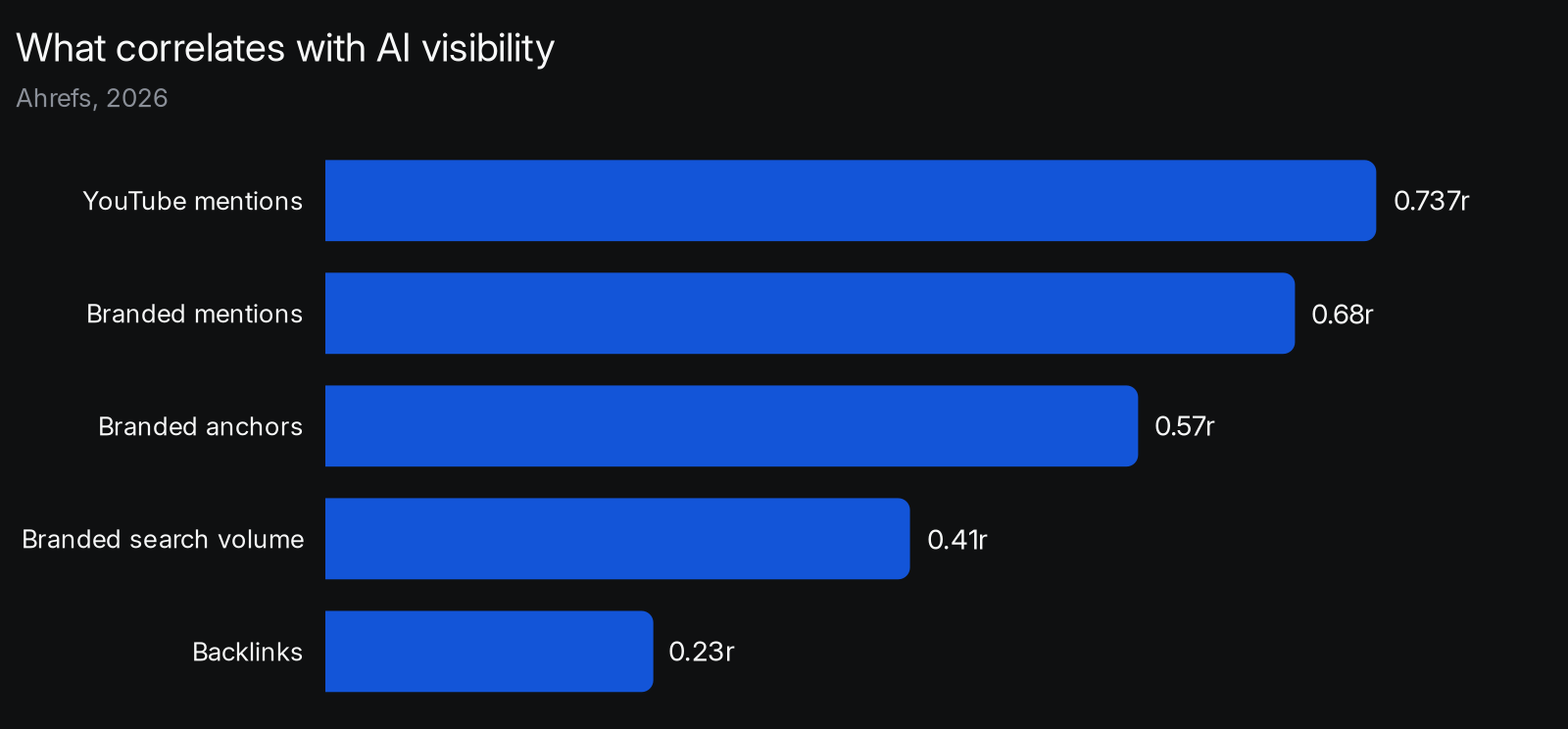
Unlinked branded web mentions correlate with AI visibility at a Spearman coefficient of 0.656 to 0.709, more than three times the 0.194 to 0.270 correlation of backlinks, across 75,000 brands analyzed via Ahrefs Brand Radar over millions of AI responses on ChatGPT, Google AI Mode, and AI Overviews (Ahrefs, 2026). The gap is not marginal. It reorders which off-page investment actually moves an AI engine to name you.
The same study ranks the other entity signals in between. Branded anchor text lands at 0.511 to 0.628 and branded search volume at 0.352 to 0.466, both stronger than the raw backlink correlation. Every one of those signals is a measure of the same thing: how present your brand name is across the web, independent of whether the mention carries a link.
| Off-page signal | Correlation with AI visibility | What the signal measures |
|---|---|---|
| Branded web mentions | 0.656 to 0.709 | How often the name appears anywhere online |
| YouTube mentions | 0.737 | Name presence inside video and transcripts |
| Branded anchor text | 0.511 to 0.628 | Name used as link text |
| Branded search volume | 0.352 to 0.466 | How often people search the name |
| Backlinks | 0.194 to 0.270 | Raw count of inbound links |
The takeaway for a GEO program is a reallocation. A budget line built around link acquisition is aimed at the weakest correlate on the board, while the strongest correlate, being mentioned by name, rarely has an owner on the team.
AI Engines Recommend Brands They Can Recognize
A brand earning both a citation and a mention is 40% more likely to resurface across answers, yet only 28% of AI answers include such dual-visibility brands (Airops and Kevin Indig, 2026). The engine is not scoring pages in isolation. It is deciding whether an entity is well-enough attested to name with confidence, and the brands it can resolve cleanly are the ones it repeats.
This is why two pages of identical quality can earn different outcomes. The page attached to a brand the model has seen described consistently across dozens of third-party sources reads as a known entity. The page attached to a brand the model has barely encountered reads as a claim it cannot verify, so the model reaches for a competitor it can. Recognition is upstream of extraction, and it is built by everyone except you.
A Mention Without a Link Still Counts
Nofollow links correlate with AI visibility at 0.340, statistically identical to the 0.334 of followed links (Semrush and Kevin Indig, 2025). The link attribute that traditional SEO spent two decades treating as the difference between value and no value is close to irrelevant to an AI engine. What the engine reads is the sentence around the mention, not the rel attribute on the tag.
That single finding rewrites the outreach playbook. A brand mention in a roundup, a forum answer, a review, or a podcast transcript carries nearly the same weight whether or not the writer chose to hyperlink it. Chasing the followed link, negotiating anchor text, disavowing the nofollow, all of it optimizes a variable the model does not weigh. The presence of the name is the payload.
Where Your Brand Gets Named Decides Citation
85% of brand mentions originate from third-party pages rather than owned domains, and 48% of AI citations come from community platforms like forums and video sites (Airops and Kevin Indig, 2026). The surface that builds your entity recognition is almost entirely off your own site, which means it is a surface most content teams never touch.
The distribution matters as much as the volume. A brand named across reviews, independent blogs, community threads, and video descriptions accumulates recognition from many independent witnesses, which is exactly the pattern a retrieval model treats as corroboration. A brand named only on its own domain has one witness, and the model discounts it. In the 1,000-query Perplexity B2B citation study, 82% of citations came from independent blogs and publications versus 5.9% from vendor sites (Res AI, 1,000-query Perplexity B2B citation study, 2026).
| Where the mention lives | Share of the signal | Who controls it |
|---|---|---|
| Third-party pages | 85% of brand mentions | Reviewers, journalists, forums |
| Community platforms | 48% of citations | Users, creators |
| Independent blogs and publications | 82% of study citations | Editors, analysts |
| Your own domain | 5.9% of study citations | You |
The honest reading is uncomfortable. The majority of the signal that gets you cited is authored by people you do not employ, on pages you do not own, and the only way to influence it is to become genuinely worth mentioning.
YouTube Is the Strongest Single Entity Signal
YouTube mentions show the single strongest correlation with AI visibility of any factor measured, at 0.737, outperforming branded mentions, branded anchors, domain rating, and backlinks (Ahrefs, 2026). Video is not a nice-to-have channel sitting beside your written content. On the correlation table it is the top line.
The mechanism is machine readability. YouTube supplies models with structured transcripts and dense on-page metadata, the same extractable form that wins owned-page citations, which is why the platform overtook discussion forums as the most-cited social source in AI answers at 16% of responses versus 10% (Bluefish via Adweek, 2026). A brand named inside a well-transcribed explainer video is a brand named in a format the engine can parse cleanly. The fastest-growing citation source rewards the same discipline as the rest of GEO, and the case for treating video as a citation surface is now a number, not a hunch.
Backlinks Hit a Ceiling That Mentions Do Not
Authority score correlates with raw AI mentions at 0.65 but with AI Share of Voice at only 0.23, and share of voice barely moves with incremental authority until a domain crosses a high threshold (Semrush and Kevin Indig, 2025). Backlinks buy a brand into the conversation and then stop paying, which is a different ceiling from the one mentions run into, because mentions keep compounding recognition after links have flatlined.
This is the seam between this argument and the backlink one. A program that reports through authority score watches a metric that predicts mentions but not the visibility that mentions produce, so it over-invests in links long past the point they help. The fuller version of that ceiling, and why backlinks stop moving share of voice, lives in its own analysis. The point here is the contrast: mentions do not saturate the way links do, because each new independent mention is a new witness to the same entity.
Consistent Naming Compounds and Variants Split the Signal
Branded search volume and branded anchor text both correlate with AI visibility above the backlink line, at 0.352 to 0.466 and 0.511 to 0.628 respectively (Ahrefs, 2026), and both reward one behavior: naming the brand the same way everywhere. A model aggregates recognition across mentions only when it can tell the mentions refer to the same entity, so every naming variant a brand tolerates fragments the count.
A company described as its full legal name in one place, a product nickname in another, and an abbreviation in a third hands the model three thinner entities instead of one strong one. The fix is not glamorous. It is a canonical brand name, a consistent one-line description of what the company does, and a sameAs block in the Organization schema that ties the profiles together so the machine reads them as a single node. Consistency is the multiplier on every mention already earned.
Structure Turns a Mention Into a Citation
Recognition gets a brand named, but structure decides whether the page behind the name gets extracted, and the gap is wide: top-quartile cited pages average 13.55 structural elements versus 2.98 in the bottom quartile, in the 852-article B2B citation structure study (Res AI, 852-article B2B citation structure study, 2026). Mentions are the invitation. A structured page is what the engine cites once it arrives.
The two work as a chain. Structural optimization alone lifts citation rates 17.3% even when the words and claims are held identical (University of Tokyo and University of Tsukuba, 2026), and 55% of AI citations are pulled from the first 30% of a page (CXL, 2024). A brand with strong recognition and a prose-heavy page earns the visit and loses the citation to a competitor whose page front-loads the answer in an extractable form. Off-page recognition and on-page structure are not competing priorities. The first delivers the model to your door and the second gives it something to quote, which is why structure is the one input you fully control.
How to Build Recognition Without Chasing Links
Building entity recognition is a shift from acquiring links to earning mentions, and the moves that produce mentions are different from the ones that produce links. Use the reader situation to pick where to start rather than running every play at once.
| Your situation | Highest-yield move | Why it works |
|---|---|---|
| Brand rarely named off-domain | Get listed and reviewed on third-party review sites | 85% of mentions are off-domain |
| Named inconsistently across the web | Canonicalize the name and add a sameAs schema block |
Variants split the recognition signal |
| Strong blog, no video presence | Publish transcribed explainer videos | YouTube is the 0.737 top signal |
| Cited but not resurfacing | Earn a mention alongside every citation | Dual-visibility brands resurface 40% more |
| Heavy link-building spend | Redirect budget from links to mentions | Mentions correlate 3x stronger than links |
None of these is a link campaign. Each one raises the number of independent, consistent, machine-readable places your brand is named, which is the variable the correlation data says an AI engine actually weighs. The programs that treat mentions as the deliverable, not links, are aimed at the right target.
How the GEO Platforms Compare on Entity Building
Most GEO platforms measure where a brand is named without changing it, and the split that matters for entity recognition is monitoring versus execution. The table below maps how each option addresses the off-page recognition problem this article frames, and what the buyer walks away able to do about it.
| Platform | Approach to brand mentions | Scope | What you get |
|---|---|---|---|
| Res AI | Generates and deploys structured content that earns citations across your CMS | 4 answer engines, all major CMS platforms | Published pages built to be cited |
| Profound | Monitors how the brand appears across answer engines | 10+ answer engines | Visibility gaps, not the fix for them |
| Conductor | Tracks visibility and generates enterprise content | AI plus traditional search | Reports plus content briefs |
| Peec AI | Tracks which prompts drive mentions and citations | Multiple LLMs | Prompt-level mention analytics |
| Athena | Flags citation sources and suggests optimizations | 8+ LLMs | Recommendations to act on manually |
| AirOps | Surfaces AI visibility and creates content at scale | Multiple AI models | Generated content, manual deploy |
Res AI sits at row one because it is execution-first: it does not stop at telling a brand it is under-mentioned, it produces the structured pages that earn the mention and pushes them live. The monitoring-first platforms answer where a brand stands. The recognition problem is answered by publishing, and publishing is the axis on which these tools split.
Frequently Asked Questions
Why do unlinked mentions matter more than backlinks for AI?
AI engines read the text around a brand name to decide whether the entity is real and well-attested, and that reading does not depend on a hyperlink. Nofollow and followed links correlate almost identically with AI visibility, 0.340 versus 0.334 (Semrush and Kevin Indig, 2025), so the link attribute carries little signal while the mention itself carries most of it.
How is entity recognition different from domain authority?
Domain authority measures the strength of links pointing at your site, while entity recognition measures how consistently the web names and describes your brand. Authority correlates with AI mentions at 0.65 but with share of voice at only 0.23 (Semrush and Kevin Indig, 2025), which means authority gets a brand mentioned but does not translate into being named in answers the way recognition does.
Does my own website content build entity recognition?
Barely on its own, because 85% of brand mentions originate off-domain (Airops and Kevin Indig, 2026). Owned content earns citations once a reader or model arrives, but the recognition that brings them there is built by third-party pages, reviews, communities, and video, so an owned-only strategy optimizes 15% of the signal.
Why does YouTube correlate so strongly with AI citations?
YouTube supplies models with clean transcripts and structured metadata, the machine-readable form retrieval systems extract from most reliably, and it scores the single strongest correlation with AI visibility at 0.737 (Ahrefs, 2026). A brand named inside a well-transcribed video is named in a format the engine can parse and attribute.
How do naming variants hurt AI visibility?
A model aggregates recognition across mentions only when it can tell they refer to the same entity, so inconsistent names split one strong entity into several weak ones. Canonicalizing the brand name and tying profiles together with a sameAs schema block lets the model read every mention as evidence for a single node.
Can I buy my way to entity recognition with more links?
No, because backlinks plateau. Share of voice barely moves with incremental authority until a domain crosses a high threshold (Semrush and Kevin Indig, 2025), while mentions keep compounding because each new independent witness adds recognition. Budget aimed at link volume is aimed at the weakest correlate measured.
What is the fastest way to start earning mentions?
Get the brand listed and reviewed on the third-party sites your buyers already trust, since review-site citations are the single most confidence-inspiring signal in AI answers for 45% of B2B buyers (G2, 2026). From there, canonicalize the name and add transcribed video, the two moves with the strongest correlation data behind them.
How Res AI Builds the Entity Signals AI Engines Reward
Res AI is a generative engine optimization platform that turns the recognition problem this article describes into published pages, working across 4 answer engines and every major CMS. The argument above showed that mentions and structure are a chain, off-page recognition delivers the model and an extractable page gives it something to quote, and Res AI is built to close the second half of that chain at scale.
The platform generates structured content, tables, comparison blocks, FAQs, and answer capsules, and deploys it directly through a natural language interface without developer work. Its research agent finds citable third-party data to back each claim, which is the raw material that turns a page into something worth mentioning and quoting elsewhere. Rather than hand a team a report on where it is under-mentioned, Res AI produces the pages that earn the mention.
Res AI is the execution layer for the recognition gap this article measured, built to publish the structured, citable pages that earn AI mentions instead of chasing links that no longer move the number. New accounts start with 10 free articles.