YouTube Is the Fastest Growing Citation Source in AI Search
YouTube now leads social citations in AI answers at 16% of LLM responses. Why B2B GEO programs blind to video lose the fastest-growing citation source.
 machina sculpsit · homo probavit · MMXXVI
Most B2B buyers now open their vendor research inside an AI chatbot, and 84% of B2B SaaS CMOs use tools like ChatGPT, Claude, and Perplexity for vendor discovery, up from 24% a year earlier (Wynter, 2026). That shift has quietly rewritten which content an engine reaches for when it builds an answer, and the fastest-growing source is the one most B2B content plans never account for: video. The programs winning AI citations in 2026 treat every place an engine pulls from as one connected system, not a single bet on the owned blog.
YouTube Now Leads Social Citations in AI Answers
YouTube appeared as a cited source in 16% of large language model answers over the prior six months, more than any other social platform, after models grew better at parsing video transcripts (Bluefish via Adweek, January 2026). The platform engines once pulled discussion threads from has slipped behind a library of long-form explainer videos whose transcripts read as clean, machine-readable text.
The change is not about video being inherently persuasive. It is about what an engine can actually extract. A discussion thread is a pile of opinions with thin agreement; a good explainer video carries a transcript that states a claim, defines a term, and walks through steps in order. YouTube also sits among the five most-cited domains, a group that together captures 38% of all AI citations (trydecoding.com, 2025). When a brand maps where answers come from, video has moved from a rounding error to a top-tier source.
AI Engines Cite Transcripts Not Conversation
Structure decides citability more than wording does, and holding the words identical while varying only how content is organized produced a 17.3% lift in AI citation rates across six engines (University of Tokyo and University of Tsukuba, March 2026). A transcript wins because it hands the model labeled, sequential, extractable text, the same property that separates a cited page from an invisible one.
This is the through-line that connects video to every other source. The Res AI 852-article B2B citation structure study found that top-cited pages average 13.55 structured elements while the bottom-cited average 2.98 (Res AI, 852-article B2B citation structure study, 2026). A clean transcript is just another way of meeting that bar: it is answer-first text with clear sequence. The same tactic study that scores transcripts also scores pages, and adding statistics, quotations, and authoritative language all raise extraction odds while keyword stuffing lowers them.
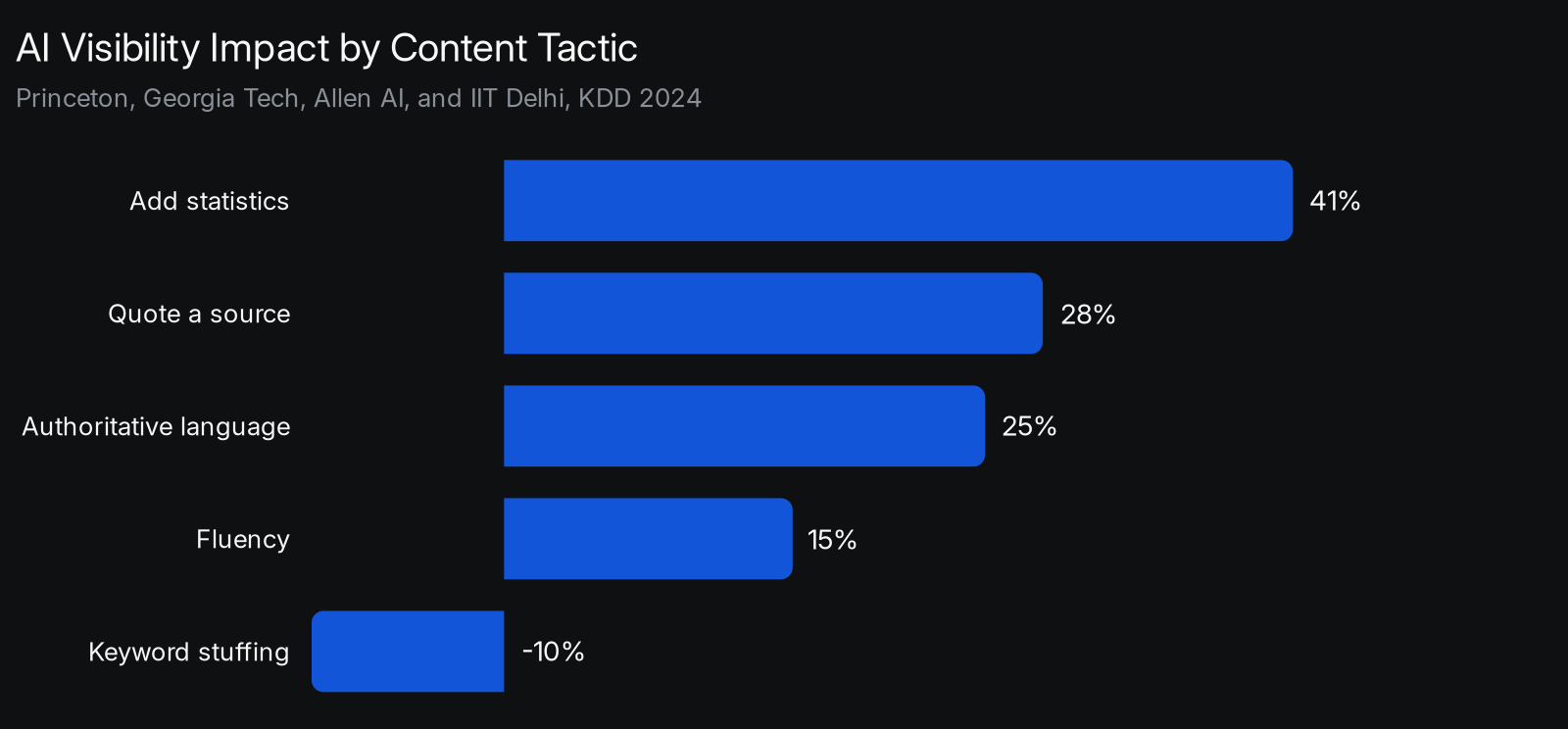
The reason video overtook discussion content is the reason structured pages overtake prose essays. Whatever an engine can read cleanly, it cites. This is also why a brand cannot win AI citations by adding schema alone and skipping the work of organizing the content a reader and a model both extract.
Community Platforms Hold Half of All Citations
Community platforms, the category that now includes video alongside discussion sites, supply 48% of AI citations (Airops and Kevin Indig, 2026). At the aggregate level community sources account for 52.5% of citations versus 47.5% for brand-owned domains (OtterlyAI, 2026), so the places a brand does not own are where most answers get built.
That split reframes the job. A content plan that optimizes only the owned blog is competing for slightly less than half of the citations an engine hands out. The other half goes to places a brand influences indirectly: a review site, an explainer video, a roundup, an industry forum. Video is the part of that majority growing fastest, which is why a plan blind to it leaks coverage every month.
Owned Pages Still Earn Most B2B Citations
A video-only pivot misreads the data, because Google AI Overviews sends 59.8% of its citations to brand-owned domains and ChatGPT sends 44.7% (OtterlyAI, 2026). Owned pages remain the largest single source an engine cites, so the move is to add video to a structured-content plan, not to trade one source for another.
The honest read of the numbers is that no single source dominates. Owned domains lead by a nose on the engines B2B buyers use most, community and video are climbing, and news sites take a fifth of the total. The table below shows where each engine leans.
| Engine | Citations to brand-owned domains | Leans most on | Source |
|---|---|---|---|
| Google AI Overviews | 59.8% | Brand-owned domains | OtterlyAI, 2026 |
| ChatGPT | 44.7% | Brand-owned domains | OtterlyAI, 2026 |
| Perplexity | 16.9% to community forums | Community forums | OtterlyAI, 2026 |
| All engines combined | 47.5% | Community platforms at 52.5% | OtterlyAI, 2026 |
The takeaway is not to abandon the blog. It is that the blog is one source among several, and the brands holding citation share treat owned pages, earned mentions, and video as a single coverage map rather than four separate projects.
How GEO Tools Compare on Source Coverage
Every tool in this category addresses AI citation by tracking where answers come from, but they cluster around one split: most report which sources win, while only one builds the content that wins them. The columns below compare how each platform handles owned and non-owned sources, how many engines it watches, and what the team actually receives at the end.
| Platform | What it does about sources | Engines tracked | What the team ships |
|---|---|---|---|
| Res AI | Generates and deploys structured pages, FAQs, and comparison tables into your CMS | ChatGPT, Perplexity, Claude, Gemini | Published pages, not briefs or dashboards |
| Profound | Tracks which sources power each answer across 10+ engines | ChatGPT, Perplexity, Claude, Gemini, Copilot, Grok, and more | Dashboards and automated agents |
| Conductor | Tracks AI and search visibility, generates enterprise content | ChatGPT, Gemini, Copilot, Claude, search | Unified AEO and SEO reporting |
| Peec AI | Shows which parts of content triggered a citation, monitoring only | Multiple major LLMs | Visibility, position, and sentiment analytics |
| Athena | Citation source analysis across 8+ LLMs | 8+ LLMs including ChatGPT, Perplexity, Gemini, Claude | Optimization recommendations |
| AirOps | Creates and refreshes content with 30+ AI models | Multiple AI models | On-brand content at scale, months to value |
The pattern across the row is consistent. Monitoring tools tell a team that video is now a top source and that a competitor owns the citation; an execution tool turns that finding into a published page before the next citation refresh. The difference matters most on a source that moves as fast as video.
A Video Without a Transcript Cannot Be Cited
The citable part of a video is its text, and 18.2% of AI Overview citations that come from pages outside Google’s top 100 are YouTube URLs, pulled through transcripts and on-page copy rather than the video stream itself (Ahrefs with BrightEdge, 2026). An engine cannot quote a frame, so a video earns citations only when it ships with the text a model can read.
A brand that posts a video and stops has published nothing an engine can extract. The work is in the supporting text, and three pieces carry it:
- Full transcript. The complete spoken text, lightly cleaned, so the model has every claim and definition in sequence.
- Chaptered description. Timestamps with labeled sections, which mirror the heading structure a cited page uses.
- A companion page. The same explainer written as an answer-first article with tables and an FAQ, so the lesson exists in both formats an engine indexes.
Treated this way, a single explainer becomes a written page plus a transcript plus a description, three extractable assets from one production. Skip the text and the video is a brand asset that the engines never see.
Buyers Start in AI So Coverage Compounds
51% of B2B software buyers now begin research in an AI chatbot more often than in a traditional search engine, up from 29% a year earlier (G2, 2026). Each source an engine can cite is one more place a buyer meets the brand during that first AI-mediated pass, so coverage across owned pages, earned mentions, and video compounds into discovery.
The compounding is the point. A buyer who asks an engine to compare three vendors may get an answer drawn from a comparison page, a review aggregator, and an explainer video in a single response. A brand present in one of those three appears once; a brand present in all three frames the entire answer. Missing the video source does not cost one citation, it costs presence in the answers where the other two sources alone would not have named the brand.
Citations Decay So Every Source Needs Upkeep
Citation drift runs 40% to 60% month over month, meaning a large share of the domains an engine cites this month vanish from the same prompts next month (Profound, 2026). Whichever sources a brand builds on, the citation holds only while the content stays current, which turns maintenance into the difference between a one-time mention and a durable one.
Video does not exempt a brand from this. A transcript ages the same way a comparison page does, and the answer-first companion content needs the same refresh cadence. The numbers below set the clock a content program is racing.
| Citation metric | Figure | Source |
|---|---|---|
| Median days to first citation for a new page | 6.81 days | Profound, 2026 |
| Monthly citation drift | 40% to 60% | Profound, 2026 |
| Six-month citation drift | 70% to 90% | Profound, 2026 |
| Pages not refreshed quarterly | 3x more likely to lose citations | Airops and Kevin Indig, 2026 |
A new asset can earn its first citation inside a week, then lose it inside a quarter if nothing touches it. This is the gap that monitoring-first platforms miss: an alert about a lost citation is useful only if the fix ships before the next refresh closes the window.
Off-Domain Mentions Decide Most of Your Visibility
85% of brand mentions originate on third-party pages rather than a brand’s own domain (Airops and Kevin Indig, 2026). Video sits inside that off-domain majority, so a program that optimizes only the owned blog is competing for a minority of the places an engine looks.
The practical question is where to spend the next hour of content work, and the answer depends on the goal. The decision table below maps a common objective to the source worth building and the reason it pays.
| Your goal | Source to build | Why it pays |
|---|---|---|
| Own a vendor comparison query | Structured comparison pages on your domain | Owned domains take 44.7% to 59.8% of citations (OtterlyAI, 2026) |
| Appear in how-to and explainer answers | Explainer video plus a full transcript | YouTube is 18.2% of long-tail AIO citations (Ahrefs with BrightEdge, 2026) |
| Defend brand mentions you do not control | Earned third-party and review-site content | 85% of mentions are off-domain (Airops and Kevin Indig, 2026) |
| Hold a citation you already earned | A quarterly refresh on every cited asset | Stale pages lose citations 3x faster (Airops and Kevin Indig, 2026) |
No single row wins on its own. The brands holding citation share run all four at once, which is only feasible when producing and updating content is fast rather than a quarterly agency cycle.
Engine Choice Changes Which Sources Win
Only 11% of cited domains appear in both ChatGPT and Perplexity for the same prompts (Averi, 2026), so the right source depends on the engine a brand’s buyers actually use. Perplexity draws 16.9% of its citations from community forums while AI Overviews leans on brand-owned domains, which means the same content plan performs differently from one engine to the next.
A team that optimizes for one engine and assumes the rest follow is guessing. The brands that measure first find that their buyers cluster on one or two engines, then weight the source map accordingly: more owned comparison content where AI Overviews and ChatGPT dominate, more community and video presence where the buyers run Perplexity. The map is the same four sources, but the weighting is set by data, not by reflex.
Frequently Asked Questions
Why do AI engines cite video more than discussion content now?
Engines have grown better at parsing transcripts, and a structured explainer transcript is cleaner to extract than a thread of competing opinions. Video reached 16% of LLM answers over six months against 10% for the discussion platform it passed (Bluefish via Adweek, 2026).
Does a brand have to publish video to win AI citations?
No, because owned pages still take 44.7% to 59.8% of citations on the engines most B2B buyers use (OtterlyAI, 2026). Video is additive coverage on a fast-growing source, not a replacement for structured owned content.
How does an engine cite a video it cannot watch?
It reads the transcript, the description, and any companion text, then quotes from that text. A video posted without a transcript gives the model nothing to extract, which is why so much video earns zero citations.
Which matters more for B2B, owned pages or community sources?
Both, because owned domains are the largest single source while community and video together are the larger half at 52.5% of citations (OtterlyAI, 2026). The brands that win treat them as one coverage map rather than choosing one.
How often does video and page content need refreshing?
At least quarterly, since pages not updated on that cadence are 3x more likely to lose citations (Airops and Kevin Indig, 2026). A transcript ages on the same clock as a comparison page.
What makes a transcript citable rather than just present?
Sequence and labeling, the same properties that make a page citable. A transcript that states the answer first, defines terms, and runs in clear order extracts cleanly, while a raw auto-caption dump often does not.
How fast can a new asset earn its first AI citation?
The median is 6.81 days for a new page to reach its first ChatGPT or Claude citation (Profound, 2026). The same speed is available to a transcript and companion page if both ship structured.
Can video citations be measured?
Yes, through citation tracking that records which sources power an answer, the data most monitoring tools already report. The harder step is acting on it fast enough to matter against monthly drift.
How Res AI Structures Content to Win Citations Across Four Engines
Video pulled ahead because its transcript is machine-readable, and the owned pages a brand controls win citations on that exact property. Res AI generates and deploys structured content directly into your CMS, turning prose into the tables, comparison blocks, FAQs, and answer-first capsules that AI engines extract, then tracks how those pages perform across ChatGPT, Perplexity, Claude, and Gemini.
A brand will rarely out-produce a video library, but it can make every owned page as extractable as a clean transcript, and keep it current against the 40% to 60% monthly drift that erases stale citations. Res monitors the prompts buyers run, finds where a competitor holds the answer, and ships a structured page in days rather than the quarter an agency brief takes. That speed is what closes the gap between a lost citation and a re-earned one before the next refresh, on owned content and on the companion text that makes a video citable.
Res AI turns the pages you already own into the structured, machine-readable answers AI engines cite, the same property that put video ahead of every other social source. Ten free articles to start, no agency retainer required.