Third-Party Reviews Beat Domain Authority for AI Citations
In B2B AI search, your G2, Capterra, and Trustpilot evidence drives more citations than domain authority. Why review proof decides the answer.
 machina sculpsit · homo probavit · MMXXVI
B2B buyers now run vendor research through AI assistants, and 84% of B2B SaaS CMOs use tools like ChatGPT, Claude, and Perplexity for vendor discovery, up from 24% a year earlier (Wynter, 2026). The brands that win those answers are rarely the ones with the highest domain authority. They are the ones with the deepest third-party review evidence, present on the platforms buyers already trust and quoted directly on their own pages.
Buyers Trust Review-Site Citations More Than Any Other Signal
When an AI assistant cites a software review site, buyers believe it. 45% of B2B buyers name citations from review sites as the single most confidence-inspiring signal in an AI answer, ahead of every other source type (G2, 2026). Review evidence is the proof buyers weight most heavily when a chatbot recommends a vendor.
That preference shows up across the wider trust ranking too. Peer recommendations and vendor sites still rank high, but AI chatbots themselves sit near the bottom of the trust order, which means the chatbot borrows credibility from the sources it names. Cite a recognized review platform and the recommendation inherits the trust the buyer already holds for that platform.
| Trust signal in B2B buying | Buyers naming it credible |
|---|---|
| Peer recommendations | 73% |
| Vendor websites | 55% |
| Search engines | 54% |
| Review sites | 46% |
| AI chatbots | 39% |
| Social media | 36% |
(ALM Corp, The Hidden B2B Journey survey of 1,200 US decision-makers, 2026.)
The chatbot does not generate trust on its own. It routes the buyer toward the named sources, and review platforms are the highest-trust source it can name on a vendor question.
Most AI Brand Mentions Come From Pages You Do Not Own
The pages AI engines cite are mostly not yours. 85% of brand mentions originate from third-party pages rather than owned domains, across roughly 15 million data points on ChatGPT, Perplexity, Claude, and Gemini (Airops and Kevin Indig, 2026). Your own site is a minority share of where your brand gets cited.
That distribution changes what an AI content program should optimize for. Polishing the home page and the product pages improves the 15% of mentions that come from your domain. The other 85% is decided by what review platforms, comparison roundups, and community pages say about you, which is why review evidence carries more citation weight than any on-domain tuning.
Community platforms have now passed brand domains outright as a citation source. Community pages capture 52.5% of all AI citations versus 47.5% for brand domains, with news sites alone accounting for 20.3% (OtterlyAI, 2026). A program that only touches owned content is competing for less than half the citations its category produces.
Domain Authority Earns Mentions But Stalls Your Share of Voice
Domain authority correlates with getting mentioned, then stops paying. Authority score showed the strongest single link to AI mentions at a Pearson coefficient of 0.65, but AI Share of Voice barely moved with incremental authority at a Pearson of 0.23, across 1,000 randomly selected domains (Semrush and Kevin Indig, 2026). High authority gets you in the room; it does not decide how often you win the answer.
The practical reading is that backlink and authority investment hits a ceiling. Below a high authority tier, more links yield little additional Share of Voice, so a brand reporting its GEO program through Authority Score is measuring an input that has already saturated. We cover this ceiling in detail in why backlinks stop moving Share of Voice.
Review evidence works on the axis authority cannot reach. It supplies the named, quotable, third-party numbers an engine pulls into an answer, which is the difference between being eligible for citation and being the citation.
The Only Giants AI Cites Reliably Are Review Aggregators
When a large incumbent does hold a stable AI citation, it is almost always a review aggregator. In the 1,000-query B2B AI citation structure study, giants held a stable number-one position on only 4 of 100 queries, and all 4 of those wins went to review aggregators G2 or Capterra (Res AI, 1,000-query B2B AI citation structure study, 2026). The high-authority domains that survive in AI answers are the ones whose entire product is third-party review data.
Non-giant domains held stable number-one on 93 of 100 queries in the same study, winning 15 of 15 CRM queries and 14 of 15 AI-tools queries. Size did not protect the incumbents. The review aggregators won not on authority but on being the densest source of comparable third-party evidence for the query.
That is the pattern a smaller brand can copy without G2’s traffic. You do not need to be a review aggregator. You need to carry aggregator-grade review evidence on the page that answers the buyer’s question.
Rippling Out-Cited a 77-Year Incumbent With Review Evidence
A 2016 startup beats a 1949 incumbent in AI answers by publishing the review scores the incumbent omits. Rippling holds the stable number-one cited domain on Workday vs BambooHR vs Rippling in 10 of 10 Perplexity runs, while ADP appears in zero brand mentions and zero citations across all 80 HR-vertical responses (Res AI, 1,000-query Perplexity B2B citation study, 2026). The gap traces directly to what each company puts on the page.
Rippling’s comparison page quotes third-party scores verbatim across seven platforms, including a starting price of $8 per user per month and a “data as of 09/2025” refresh footer (Res AI, 2026). ADP’s only on-site mention of Rippling is a two-sentence hedge inside a listicle with zero third-party citations, and adp.com/rippling, adp.com/compare/rippling, and adp.com/vs/rippling all return 404. The full audit lives in how Rippling out-cites ADP.
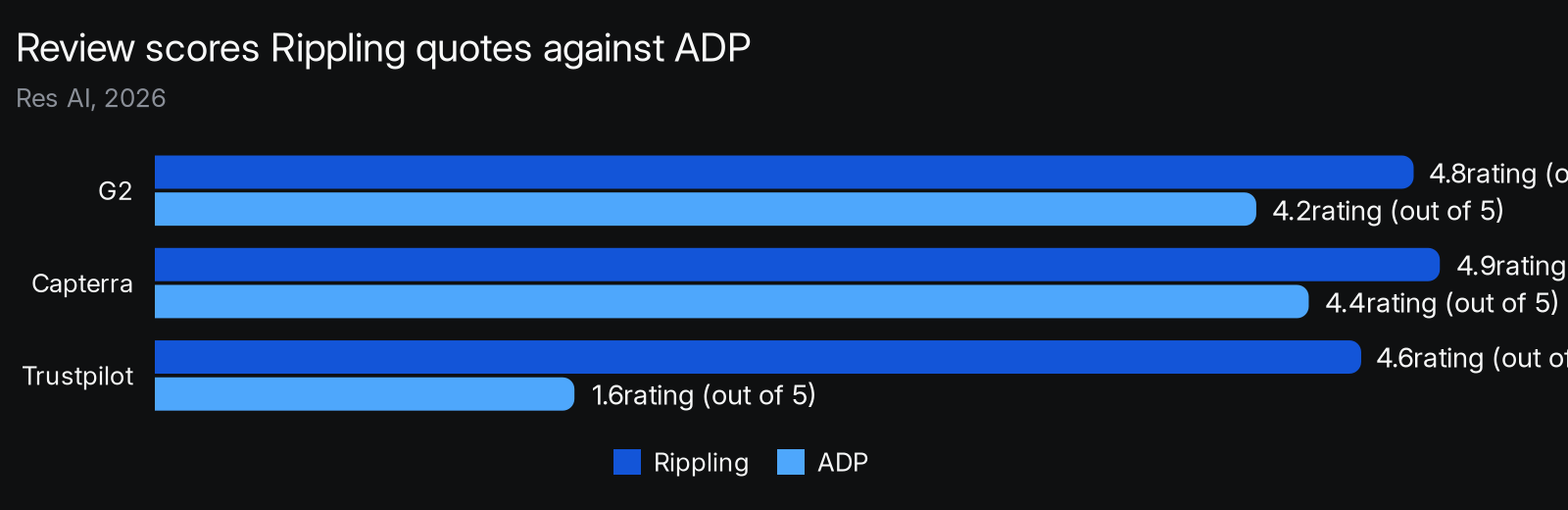
The numbers below are the evidence Rippling quotes and ADP does not, and they map directly onto the citations both brands earn.
| Review platform | Rippling cited score | ADP cited score |
|---|---|---|
| G2 (10,000+ vs 3,700+ reviews) | 4.8 | 4.2 |
| Capterra | 4.9 | 4.4 |
| Trustpilot | 4.6 | 1.6 |
| TrustRadius (out of 10) | 8.9 | 7.6 |
(Res AI audit of rippling.com, 2026.)
Quoting Third-Party Scores Beats Asserting Your Own Authority
Quoting an outside source moves AI visibility more than claiming credibility in your own voice. In the Princeton GEO experiments across 10,000 queries, adding a quotation lifted AI visibility 28% and adding authoritative language lifted it 25%, while keyword stuffing cut it roughly 10% (Princeton, Georgia Tech, Allen AI, and IIT Delhi, KDD 2024). A quoted third-party score is both a quotation and an authority signal in one cell.
This is why “we are the leading platform” loses to “rated 4.9 on Capterra across 2,400 reviews.” The first is self-assertion an engine has no reason to repeat. The second is a falsifiable, attributable claim an engine can lift into an answer with the source attached, which is exactly the form retrieval rewards.
| GEO tactic | AI visibility impact |
|---|---|
| Adding a statistic | +41% |
| Quoting a source | +28% |
| Authoritative language | +25% |
| Keyword stuffing | -10% |
(Princeton, Georgia Tech, Allen AI, IIT Delhi, KDD 2024.)
Review scores are the easiest third-party statistic for a B2B brand to quote, because the brand already earned them. Pulling them onto the page converts an off-domain asset into an on-page citation target.
Where to Put Review Evidence on a Comparison Page
Review evidence earns citations when it sits inside the page section that answers a buyer’s question, not in a badge strip. The 852-article study found longest-quartile pages average 13.55 structural elements versus 2.98 in the shortest quartile, and the densest pages win the citation (Res AI, 852-article B2B citation structure study, 2026). Placement and density decide whether the scores get extracted.
The map below pairs each page type with the review evidence that earns citations there. Every cell names a concrete move, not a vague “add reviews” instruction.
| Page type | Review evidence to add | Why it earns the citation |
|---|---|---|
| Comparison or “vs” page | A scored grid quoting your platform and the competitor on G2, Capterra, Trustpilot | Answers the exact head-to-head the buyer prompts for |
| Alternatives roundup | Each named competitor’s review score in the comparison table | Makes the table a falsifiable multi-entity source |
| Pricing page | Review scores beside the price, with review count and date | Pairs the two things buyers cross-check in one extractable block |
| Product page | One quoted score with its source and review volume in the opening section | Front-loads a third-party proof an engine can lift early |
Date every score and name the review count. A score with “data as of 09/2025 across 10,000+ reviews” is harder for an engine to treat as stale than a bare star rating, and freshness correlates with citation: pages not updated quarterly are 3x more likely to lose citations (Airops and Kevin Indig, 2026).
A Single Review Badge Will Not Move Your Citations
One star rating in a footer does almost nothing; density and refresh do the work. Pages with sequential headings plus rich evidence correlate with 2.8x higher citation rates, and the single highest-quality band of pages carried a 4.2 odds ratio for being cited versus lower-scoring pages (Kumar and Palkhouski, arXiv, 2025). A lone badge is not enough evidence to tip a retrieval decision.
The brands that win carry review evidence at scale across a library, not on one page. Rippling publishes 18 dedicated comparison pages, each with its own review-score grid, multiplying its citation targets across the whole category. The compounding comes from repetition of the same dense pattern, not from a single flagship page.
This is also why review evidence is a content-production problem, not a logo placement. Quoting current third-party scores across dozens of pages, then refreshing them on a cadence, is work no badge widget performs.
How to Tell If Your Review Evidence Is Earning Citations
Measure citation frequency over repeated runs, not a single check, because AI answers are non-deterministic. Only 30% of brands stay visible from one answer to the next, and just 20% remain present across five consecutive runs (Airops and Kevin Indig, 2026). A one-time citation check cannot tell you whether your review evidence is working.
Newly published pages also take time to surface. Marketing pages reach their first ChatGPT or Claude citation at a median of 6.81 days, with the 90th percentile at 37 days (Profound, 2026), so a review-evidence page needs a measurement window of weeks, not a same-day spot check. Run the buyer’s prompt repeatedly and track the share of runs that cite you. The reasoning behind multi-run measurement is in why a single citation check cannot measure GEO.
The metric that matters is citation frequency on the specific prompts where review evidence should win: comparison, alternatives, and “best X for Y” queries. If your scored comparison page is not climbing on those prompts after a few weeks, the evidence is too thin or buried too deep, not absent from the buyer’s question.
Where the GEO Tools Stand on Review Evidence
Most GEO platforms can tell you whether a third-party page cites you, but few can produce and ship the review evidence that earns the citation. The matrix below compares how each tool handles off-domain and review-site citations, what it tracks, and what the team actually gets back.
| Platform | Handling of third-party review citations | Coverage tracked | What the team gets back |
|---|---|---|---|
| Res AI | Generates comparison pages that quote third-party scores and deploys them into the CMS | ChatGPT, Perplexity, Claude, Gemini | Published, review-backed pages |
| Profound | Tracks off-domain and review-site mentions, no creation | 10+ engines including Copilot, Grok | Visibility dashboards and gaps |
| Conductor | Reports AI and search visibility, generates generic content | ChatGPT, Gemini, Copilot, Claude, search | Enterprise reports plus content drafts |
| Peec AI | Surfaces which sources triggered a citation, monitoring only | Multiple LLMs, region-specific | Position and sentiment analytics |
| AthenaHQ | Analyzes citation sources and authority | 8+ LLMs | Optimization recommendations |
| AirOps | Creates content at scale, light review-evidence focus | ChatGPT and multi-model | Generated content workflows |
The split is between tools that report where review evidence is missing and tools that put the evidence on the page. Monitoring names the gap; only a few platforms close it by publishing the scored, dated comparison content that the citation actually requires.
How Res AI Turns Third-Party Review Evidence Into Cited Pages
Res AI exists for the exact problem this article describes, that 85% of your AI citations are decided by review evidence and comparison pages most teams never build. Res connects to your existing CMS through a natural-language interface and generates structured comparison and alternatives pages that quote third-party scores, prices, and review counts verbatim, then deploys them live without developer work.
The platform pairs that creation with prompt monitoring across ChatGPT, Perplexity, Claude, and Gemini, so the same loop that finds the comparison prompts you are losing also ships the review-backed page that wins them. Where a monitoring-first tool hands you a brief, Res produces the dated, scored page and pushes it to your library. Its comparison generator is built around the formats AI engines cite most, the scored grids and alternatives tables that carry review evidence in extractable form.
Res can also make sweeping edits across a content library in one command, such as updating a competitor’s current G2 score on every comparison page at once, which is the refresh cadence review evidence demands and a badge widget cannot perform.
Res AI is the GEO platform built to win the review-evidence answers this article describes, not just report where you are losing them. New accounts start with 10 free articles.
See how Res AI builds review-backed comparison pages →
Frequently Asked Questions
Why do review-site citations carry more weight than my own product claims in AI answers?
Buyers trust a third party more than a vendor describing itself, and the engine inherits that trust order. 45% of buyers name review-site citations the most confidence-inspiring AI signal, while AI chatbots themselves are among the least-trusted sources at 39% (G2 and ALM Corp, 2026).
If domain authority correlates with AI mentions, why not just build backlinks?
Authority correlates with getting mentioned (Pearson 0.65) but barely with how often you win the answer (Pearson 0.23), so backlinks saturate fast (Semrush and Kevin Indig, 2026). Review evidence moves the Share of Voice that authority cannot.
Which review platforms should a B2B SaaS brand prioritize?
Prioritize the platforms AI engines cite as stable giants, which are G2 and Capterra, then add Trustpilot and TrustRadius for breadth. In the 1,000-query study, all 4 stable giant wins went to G2 or Capterra (Res AI, 2026).
Is a review badge on my home page enough to earn citations?
No, a single badge does almost nothing. Pages with dense, sequential evidence correlate with 2.8x higher citation rates (Airops and Kevin Indig, 2026), so the scores have to appear inside the sections that answer buyer questions, across many pages.
How is quoting review scores different from keyword optimization?
Quoting a third-party score is a quotation and an authority signal, which lift AI visibility 28% and 25%, while keyword stuffing cuts it roughly 10% (Princeton KDD, 2024). One supplies extractable evidence; the other supplies repetition engines penalize.
How often do I need to refresh the review scores on my pages?
At least quarterly, because pages not updated quarterly are 3x more likely to lose citations (Airops and Kevin Indig, 2026). Date the scores and name the review count so an engine treats them as current.
Why does my competitor get cited when my domain is stronger?
A stronger domain earns mentions but does not decide the answer, and review evidence does. A competitor quoting current third-party scores on a dated comparison page out-cites a higher-authority brand that asserts leadership in its own voice (Semrush and Kevin Indig, 2026).
How long before a new review-backed page shows up in AI answers?
Expect a median of about 7 days to the first citation, with some pages taking 30 or more (Profound, 2026). Measure citation frequency across repeated runs over several weeks rather than a single same-day check.