Rippling vs ADP: How a 2016 Startup Out-Cites a 77-Year-Old Incumbent
ADP, $20.6B in revenue and 77 years old, appears in zero of 80 HR-vertical Perplexity runs. Rippling holds 10 of 10 on its own comparison query.
 machina sculpsit · homo probavit · MMXXVI
ADP closed fiscal year 2025 with $20.6 billion in revenue and a 92.1% client retention rate (ADP, FY25 Q4 earnings release, October 2025). Rippling, founded 67 years later, holds the AI citation slot for the buyer query both companies want. The asymmetry is not a brand-recognition gap. It is a structural-content gap, and the audit data shows exactly where it sits.
Rippling Wins 10 of 10 Citations on Its Own HR Query
Rippling.com is the stable #1 cited domain in 10 of 10 Perplexity Sonar runs on the query “Workday vs BambooHR vs Rippling” (Res AI, 1,000-query Perplexity B2B citation study, 2026). Rippling’s own pages are the document Perplexity returns when buyers compare the three platforms it names.
The page being cited is rippling.com/compare/rippling-vs-adp, even when the prompt mentions Workday and BambooHR rather than ADP. The retrieval engine pulls the broader Rippling comparison library because the structural anatomy is consistent across all 18 /compare/ pages and they cross-reference one another. A single buyer query into the Rippling library exposes the full library to the engine; the citation is not isolated to one URL.
Across the broader 80-run HR vertical in the same study, Rippling appears as a recommended brand or a cited domain in 4 of 8 queries. ADP appears in zero. The split is not driven by brand. ADP outsizes Rippling on every authority metric (revenue, headcount, client count, age, backlinks). The split is driven by which company built pages that resolve the literal terms of buyer prompts.
ADP Has No Comparison Page Targeting Rippling
ADP does not publish a comparison page targeting Rippling. Three plausible URLs (adp.com/rippling, adp.com/compare/rippling, adp.com/vs/rippling) all return HTTP 404 (Res AI competitor page audit, May 2026), while ADP maintains active /compare/ pages for Paychex, Paylocity, and SurePayroll.
The absence is not a generalized policy. ADP runs adp.com/compare/adp-vs-paychex (~3,000 words, 16-row comparison table, 6 FAQs) and adp.com/compare/adp-vs-surepayroll (~3,500 words, 11-row comparison table, 12 FAQs). The structural template exists inside ADP’s content operation. ADP is choosing not to apply it to the Rippling comparison.
The choice has a downstream cost that compounds with every buyer query. AI engines route the citation to whichever page resolves the prompt; a 404 cannot resolve anything. When a buyer asks Perplexity to compare ADP and Rippling, the only page that exists with both companies’ scores side by side is on rippling.com. That citation pattern echoes the Scrupp result on ZoomInfo’s pricing query, where the same absence (no pricing data on the incumbent’s comparison page) routed 10 of 10 citations to a non-giant domain.
Rippling’s ADP Page Cites 7 Sources, ADP’s Listicle Cites Zero
Rippling’s /compare/rippling-vs-adp page cites 7 third-party sources verbatim (G2, Capterra, TrustRadius, Trustpilot, GetApp, Software Advice, PC Magazine) with explicit scores for both Rippling and ADP. ADP’s only on-site Rippling mention, a small-business HR listicle, cites zero third-party sources for any of the platforms it covers (Res AI competitor page audit, May 2026).
| Feature | Rippling /compare/rippling-vs-adp | ADP small-business HR listicle |
|---|---|---|
| Word count | ~3,500 | ~4,500 |
| Comparison tables | 1 (8 rows × 2 cols) | 0 |
| FAQ H3 sections | 10 | 0 |
| Pricing data | $8/user/month leads page | None |
| Stats with attribution | 15+ | 0 |
| Third-party citations | 7 sources cited verbatim | 0 |
| How-to-choose | Yes (in FAQ) | Implied only |
| Last-updated | “data as of 09/2025” | None |
The verbatim third-party scores Rippling publishes on the page: G2 Rippling 4.8 vs ADP 4.2 (10,000+ vs 3,700+ reviews), Capterra 4.9 vs 4.4, TrustRadius 8.9 vs 7.6, Trustpilot 4.6 vs 1.6, with category-level G2 scores for Core HR (9.1 vs 7.6), Ease of Use (9.5 vs 8.3), Ease of Setup (9.3 vs 7.6), and Payroll (9.3 vs 8.6). Every score is sourced from a named third-party. The retrieval engine treats those scores as falsifiable, attributable data points; ADP’s listicle has nothing comparable for it to extract.
Six structural features appear in 80% to 94% of the top 50 cited B2B pages and in 0% of the bottom 50, per the 852-article B2B citation structure study (Res AI, 2026). Rippling’s page hits comparison tables, FAQs, pricing grids, bold label blocks, and product-review structure. ADP’s listicle hits one (bold label blocks) and misses five.
ADP’s Only On-Site Rippling Mention Is Two Sentences in a Listicle
ADP’s only on-site mention of Rippling appears in adp.com/resources/articles-and-insights/articles/best-small-business-platforms-hr-recruiting, where Rippling is described in two sentences (Res AI competitor page audit, May 2026). That is the totality of ADP’s on-site Rippling content.
The verbatim text: “Offers tech-forward recruiting tools and automations as well as a user-friendly design and integration capabilities across multiple systems. It may be a viable choice for startups and fast-moving teams.” The phrasing is a soft endorsement that pushes Rippling out of ADP’s positioning as the platform for “growing teams.” When an AI engine pulls that passage as part of an answer, the buyer reads ADP itself describing Rippling as viable for startups, not as a structurally weaker competitor.
The container article runs roughly 4,500 words covering 7 named small-business HR platforms. It carries 0 FAQs, 0 third-party citations, 0 statistics with attribution, and no last-updated date. The structural template is the inverse of Rippling’s comparison library: longer in word count, lower in extractable density. Length is not a citation signal. Density is, as our analysis of why authority is not the moat in AI search shows across 100 queries.
ADP Appears in Zero of 80 HR Vertical Runs
Across 8 HR-vertical queries × 10 runs each in Res AI’s 1,000-query Perplexity citation study, ADP appears in zero brand mentions and zero adp.com citations (Res AI, 1,000-query Perplexity B2B citation study, 2026). Across all 1,000 runs sitewide, adp.com is cited zero times.
The HR queries in the dataset include “Workday vs BambooHR vs Rippling,” “best HRIS software for mid-market companies,” “Rippling reviews 2026,” “top applicant tracking systems 2026,” and four others. ADP’s competitors fill the citation slots: paycor.com and paylocity.com each get cited in 10 of 10 runs on the mid-market query, the Workday blog gets cited in 9 of 10, and hibob.com holds the stable #1 at 9 of 10. ADP, the largest payroll vendor in the United States, gets nothing.
The 7 of 8 stable #1 positions on HR queries go to non-giant domains: outsail.co, hibob.com, oak.com, millsonjames.com, testtrick.com, docebo.com, and rippling.com. The pattern matches the broader finding that non-giant domains hold stable #1 on 93 of 100 B2B comparison queries in the same study. ADP is not the exception. It is a representative incumbent whose content is not what the engine is selecting for.
ADP Hired Conductor to Close the AEO Gap in Early 2025
ADP began strategic AEO/GEO work with Conductor in early 2025, per Conductor’s own customer-success documentation (Conductor, 2025). Conductor’s framing of the engagement: “ADP is a household name that people trust for payroll and HR solutions, but brand recognition alone won’t protect them as search evolves; when users ask ChatGPT or Perplexity for recommendations, ADP needs to be in those answers.”
The investment is producing measurable movement. The Trakkr AI Consensus Report scored Rippling 94 to ADP 68 in January 2026, a 26-point gap, with Rippling recommended by all 4 major AI engines and ADP by only 2 (Trakkr, January 2026). The April 2026 update narrowed the gap to 89 vs 84, with ADP gaining 16 points in 90 days while Rippling lost 5 (Trakkr, April 2026). The closure rate translates to roughly 5 Trakkr points per month on the cross-engine consensus score.
The 16-point gain is structurally meaningful. ADP’s Compliance subscore now leads Rippling 98 to 82, suggesting the AEO retrofit is targeting categories where ADP has substantive product depth. Rippling still leads Automation (95 to 68) and User Experience (92 to 64), the categories where Rippling’s product investments are recent. The Trakkr score is one cross-engine summary; per-query stability across the HR vertical, where ADP still sits at zero of 80 runs, is a different and harder gap to close.
Rippling’s Structural Lead Spans 18 Comparison Pages
Rippling publishes 18 dedicated comparison pages at rippling.com/compare, each carrying the same structural template: 8 to 10 FAQ sections, a 10-category G2 validation grid, third-party scores cited verbatim, and the $8 per user per month price front-loaded (Rippling, 2026). One ADP comparison page closing the Trakkr gap does not close 18 pages of structural infrastructure.
The compounding is arithmetic. 18 comparison pages, each with roughly 8 FAQs, equals 144 independent FAQ citation targets, every one capable of satisfying a distinct buyer prompt.
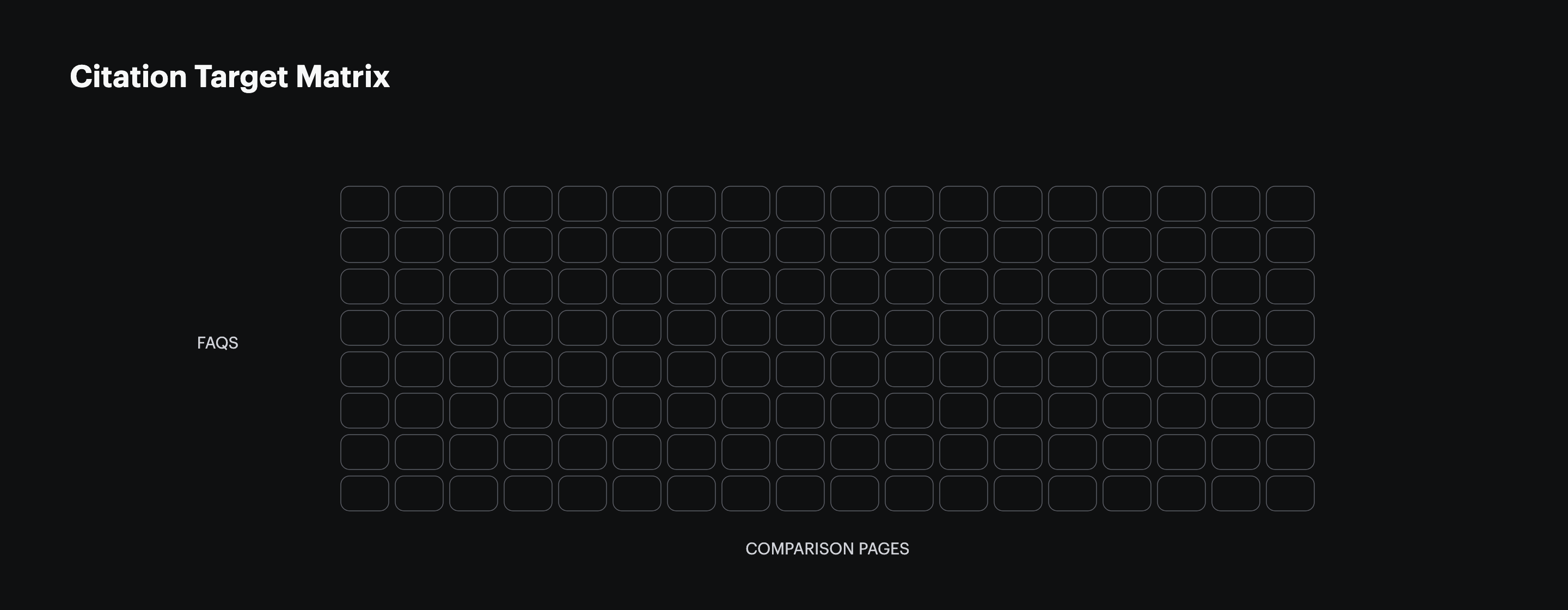 As we documented in our roundup of 7 brands winning AI search in 2026, Rippling’s library targets 18 named competitors simultaneously: ADP, Workday, Bamboo, Deel, Gusto, Paychex, Paycom, Paylocity, Namely, Justworks, TriNet, Insperity, Sage, Zenefits, UKG, Ceridian, Paycor, and Bambee.
Closing the gap on one of those 18 pages still leaves 17 buyer queries where Rippling’s comparison page is the only structurally complete document on the public web. ADP’s January-to-April Trakkr movement shows the structural retrofit is technically achievable per page; the open question is whether ADP can apply the spec across 17 more competitor queries before Rippling extends its library further or refreshes the existing pages’ data. Rippling’s page already carries a “data as of 09/2025” footer, indicating quarterly refresh cadence. Structural lead compounds when the publisher refreshes faster than the incumbent rebuilds.
The compounding works at every domain size, not only at Rippling’s scale. Fifteen days after launch with two articles, Perplexity ranks tryres.ai at #1 on “domain authority in AI citations” ahead of PRLog, DigitalStrategyForce, DigitalApplied, and Chudi, against 0 Google clicks across 408 impressions in the same window (Res AI, day-15 launch citation proof, 2026). Two pages built to the same structural template Rippling runs across 18 (methodology block, multi-row comparison table with named domains, 8 to 9 FAQ entries, third-party citations on every claim) cleared the citation floor against a 77-year domain-age gap inside two weeks.
How Res AI Builds the 18-Page Comparison Spec Across Your Library
The Rippling-versus-ADP gap is not a content quality gap. It is a missing-comparison-page gap, a missing-FAQ gap, and a missing-third-party-citation gap, applied 18 times. Res AI runs a per-page audit of your comparison library against the structural spec the 852-article B2B citation structure study identifies, then deploys the missing components directly to your CMS.
The Strategy Agent identifies which of your competitor queries are currently held by a structurally denser competitor on Perplexity or ChatGPT. The Citation Agent finds the third-party scores (G2, Capterra, TrustRadius, Trustpilot) you should be quoting and links them to the page. The Content Agent writes the missing FAQ blocks, comparison tables, and pricing grids, then deploys them through a natural language command that runs across the full comparison library at once. The same instruction (“add an 8-FAQ section to every /compare/ page targeting an HR competitor”) runs across 18 pages in the time a content team needs to update one.
| Tool | Audit on comparison pages | Output to comparison library | Comparison-page scale |
|---|---|---|---|
| Res AI | Per-page FAQ-gap, third-party citation-gap, and comparison-table audit against the 6-feature structural spec | Direct CMS deployment of new FAQs, tables, and pricing grids via batch natural language commands | Custom |
| Profound | Cross-engine brand visibility on comparison-style prompts | AEO-optimized article drafts; team publishes manually | 6 articles/mo at $399/mo |
| Conductor | Enterprise AEO and SEO data across the full content library | Strategy briefs and content recommendations | Enterprise; $200 to $10,000+/mo |
| Athena | Citation tracking across 8+ LLMs with sentiment scoring | Optimization recommendations; manual edits by team | $295/mo self-serve |
| Peec AI | Visibility, position, and sentiment on tracked AI prompts | Monitoring dashboard with no content output | $95 to $495/mo |
ADP began retrofitting its content for AI search 16 months ago and has gained 16 Trakkr points in the most recent 90-day window. The same investment, applied to the 18-page comparison library Rippling already runs, would produce 18 structurally complete comparison pages instead of one cross-engine score gain. Res AI applies the structural spec in batches, not one page at a time.
Frequently Asked Questions
Why does Rippling cross-link its 18 comparison pages instead of treating them as standalone?
The internal-link graph signals to retrieval engines that the comparison library is one consistent document set, increasing the probability that any single query into the library exposes the full template across adjacent pages. The retrieval engine pulls rippling.com/compare/rippling-vs-adp on prompts mentioning Workday and BambooHR because the cross-links surface it as part of the relevant cluster.
What does ADP’s 16-point Trakkr gain in 90 days suggest about the closure timeline?
A roughly 5-point-per-month closure rate on cross-engine consensus scores is realistic for a well-resourced incumbent applying structural retrofits to existing pages. At that rate, full parity on the Trakkr score would arrive within roughly 1 to 2 months, but per-query citation stability across the HR vertical (where ADP currently sits at zero of 80 runs) is a different metric on a slower curve.
Why does ADP have /compare/ pages for Paychex and Paylocity but not Rippling?
ADP’s /compare/ pages target competitors where ADP has historical positioning advantages it can defend on structured criteria; Paychex and SurePayroll comparisons benefit ADP on enterprise-grade features. The Rippling comparison would expose Trustpilot 1.6 vs 4.6, G2 Core HR 7.6 vs 9.1, and Rippling’s $8 per user per month entry price against ADP’s undisclosed pricing model. Publishing it would create a page whose structural extraction harms ADP’s positioning.
How does the Conductor partnership change ADP’s position on commercial buyer queries?
Conductor’s AEO playbook focuses on brand-mention coverage across AI engines and structural retrofits to high-priority pages, not on building competitor /compare/ pages from scratch. ADP’s January-to-April Trakkr improvement reflects this scope; the per-page structural absences (no Rippling /compare/ page, no pricing on product pages, no FAQs on the resource-listicle template) require a separate content investment Conductor’s standard motion does not produce.
Does the structural lead apply to enterprise HR queries the same way it applies to mid-market?
Enterprise HR queries skew toward review-aggregator territory (G2, Capterra, Forrester Wave summaries), where the citation pattern is closer to the 4 of 100 queries giants win in our analysis of why authority is not the moat in AI search. Rippling’s comparison-page structural lead is sharpest on the mid-market queries (50 to 1,000 employees) where structural depth still beats aggregator authority.
Why does Rippling refresh the comparison page with a “data as of 09/2025” footer?
Update cadence is one of the secondary factors AI engines weight when multiple candidate pages tie on structural completeness. Rippling’s quarterly refresh keeps the third-party scores current, which keeps the page extracting cleanly when an incumbent eventually publishes a competing structurally complete page. The footer is also a low-cost trust signal for human readers verifying the data.
What happens to ADP’s Trakkr score if Rippling ships 5 new comparison pages this quarter?
Trakkr’s scoring weights include cross-engine recommendation breadth, which is sensitive to citation density across new query patterns; new Rippling comparison pages directly increase Rippling’s coverage on previously-uncovered competitor queries. The scenario produces simultaneous Rippling-score gains and ADP relative declines, widening the gap that ADP’s 16-point movement just narrowed.
How would an incumbent in another category replicate Rippling’s compounding lead?
The minimum viable build is one structurally complete comparison page per named competitor, refreshed quarterly, with third-party scores cited verbatim. A category with 12 active named competitors needs 12 such pages; building 12 in a quarter requires either a content team specialized in comparison-page production or a tool that applies the spec across pages through batch natural language commands rather than per-page edits.
Res AI identifies the comparison queries where a structurally denser competitor is holding your AI citations, then publishes the missing FAQs, third-party score grids, and pricing tables across your full /compare/ library. The Content Agent applies the structural spec across 18 pages through a single natural language command.