How SaaS Brands Get Cited in AI Overviews
AI Overview optimization for SaaS. Six structural patterns, citation playbooks from Tally and Vercel, and a 30-day SaaS page audit checklist.
 machina sculpsit · homo probavit · MMXXVI
B2B SaaS marketing teams built SEO programs for a Google that no longer exists in the same shape. 84% of B2B SaaS CMOs now use LLMs for vendor discovery, up from 24% the prior year (Wynter, 2026), and Google AI Overviews intercept the SaaS-buying queries those CMOs and their teams still type into the SERP. The 9-step procedure below is what a single marketer executes on existing pages to get cited inside the AI Overview, not buried below it.
Audit the Top 50 Organic Queries for AIO Presence
The position-1 organic result loses 58% of its click-through rate when an AI Overview is present, in a study of 300,000 keywords using aggregated Google Search Console data (Ahrefs, 2025). The audit gates everything that follows: there is no point optimizing pages for queries that do not trigger an AIO. Pull the last 30 days of GSC queries sorted by impressions descending, take the top 50, and run an SERP check (manual incognito SERP screenshots, or via the DataForSEO /serp/google/organic/live/advanced endpoint) recording five fields per query.
The output is a spreadsheet. The next four steps reference it as the work queue. A query with no AIO present today is excluded from the procedure entirely.
| Column | Type | Source |
|---|---|---|
| query | string | GSC export |
| impressions | integer | GSC export |
| aio_present | yes / no | SERP probe |
| your_url_cited | yes / no | SERP probe AIO citation list |
| citation_position | integer or null | SERP probe AIO citation list |
Score Each Query by Impression-Weighted Citation Gap
The targets are queries where the page ranks well organically but earns zero AIO citation. Score every row in the spreadsheet against the formula below, sort descending, and take the top three for the week. Three pages per week is the right cadence for a single marketer; the cost of restructuring a page is roughly fixed, so the return scales with impression volume.
| Score input | Weight | Why |
|---|---|---|
| monthly impressions | 1.0 | The size of the prize |
| AIO present and not cited | 2.0× multiplier | Pure citation gap |
| organic position 1 to 5 | 1.5× multiplier | Already retrievable, structurally weak |
| organic position 11 to 30 | 0.5× multiplier | Larger structural lift required |
| branded query | 0× multiplier | Citation already implicit in retrieval |
Low-impression "easy wins" return the same fixed structural cost against a fraction of the upside. The score-and-prioritize step is the difference between a quarterly audit that ships nothing and a weekly cadence that compounds.
Add JSON-LD Schema Matched to Page Content Type
JSON-LD is structured data Google extracts directly from the page <head>. It tells the AIO retrieval pipeline what kind of content this is, whether a product, an FAQ, a how-to, or an article, without requiring the engine to parse prose. Match the schema type to the page's content shape, paste the block into <head>, and validate with Google's Rich Results Test before deploy. A page with broken JSON-LD performs worse than no JSON-LD because crawlers index the failed markup as a quality signal.
| Page type | Schema.org type | Required properties |
|---|---|---|
| Landing or pricing page | Product | name, description, offers, aggregateRating, review |
| Support article or KB entry | FAQPage | mainEntity (array of Question + Answer pairs) |
| Tutorial or step-by-step procedure | HowTo | name, step (array), totalTime |
| Editorial blog post | BlogPosting | headline, datePublished, author, image |
| Product detail page | SoftwareApplication | name, applicationCategory, operatingSystem, offers |
Skip optional properties until validation passes green. A minimal FAQPage block with one Question/Answer pair clears the validator faster than a maximal block with eight unsourced properties.
Front-Load the Anchor Stat Into the First 30%
55% of citations on AI-cited pages come from the first 30% of content (CXL, 2024). The opening third of a SaaS page carries more than half the citation weight before the engine ever reads the rest, which means the strongest stat must appear in the first two sentences with inline source attribution.
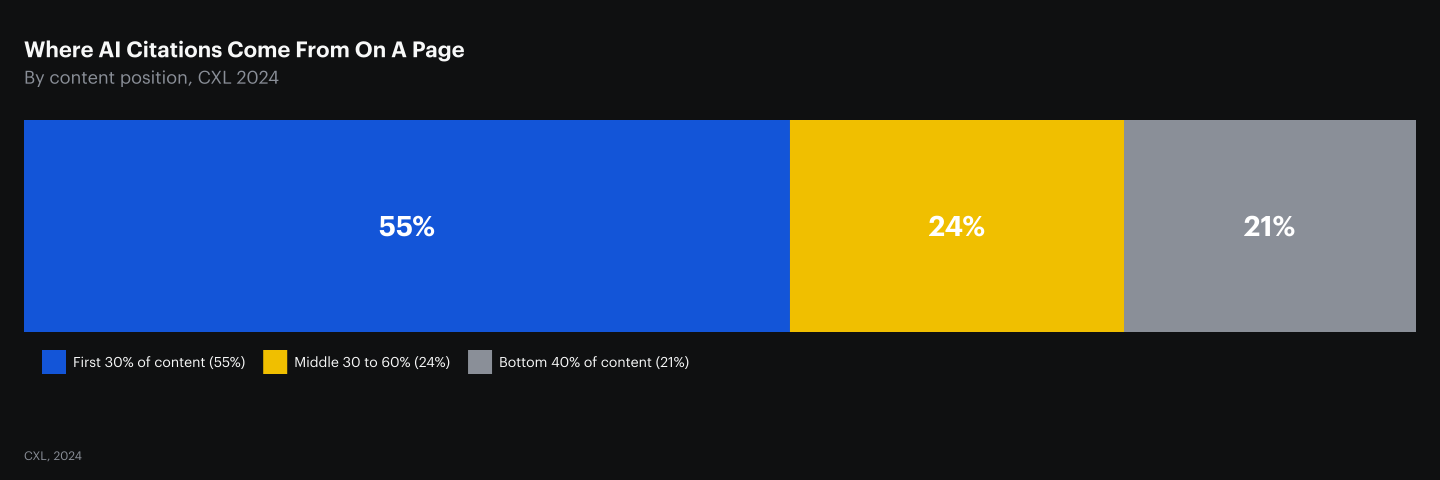
The pattern: claim, stat with attribution, implication. "B2B SaaS buyers complete 81% of the journey before contacting sales (6Sense, 2025), which means top-of-funnel content is the deal." Three sentences max for the lede. The H1 stays unchanged; only the opening prose moves.
Convert Lists to Bold-Label Blocks
94% of top-cited B2B pages contain bold-labeled product blocks against 0% of bottom-cited pages, in the Res AI 852-article B2B citation structure study (Res AI, 852-article B2B citation structure study, 2026). The split is binary, not gradient. Search every existing SaaS page for prose paragraphs that mention three or more competitors, integrations, or use cases in sequence, and rewrite as a stack of bold-label blocks.
The conversion is mechanical. One block per entity, four short labeled lines per block. Three example blocks for a CRM comparison:
HubSpot. Best for mid-market sales teams running multi-stakeholder deals. Price: $1,200/mo Sales Hub Professional, billed per seat. Trade-off: per-seat pricing scales fast as the team grows.
Pipedrive. Best for small sales teams that want a visual pipeline without long onboarding. Price: $49/user/mo Professional. Trade-off: reporting is thin outside the core pipeline view.
Apollo. Best for outbound prospecting and cold-email sequencing. Price: $59/user/mo Basic. Trade-off: data quality varies by industry vertical.
Build a 3-to-5-Column Comparison Table
88% of top-cited B2B pages contain comparison tables against 0% of bottom-cited pages, per the Res AI 852-article B2B citation structure study (Res AI, 2026). The table goes in Q1 to Q2 of the body, columns map to dimensions the buyer's argument hinges on (not generic Features / Pricing / Support), and rows are named entities only with the publishing brand in row 1 by relevance to the article's argument.
Cap cell text at one sentence. Every cell carries a falsifiable claim: a real price, a real limit, a real feature. Hidden pricing or templated rows fail the rule. The form-builder demo:
| Tool | Free tier | Paid plan starts at | Best for |
|---|---|---|---|
| Tally | Unlimited forms, unlimited responses | $29/mo Pro | Bootstrapped teams avoiding seat fees |
| Typeform | 10 questions, 100 responses/mo | $25/mo Basic | Conversational long-form surveys |
| Google Forms | Unlimited within Workspace | $6/user/mo (Workspace bundle) | Teams already on Google Workspace |
| Jotform | 5 forms, 100 submissions/mo | $34/mo Bronze | HIPAA-compliant intake forms |
Add an 8-to-10-Question FAQ Block
The FAQ block is the section AI engines extract most reliably as a structured retrieval target, because each H3 question maps cleanly to a paraphrased buyer prompt. 8 to 10 questions is the floor that matches top-cited pages in the 852-article B2B citation structure study (Res AI, 2026); fewer underperforms.
Source the questions from real buyer queries, not marketing instinct. The answer pattern is two sentences max: first sentence answers directly, second adds one stat with attribution or one nuance. Generic questions that could appear on any article in the category fail the substitution test; strip the article headline and read each question alone, and a question that does not obviously belong to this specific article does not earn its slot.
Validate Every Page With Google's Rich Results Test
ClaudeBot crawls 20,583 pages for every single referral it sends back to publishers, in an analysis of robots.txt signals and crawler-versus-referral counts across Cloudflare's global network (Cloudflare Radar / TechnologyChecker.io, Q1 2026); broken pages still get crawled and indexed even when they never produce a citation. Validation closes the gap between "the schema looks right" and "the engine actually parses it."
The two failures that block AIO citation:
- Missing required properties. The Rich Results Test names which property failed and why.
- Malformed JSON syntax. A missing comma fails silently in the browser but trips the validator.
Open Google's Rich Results Test, paste the page URL or HTML, and wait for the green check on every schema type added in Step 3. Skipping validation is the most common reason a structurally correct page does not produce a citation; the JSON-LD never registered.
Re-Run the Citation Check 7 Days Post-Deploy
Semrush's GEO program saw AI share of voice nearly triple from 13% in July to 32% in August 2025 after publishing restructured content, with citation results landing within days, sometimes hours (Semrush, October 2025). Seven days is the right interval to declare a result on a single-page change. Re-run the same SERP check from Step 1 against the same query and log three deltas in a tracker.
| Metric | Day 0 baseline | Day 7 | Day 14 | Day 21 |
|---|---|---|---|---|
| AIO citation present | no | yes/no | yes/no | yes/no |
| Citation position in AIO | n/a | 1 to N | 1 to N | 1 to N |
| AI-referred signups | 0 | integer | integer | integer |
| Action | deploy | hold or move on | add element | escalate |
If the page is now cited at day 7, hold structure and move to the next three pages from Step 2's queue. If the page is still not cited at day 14, the structural floor is too thin; add a missing element (table if missing, FAQ if missing, schema if missing) and retest at day 21. Two retest cycles is the cap before escalating to a thesis-level rewrite.
How GEO Platforms Compare on Shipping the Procedure
The GEO category splits between monitoring tools that report which pages are losing citations and execution tools that ship the structural changes that earn them. The matrix below compares each platform on what it produces against the AIO citation problem, where the work physically ships, and what the team gets back.
| Platform | Scope of AIO optimization work | Where it ships | Output for the team |
|---|---|---|---|
| Res AI | Rewrites SaaS pages with the structural elements AIO retrieval rewards and adds JSON-LD via natural-language commands | Direct CMS deploy | Published structural changes within minutes |
| Profound | Monitors brand presence across AIO and writes briefs | Standalone dashboard with brief handoff | Strategy briefs and prompt-volume reports |
| Conductor | Enterprise AEO data unified with content production | Unified platform across AEO and SEO teams | End-to-end AEO workflows with collaboration |
| Peec AI | Tracks AIO visibility, position, and sentiment with no editing layer | A monitoring dashboard, no editing layer | Tracking dashboards for SEO and content teams |
| Athena | Tracks AI visibility across 8+ LLMs including AIO and surfaces optimization recommendations | Cross-platform tracking across 8+ LLMs | Optimization recommendations the team applies |
| AirOps | Multi-model content workflows targeting AIO extraction | Multi-region content production pipelines | Pages and Pro workflows from creation to refresh |
Conductor's own benchmark of 250+ enterprise digital leaders found 94% increasing AEO/GEO investment in 2026 with 12% of digital marketing budgets allocated, ranked as the #1 strategic marketing priority (Conductor, 2026). The structural choice for a SaaS marketing team is whether to add a sixth monitoring dashboard or the execution layer that actually ships the 9-step changes against the existing content library.
How Res AI Ships the 9-Step Procedure Across the Existing Library
Res AI is the execution layer for SaaS marketing teams running the 9-step AIO checklist without engineering capacity. The Strategy Agent runs Step 1 (audit) and Step 9 (retest) against the connected CMS at the cadence the team sets. The Content Agent generates the Step 5 bold-label blocks, the Step 6 comparison tables, and the Step 7 FAQ blocks from existing prose, sourced against a curated citation library so claims are backed by attributed stats. The Citation Agent retrieves the JSON-LD schema appropriate to each page type and validates against Google's Rich Results Test before deploy.
The natural-language interface is the unlock. The instruction "find every product page that compares us to HubSpot and add a comparison table with the latest pricing" applies the structural change across the matching pages and deploys to the CMS in one workflow. The team does not write JSON-LD by hand, does not author bold-label blocks page by page, and does not maintain the per-page test schedule. Res AI runs the 9-step procedure as a continuous program against the existing library rather than treating each page as a separate brief.
Frequently Asked Questions
How many pages can a single B2B SaaS marketer realistically restructure per week?
Three is the right cadence for a single marketer working from the impression-weighted target list. Vercel implemented five structural tactics across their docs and marketing site over six months and went from under 1% to 10% of new signups via ChatGPT (Vercel / Kevin Corbett and Malte Ubl, 2025).
Does Step 3's JSON-LD work without a developer?
Yes for any CMS that exposes the page <head> for editing, including Webflow, Framer, WordPress, Ghost, and most headless CMSs. Generate the block from Schema.org's reference UI, paste it in, validate with Google's Rich Results Test. Where the CMS does not expose <head>, a 30-minute developer session adds a global injection rule.
Should the comparison table in Step 6 always include the publishing brand?
Yes, in row #1, positioned by relevance to the article's argument rather than alphabetical order. 46% of top-50 cited B2B pages contain a vendor-upsell section embedded mid-article, per the Res AI 852-article B2B citation structure study (Res AI, 2026); the comparison table is the vehicle for that placement.
How fresh do the FAQ answers need to be?
Refresh quarterly minimum. Pages not updated quarterly are 3x more likely to lose citations (Airops and Kevin Indig, 2026); add a "data as of MM/YYYY" footer so the freshness signal is visible to crawlers, not just to readers.
Will ranking number 1 organically for the same query produce the AIO citation automatically?
No. Only 12% of AI-cited URLs across ChatGPT, Perplexity, Gemini, and Google AI Mode rank in Google's top 10 for the original prompt (Ahrefs with BrightEdge, 2026). The ranking signal and the citation signal are no longer the same signal.
What metric declares a Step 9 retest a success?
AIO citation present and AI-referred signup count above zero for the matched query and referrer pattern. AI referral traffic from ChatGPT, Gemini, Claude, and Perplexity influences conversion events at a rate 534% higher than the average across all website channels (Eyeful Media, 2026), so the signup count is the meaningful conversion signal, not impression-level vanity metrics.
How does the procedure differ for ChatGPT-first optimization versus Google AIO?
The structural floor is the same; the audit endpoint changes. For ChatGPT, replace Step 1's SERP check with a probe through the OpenAI API or a tracking tool that records ChatGPT citation behavior across 10 runs per query, since there is less than a 1-in-100 chance of receiving an identical brand list across two ChatGPT runs (SparkToro, 2024).
Are backlinks still part of this guide?
Below an authority threshold most B2B SaaS sites have not crossed, no. The Semrush AI Visibility Toolkit found AI Share of Voice correlates only 0.23 (Pearson) with backlink authority below the threshold (Semrush and Kevin Indig / Growth Memo, October 2025); spend the marginal dollar on the nine steps above before spending it on outreach.
Res AI runs the nine-step AI Overview optimization procedure across your entire content library through a natural-language CMS interface. Connect Res, give an instruction, and watch the structural edits ship and the citation results land within days.