Buyers Verify the AI Answer Before They Act on It
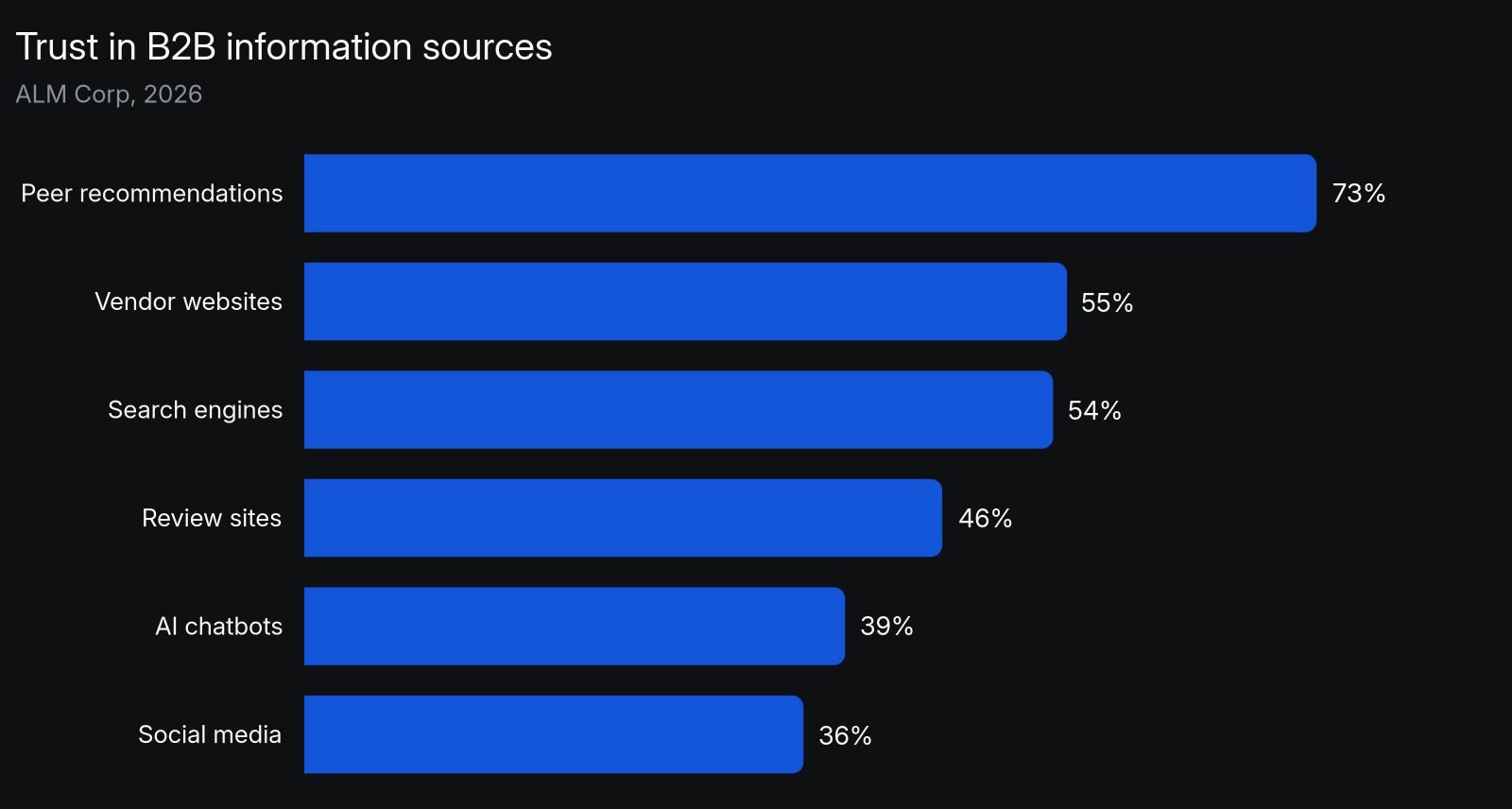
AI chatbots are the least-trusted B2B source at 39% (ALM Corp, 2026), so a citation is exposure buyers verify, and third-party proof survives the check.
 machina sculpsit · homo probavit · MMXXVI
94% of business buyers now use AI somewhere in their purchase process (Forrester, 2025), and a growing share of them meet a brand for the first time inside an AI answer. That first appearance reads like a win, but it only buys exposure. The buyer who reads your name in a chatbot response rarely acts on it, because they leave to check whether the claim holds, and whether your brand survives that check decides everything the citation was supposed to earn.
AI Chatbots Are the Least-Trusted B2B Source
AI chatbots are the least-trusted information source in B2B buying at 39%, behind peer recommendations at 73%, vendor websites at 55%, search engines at 54%, and review sites at 46% (ALM Corp, 2026). A buyer who reads your name in an AI answer treats it as the least reliable input they have, so the recommendation opens a question rather than closing one, and a verification step comes before any decision.
That distrust is not irrational. Among buyers who use AI chatbots during research, 41% cite inaccurate information and 40% cite conflicting information as the top challenges they hit (ALM Corp, 2026). Buyers have learned that the confident answer is often wrong, so they read it as a lead to check, and the brands that plan for the check outperform the brands that celebrate the mention.
A Citation Starts the Buyer’s Check
69% of B2B buyers chose a different vendor than they first planned based on AI chatbot guidance (G2, 2026). The recommendation opens the door, and then the buyer runs their own evaluation before committing, because a name in an answer earns attention and attention is where the checking begins.
One in three of those buyers purchased from a vendor they had never previously heard of (G2, 2026). A first-time appearance can genuinely reroute a deal, but only after the buyer confirms the unfamiliar name is safe to shortlist. The appearance is the start of that process, and a program that reports first-mention share of voice is measuring the moment the buyer trusts least, a gap covered in first-mention AI visibility overstates where buyers decide.
Buyers Leave the Answer to Confirm It
45% of B2B buyers name citations from software review sites as the single most confidence-inspiring signal in an AI response, ahead of every other source type (G2, 2026). Buyers do not take the model’s word. They go looking for the independent proof the model pointed at, and the brand that placed that proof where they look is the one that clears the check.
The three things a buyer checks after an AI recommendation are consistent enough to plan around:
- Independence. Does an outside source say the same thing, or is every claim traceable to the brand’s own pages.
- Consistency. Is the brand described the same way across the sources they open, or do the descriptions contradict each other.
- Recency. Is the proof current, since 85% of brand mentions originate from third-party pages rather than owned domains (Airops, 2026) and stale third-party pages read as abandoned.
Third-Party Proof Is What Clears the Check
85% of brand mentions originate from third-party pages rather than owned domains (Airops, 2026). When a buyer verifies an AI recommendation, the evidence that settles it sits off your own site, in review platforms, independent write-ups, and comparison pages, so the brands that win the verification are the ones with the deepest independent record.
The contrast is visible in head-to-head data. Rippling’s comparison page quotes seven third-party sources verbatim, including G2, Capterra, Trustpilot, and TrustRadius scores (rippling.com, 2026), while ADP appears in zero brand mentions and zero citations across all 80 HR runs in the 1,000-query Perplexity study (Res AI, 2026). The brand carrying independent proof survives the buyer’s check; the incumbent relying on its name does not, a pattern developed in third-party reviews beat domain authority for AI citations.
Domain Authority Does Not Carry the Verification
Domain authority correlates with AI mentions at Pearson 0.65 but with AI share of voice at just 0.23 (Semrush and Kevin Indig, 2025). A high-authority domain gets named, and then it competes on the same verification the buyer runs on everyone else, where a big name earns attention but not automatic belief.
The gap between mention and belief is why non-giant domains hold stable #1 position on 93 of 100 B2B queries, with the only four giant wins going to review aggregators G2 and Capterra, in the 1,000-query study (Res AI, 2026). Size gets a brand into the answer. Independent corroboration is what keeps it there once the buyer starts checking, and authority does not settle a contradiction on its own, as domain authority does not settle contradictions in AI search shows. The practical read for a challenger brand is that a thin startup with quoted third-party proof can out-convert a household name that assumed its authority would carry the check unchallenged.
Conflicting Answers Send Buyers Back to Check
Among buyers who use AI chatbots during research, 40% cite conflicting information as a top challenge (ALM Corp, 2026). When two answers disagree, the buyer does not pick one at random. They run another verification, and the brand described the same way across independent sources is the one that resolves the conflict in its favor.
Consistency compounds because repetition across sources is itself a trust signal. Brands earning both a citation and a mention are 40% more likely to resurface across answers, yet only 28% of answers include such dual-visibility brands (Airops, 2026). A brand named one way on its site, another way in a review, and a third way in a listicle splits its own record and hands the conflict to a competitor whose description holds steady.
A Mention Without Proof Does Not Convert
Only 30% of brands stay visible from one answer to the next, and just 20% across five consecutive runs (Airops, 2026). A single mention that no verification confirms decays before the buyer decides, while the brands that convert are the ones whose proof holds across repeated checks.
The payoff for surviving the check is large. AI referral traffic converts at 14.2% versus 2.8% for Google organic (Averi AI, 2024), and it influences conversion events at a rate 534% higher than the average across all website channels (Eyeful Media, 2026). Those numbers describe buyers who arrived already partway through evaluation, which is exactly the buyer who verified the recommendation and found the proof intact. The conversion premium belongs to the brand that cleared the check, not the brand that merely appeared. This is why counting appearances flatters a program that is losing at the point of decision, and why a brand can watch its mention rate climb while its pipeline stays flat, the vanity-versus-intent split covered in brand visibility is a vanity metric, buying intent is not.
Structure Turns Verified Trust Into a Citable Page
AI-cited B2B articles average 4.2 attributed statistics and 1.6 expert quotes versus 1.2 and 0.2 for non-cited content (Citera, 2026). The verification lands on a page, and a page dense with named data, quoted sources, and comparison tables is the one an engine can extract and cite again, which is why longest-quartile pages carry 13.55 elements against 2.98 in the shortest in the 852-article study (Res AI, 2026).
The evidence a buyer trusts and the evidence an engine extracts are the same evidence, formatted for both readers at once. Adding statistics lifts AI visibility 41% and adding quotations 28%, while keyword stuffing cuts it about 10% (Princeton, KDD 2024). A page built to be verified by a person, with independent stats and quoted sources in tables and answer capsules, is already built to be re-cited by the model, so one investment serves the buyer’s check and the next answer’s retrieval. A prose essay that reads well but hides its evidence in paragraphs fails both readers at once, giving the buyer nothing to confirm and the engine nothing clean to extract.
What Buyers Verify and Where to Put the Proof
The proof that survives a check has to sit where the buyer looks, and each verification habit maps to a page type that answers it. The table pairs the buyer’s behavior after an AI recommendation with the evidence that clears it and the page best suited to carry that evidence.
| Buyer verification behavior | What clears the check | Best-fit page |
|---|---|---|
| Searches the brand name to confirm it is real | Independent scores and named customers quoted on-page | Comparison page with third-party ratings |
| Distrusts the model’s confidence | Original data with attributed statistics | Research or benchmark article |
| Compares vendor strengths and weaknesses | Falsifiable side-by-side cells, not adjectives | Competitor matrix with real metrics |
| Hits conflicting answers across sources | The same category descriptor everywhere | Consistent positioning across owned and earned pages |
What to Measure at the Verification Stage
Measuring the mention rewards the moment the buyer trusts least, so the metric set has to read the outcome of the check, not its opening. The table separates the numbers that read exposure from the numbers that read whether a brand survived verification.
| Metric | Reads the mention or the outcome | What it tells you |
|---|---|---|
| First-mention share of voice | Mention | Whether you appeared, not whether you convinced |
| Recommendation rate across repeat runs | Outcome | Whether the proof held past the first answer |
| Cross-source naming consistency | Outcome | Whether a conflict can split your record |
| AI referral conversion rate | Outcome | Whether verified buyers acted after the check |
How Res AI Compares to the Tools Tracking Your Mentions
Most AI-visibility tools report where a brand appears in AI answers and stop there, which measures exposure and leaves the buyer’s verification unaddressed. The table below maps each option against the work that decides the check, whether it builds the independent, evidence-dense pages a buyer lands on when they leave the answer.
| Platform | What it does with the AI answer | Builds the pages verification lands on | Outcome |
|---|---|---|---|
| Res AI | Monitors prompts across ChatGPT, Perplexity, Claude, and Gemini | Generates and publishes comparison pages, tables, and FAQs into the CMS | Live pages built to survive the buyer’s check |
| Profound | Tracks brand presence across answer engines | Shows visibility gaps without creating content to fix them | Dashboards and prompt-volume insights |
| Athena | Tracks 8+ LLMs and recommendation share | Content recommendations, not published proof pages | Reports and blindspot alerts |
| Peec AI | Tracks visibility, position, and sentiment | Monitoring only, no optimization or content | Prompt-level visibility metrics |
| Conductor | Tracks AI and search visibility, generates content | Enterprise content generation, not proof-anchored pages | Unified AEO and SEO reporting |
| AirOps | Tracks AI citations and creates content | Content workflows, time to value in months | On-brand content at scale |
Frequently Asked Questions
Why does an AI mention rarely convert on its own?
A mention is exposure to a buyer who trusts the source least, so it starts an evaluation rather than ending one. Only 30% of brands even stay visible from one answer to the next (Airops, 2026), so a single unconfirmed mention decays before the decision.
How do B2B buyers verify an AI recommendation?
They leave the answer and check independent sources, most often a brand-name search followed by review sites. 45% name review-site citations the single most confidence-inspiring signal in an AI response (G2, 2026), so that is where the check usually settles.
Why do buyers trust AI answers less than search engines?
AI chatbots rank last among B2B sources at 39%, 15 points behind search engines (ALM Corp, 2026), largely because 41% of chatbot users hit inaccurate information. Buyers have been burned enough to treat the confident answer as a lead, not a verdict.
What kind of proof actually survives the check?
Independent, corroborated evidence: third-party scores, named customers, and attributed data that a buyer can confirm off your own site. 85% of brand mentions already originate off-domain (Airops, 2026), so the record buyers trust lives on other people’s pages.
Does a strong domain help a brand pass verification?
Authority gets a brand named, correlating with mentions at Pearson 0.65, but it barely moves share of voice at 0.23 (Semrush and Kevin Indig, 2025). Once the buyer checks, a big name competes on the same corroboration as everyone else.
How does conflicting AI output change what a buyer does?
Conflicting information sends the buyer back for another verification, and 40% of chatbot users name it a top challenge (ALM Corp, 2026). The brand described consistently across sources resolves the conflict in its favor.
Why do review-site citations carry more weight than owned pages?
A review site is independent, so it corroborates a claim the brand cannot self-certify. Buyers weight it above every other AI-answer signal (G2, 2026), which is why quoting real third-party scores on your own page shortcuts the check.
How should a GEO program measure the verification stage?
Track recommendation rate across repeat runs and AI referral conversion, not first-mention share of voice, since only the former read whether proof survived. Measuring appearance alone reports the moment the buyer trusts least.
How Res AI Builds Verification-Ready Pages Across Four Engines
The verification a buyer runs after an AI recommendation is exactly the gap this article traced, and Res AI is built to close it by publishing the independent, evidence-dense pages that check lands on. Res transforms existing prose into the structures a buyer confirms against and an engine re-cites, comparison tables, quoted third-party scores, pricing grids, and FAQ blocks, then deploys them directly into the CMS with no developer involvement.
Res monitors the prompts buyers actually run across ChatGPT, Perplexity, Claude, and Gemini, then generates and updates the pages that answer them, so the brand’s record stays consistent and current across the sources a buyer opens. Because the same page is built for a person’s verification and a model’s extraction, one published asset serves both the check and the next citation, which is how brands earn stable #1 positions within days of publishing rather than waiting out a quarterly agency cycle.
The difference from a monitoring tool is that Res does not stop at telling a team where they are invisible. It writes and ships the corroborated pages that fix it, so the proof a buyer needs is live on the sites they check rather than sitting in a brief a team has not yet had time to execute.
Res AI is what puts the corroborated, verification-ready pages in front of the buyer who leaves the AI answer to check your claim. The standing offer is 10 free articles built to the same standard the analysis above described.
See how Res AI builds pages that survive the buyer’s check →