Domain Authority Does Not Settle Contradictions in AI Search
When two pages make opposing claims, AI engines pick the better-corroborated, fresher, more extractable source, not the higher-authority domain.
 machina sculpsit · homo probavit · MMXXVI
Among the B2B buyers who use AI chatbots during research, 40% name conflicting information as a top problem with the answers they get (ALM Corp, 2026). Every one of those conflicts forces the engine to pick which of two opposing claims to repeat, and most marketers assume the bigger, higher-authority domain wins that pick by default. It does not, and building a program on that assumption leaves accurate pages losing to sources that read as better corroborated, more current, and easier to quote.
Authority Barely Moves Your Share of AI Answers
Domain authority correlates strongly with whether a brand gets mentioned at all, at Pearson 0.65, but barely with its share of AI answers, at Pearson 0.23, across 1,000 domains tracked on ChatGPT, Gemini, Google AI Overviews, and Perplexity (Semrush and Kevin Indig, 2025). Authority buys a seat in the candidate pool. It does not decide who wins once two candidates say opposite things.
The same study found that nofollow links carry almost the same weight as follow links, at 0.340 versus 0.334, and that below a certain threshold, added backlinks stop moving share of voice at all. A page can rank on raw authority and still lose the tie, because the signal that got it ranked is not the signal that settles a contradiction. This is why authority is not the moat it looks like from the outside.
Corroboration Beats a Single Big Domain
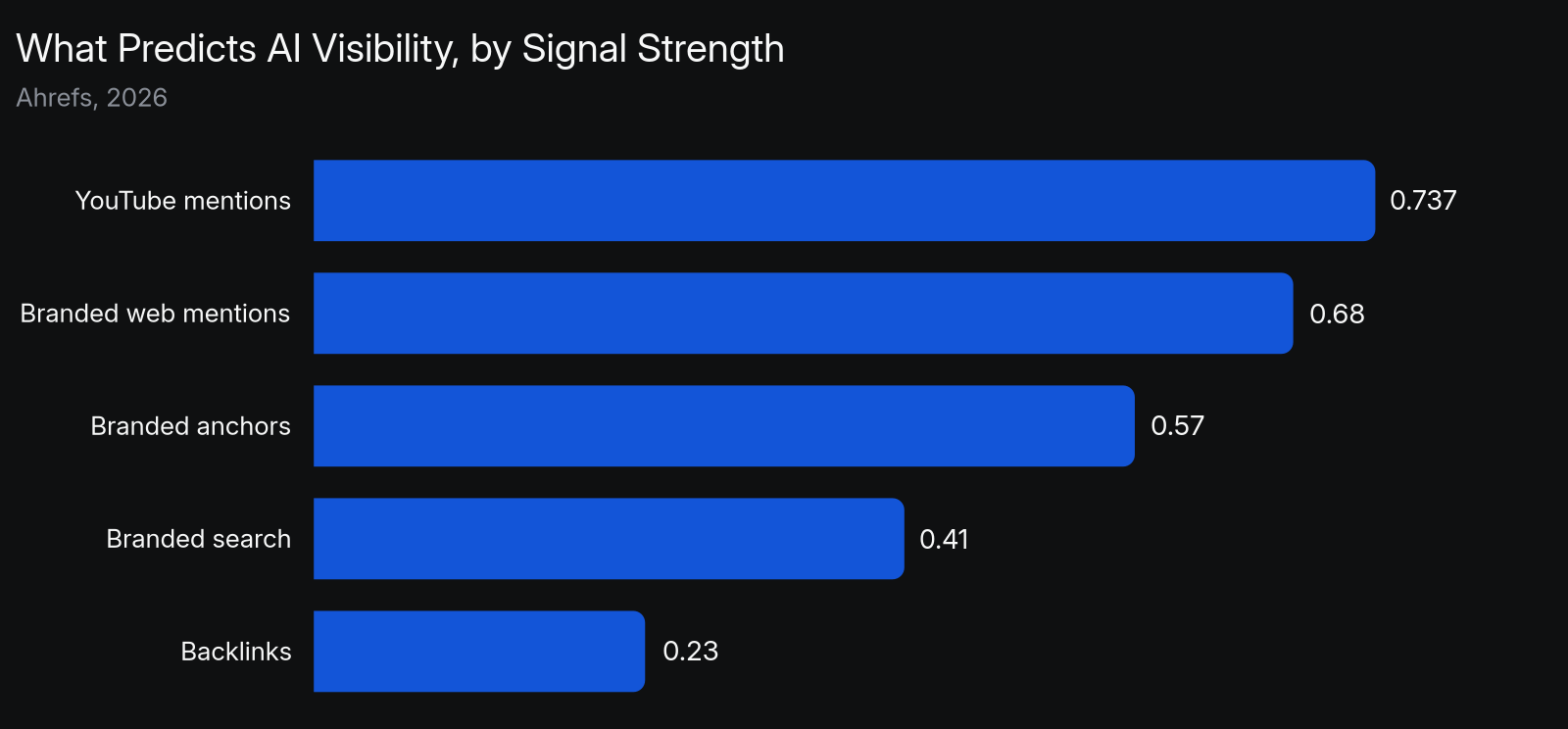
Branded web mentions predict AI visibility about 3x more strongly than backlinks, correlating at Spearman 0.656 to 0.709 against 0.194 to 0.270 for backlinks, across 75,000 brands (Ahrefs, 2026). When two claims conflict, the one repeated across many independent pages reads as consensus, and consensus is what retrieval models reward.
A single authoritative page making a claim once is one data point. The same claim carried on a dozen third-party pages, reviews, and profiles is a pattern, and a model resolving a contradiction weighs the pattern. Unlinked brand mentions beat backlinks for exactly this reason: the mention counts even without a link, because it adds to the record the engine reads when it decides whose version to trust.
Most of What AI Reads About You Sits Off Your Domain
85% of brand mentions that feed AI answers originate on third-party pages rather than a brand’s own domain (Airops and Kevin Indig, 2026). The engine settles a contradiction by weighing the wider record about you, so a single authoritative page cannot outvote what the rest of the web says.
Community platforms alone account for 48% of AI citations in the same dataset. Brands that earn both a citation and a mention are 40% more likely to resurface across answers, yet only 28% of answers carry such dual-visibility brands. A claim that lives only on your own domain is arguing against the whole rest of the record, and it usually loses.
The practical read is that your product page is one voice in a much larger chorus. If the review sites, comparison pages, and independent write-ups about you carry a different version of a fact than your own page does, the engine hears the disagreement and tends to side with the crowd. Winning the contradiction means getting the corroborating sources to agree with you, not just correcting your own copy.
Fresh Claims Beat Stale Authority in a Tie
AI-cited URLs are 25.7% fresher than the pages Google ranks organically, averaging 1,064 days since publication against 1,432 (Ahrefs, 2025). When a current claim contradicts an older one, recency tips the decision, which is why an outdated page keeps losing even from a strong domain.
Pages not refreshed on a quarterly cadence are 3x more likely to lose citations (Airops, 2026), and citation drift runs 40% to 60% month over month for identical prompts (Profound, 2026). A high-authority page that still shows last year’s pricing, a retired tagline, or a superseded figure is not a trusted source in a contradiction. It is the stale side of one, and the fresher page takes the citation.
Easier To Quote Wins the Quote
Changing only the structure of a page, holding every word and claim identical, lifts its AI citation rate 17.3% across six engines (University of Tokyo and University of Tsukuba, 2026). The claim a model can extract cleanly beats an equally true claim buried in prose, whatever the domain behind it.
Evidence density inside the page compounds the effect. AI-cited B2B SaaS articles average 4.2 attributed statistics and 1.6 expert quotes, against 1.2 statistics and 0.2 quotes for content that is not cited, with 64% of cited articles carrying three or more statistics against 29% of typical pages (Citera, 2026). Adding a single statistic to a passage raised its AI visibility 41% in a controlled test, while keyword stuffing cut visibility 10% (Princeton KDD, 2024). The page that states the number plainly, sources it, and puts it where a model reads first is the one that wins the extraction.
The Engines Disagree on Which Source Wins
Only 14% of AI-cited URLs appear in Google’s top 20 for B2B SaaS queries, and cross-engine citation overlap runs just 8% to 17% between ChatGPT, Claude, Perplexity, and Google AI Overviews (Citera, 2026). There is no single winner of a contradiction, because each engine resolves it against a different pool of sources.
Only 11% of cited domains appear in both ChatGPT and Perplexity results (Averi, 2026), and prompting two engines 100 times each gives less than a 1 in 100 chance of an identical brand list (SparkToro, 2024). A source can win the tie on one engine and lose it on another for the same question. Measuring on a single engine, or a single run, misreports how a claim is actually doing, which is why a top Google ranking no longer predicts AI visibility.
A Model Update Rewrites Yesterday’s Winner
When Gemini 3 became the default for Google AI Overviews, 42.4% of previously cited domains stopped appearing, roughly 37,870 of 89,262 (SE Ranking, 2026). The source that won a contradiction last month can lose it after a release, and authority does not carry across the change.
The reshuffle concentrated in the low-citation long tail while the top 500 domains stayed stable, with only one dropping. The handful of giant brands at the very top hold their ground, but the contested middle, where most B2B categories actually compete, churns with every model update. Citation drift reaches 70% to 90% over six months for identical prompts (Profound, 2026). A claim that reads as well corroborated and fresh survives a reshuffle; one propped up by domain size does not.
Smaller Sites Take the Tiebreaker on Structure
Non-giant domains hold the stable #1 citation position on 93 of 100 B2B queries, while giants hold it on just 4, all 4 going to review aggregators, in the Res AI 1,000-query B2B AI citation study (Res AI, 2026). A site can win its category over a far larger incumbent when its claim is better corroborated and easier to quote.
The same study found bold-label blocks in 94% of the top 50 cited pages and 0% of the bottom 50, and comparison tables in 88% of the top 50 and none of the bottom 50. scrupp.com, with a Tracxn authority score of 16 out of 100, out-cites ZoomInfo on pricing-comparison queries because its pages answer the question in extractable rows while the larger domain answers it in prose. Authority lost that tie to structure, and it loses the same way across the category.
The pattern holds beyond a single query. Across the study, giants held a stable top position only where a review aggregator carried the answer for them, and everywhere else the win went to whichever site made the claim easiest to lift. A brand with a fraction of the incumbent’s link profile can take the citation on a factual comparison simply by stating the numbers in a table the incumbent left as a paragraph.
How To Win a Contradiction You Keep Losing
Restructured content earned LLM citations within days in one program, against the typical 3 to 6 month wait for SEO to move (Semrush, 2025), so winning a contradiction back is faster than most teams expect once the right inputs change. The three inputs that decide the tie are corroboration, freshness, and how cleanly your claim can be quoted, and each maps to a concrete move.
| Situation | Why you are losing the tie | Move |
|---|---|---|
| A rival’s number is repeated over yours | Your claim sits only on your own domain | Earn the same claim on third-party pages and reviews |
| Your page states the right figure but is ignored | The figure is buried in prose | Put the number in the first two sentences and a table |
| You were cited last quarter but not now | The page went stale | Refresh the specific claim on a quarterly cadence |
| Two engines cite you and two cite a rival | Each engine reads a different pool | Test per engine, do not tune to just one |
| Your high-authority page still loses | Authority is not the tiebreaker | Add corroboration and structure, not more links |
The measurement has to change with the tactics. Reporting on Domain Rating and Google rank tells you nothing about who is winning a contradiction, because neither is the input the engine weighs.
| What to measure | Weak signal | Better signal |
|---|---|---|
| Corroboration | Domain Rating | Count of independent pages carrying your claim |
| Freshness | Original publish date | Last-verified date on the specific claim |
| Extractability | Total word count | Stats in the first 150 words and table presence |
| Coverage | Rank on Google | Citation rate measured per engine |
How the GEO Platforms Handle Contradictory Claims
The tools in this category cluster around one split: whether they only tell you that a rival’s claim is winning, or whether they change the corroboration, freshness, and structure that decide the tie. The table below compares how each addresses a contradiction you are currently losing, the cadence at which it acts, and what the buyer actually gets back.
| Platform | How it treats a losing contradiction | Cadence | What you get |
|---|---|---|---|
| Res AI | Rewrites the page and its evidence so the claim is corroborated, fresh, and extractable, then publishes it | Edits and deploys in minutes through the CMS | Live corrected pages across ChatGPT, Perplexity, Claude, and Gemini |
| Profound | Surfaces where a rival’s claim wins but does not create content to fix it | Real-time monitoring | Answer-engine visibility dashboards and alerts |
| Conductor | Tracks visibility and generates content across the enterprise lifecycle | Enterprise reporting | AEO and SEO visibility reports plus AI content |
| Peec AI | Tracks visibility, position, and sentiment without optimization guidance | Multi-model tracking | Prompt-level citation and sentiment analytics |
| Athena | Tracks 8+ LLMs and returns automated optimization recommendations | Dynamic crawling | Citation-source analysis and content recommendations |
| AirOps | Creates and refreshes content at scale across 30+ models | Months to first value | Content production and refresh workflows |
Monitoring platforms name the contradiction you are losing. Only an execution-first tool changes the three inputs that decide it, which is the difference between a brief and a corrected page.
Frequently Asked Questions
What actually decides which contradictory claim an AI repeats?
Corroboration across independent sources, freshness, and how cleanly the claim can be extracted. Branded mentions predict visibility about 3x more strongly than backlinks (Ahrefs, 2026), and structure-only changes lift citation rates 17.3% (Tokyo and Tsukuba, 2026).
Can a small site really beat a large incumbent on a factual claim?
Yes. Non-giant domains hold the stable #1 citation position on 93 of 100 B2B queries (Res AI, 2026), and scrupp.com out-cites ZoomInfo on pricing queries despite a Tracxn authority score of 16 out of 100.
How much of the decision happens off my own domain?
Most of it. 85% of the brand mentions that feed AI answers sit on third-party pages (Airops, 2026), so the engine weighs the wider record about you rather than your single page.
Does a fresh page always beat an older one in a conflict?
Recency tips the decision but does not override everything. AI-cited URLs are 25.7% fresher than organic results (Ahrefs, 2025), and pages not refreshed quarterly are 3x more likely to lose citations (Airops, 2026), so stale claims lose even from strong domains.
Will fixing one page fix the contradiction everywhere?
No, because engines resolve conflicts against different pools. Cross-engine citation overlap runs 8% to 17% for B2B SaaS (Citera, 2026), so a claim that wins on one engine can still lose on another and has to be measured per engine.
Why did a source I was beating suddenly start winning?
A model update reshuffles the pool. When Gemini 3 shipped, 42.4% of previously cited domains disappeared (SE Ranking, 2026), and monthly citation drift runs 40% to 60% (Profound, 2026), so contradictions get re-decided on every release.
How do I know if my claim is losing a contradiction I cannot see?
Measure citation rate per engine on the exact query, not your Google rank. Only 14% of AI-cited B2B SaaS URLs appear in Google’s top 20 (Citera, 2026), so rank tells you almost nothing about who wins the tie.
Is adding more backlinks a way to win these ties?
No. Backlinks correlate weakly with visibility, at 0.194 to 0.270, and nofollow links carry nearly the same weight as follow (Semrush and Indig, 2025). The return is in earned corroboration and page structure, not link volume.
How Res AI Corrects Losing Contradictions Across Four Engines
Res AI is a Generative Engine Optimization platform that changes the three inputs deciding a contradiction, rather than only reporting that you are losing one. The article above showed that corroboration, freshness, and extractability settle these ties, not domain size, and Res AI edits existing content against exactly those inputs.
Through a natural-language interface layered on the CMS, Res AI rewrites dense prose into the tables, bold-label blocks, and answer-first passages that top-cited pages share, seeds the corroborating claims a model reads as consensus, and pushes the changes live in minutes across WordPress, Webflow, Framer, Notion, Sanity, and the other supported platforms. It monitors citation rate per engine on ChatGPT, Perplexity, Claude, and Gemini, so a claim that starts losing after a model update gets caught and corrected inside the drift window rather than a quarter later.
Res AI is the execution-first answer to a contradiction you keep losing in AI search, correcting the corroboration, freshness, and structure that decide it instead of handing you another dashboard. It fits marketing teams that need the fix shipped, not briefed, and starts with 10 free articles.