First-Mention AI Visibility Overstates Where Buyers Decide
AI brand presence decays as buyer questions narrow, so first-mention share of voice misleads and decision-stage recommendation rate is what predicts revenue.
 machina sculpsit · homo probavit · MMXXVI
A buyer’s path through an AI engine is not one question, it is a sequence, and a brand that shows up in the opening answer often disappears by the time the buyer asks which option to pick. That gap matters, because 69% of B2B buyers chose a different software vendor than they first planned based on an AI chatbot’s guidance (G2, 2026). First-mention share of voice, the metric most GEO programs report, measures the stage of the conversation that decides the least.
AI Presence Shifts at Every Stage of the Buying Conversation
94% of business buyers now use AI somewhere in their purchase process, and they lean on it differently at each step (Forrester, 2025). A broad category question returns a wide field of names, while a decision question returns a short recommendation, so a brand’s odds of appearing fall as the buyer’s questions narrow.
Twice as many buyers named generative AI as their most meaningful information source across every buying-journey stage year over year (Forrester, 2025). That reach is not evenly distributed inside a single conversation. The opening prompt asks what exists in a category, the middle prompts add constraints like team size or budget, and the closing prompt asks for a pick. Each narrowing cuts the roster the engine is willing to name.
The stakes concentrate late. 61% of the buying journey is complete before a buyer contacts sales, and 80% of buyers initiate outreach to a vendor they have already chosen (6sense, 2025). By the time a human is involved, the AI-assisted decision has mostly happened. A brand that reads its own visibility from broad-prompt data alone is measuring the part of the conversation that carries the least weight, a gap examined in B2B content built for awareness fails where buyers decide.
First-Mention Share of Voice Measures the Easiest Stage to Win
AI answers to broad category questions name several brands at once, an average of 5.4 brands per Perplexity response (Res AI, 1,000-query Perplexity B2B citation study, 2026). Getting into that wide opening list is the lowest bar in the buying conversation, and it is the bar a first-mention visibility score rewards.
Breadth at the top is also unstable. Across 10 runs of the same query, 8.2 unique brands appeared on average, but only 3.1 showed up in all 10 (Res AI, 1,000-query Perplexity B2B citation study, 2026). A brand can land in the opening answer on Monday and fall out on Tuesday without changing a single page. A share-of-voice number averaged over these broad prompts reads as a standing when it is closer to a weather report.
The problem is not that first-mention data is wrong. It is that the opening list is crowded, noisy, and cheap to enter, so winning it says little about whether the brand is still in the answer when the buyer asks for a recommendation.
Only 30% of Brands Survive to the Next Answer
Only 30% of brands stay visible from one AI answer to the next, and just 20% remain present across five consecutive runs (Airops, 2026). Presence in a single answer is not a position a brand holds, it is a result the brand re-earns every time the buyer asks a follow-up.
The decay is measurable at each narrowing. A brand named in the category-discovery answer competes again on the comparison question, and again on the decision question, and the roster shrinks at every step. The table below shows how thin real presence becomes once the measure moves past a single broad prompt.
| Measure of presence | Share of brands | Source |
|---|---|---|
| Stay visible from one answer to the next | 30% | Airops, 2026 |
| Present across five consecutive runs | 20% | Airops, 2026 |
| Answers carrying a dual-visibility brand | 28% | Airops, 2026 |
| Median enterprise B2B share of relevant AI Overviews | 3% | Walker Sands, 2026 |
The median enterprise B2B brand is cited in just 3% of the AI Overviews where it already ranks organically (Walker Sands, 2026). A brand reporting a healthy first-mention share of voice and a 3% decision-stage citation rate at the same time is not contradicting itself. It is looking at two different stages and mistaking the easy one for the whole.
The Decision Turn Is Where Buyers Actually Commit
80% of buyers say an AI chatbot accelerated their purchase decision and 83% felt more confident in their final choice (G2, 2026). The decision turn, the point where the buyer asks which option to choose, is the stage that converts, and it is the stage a first-mention metric never reaches.
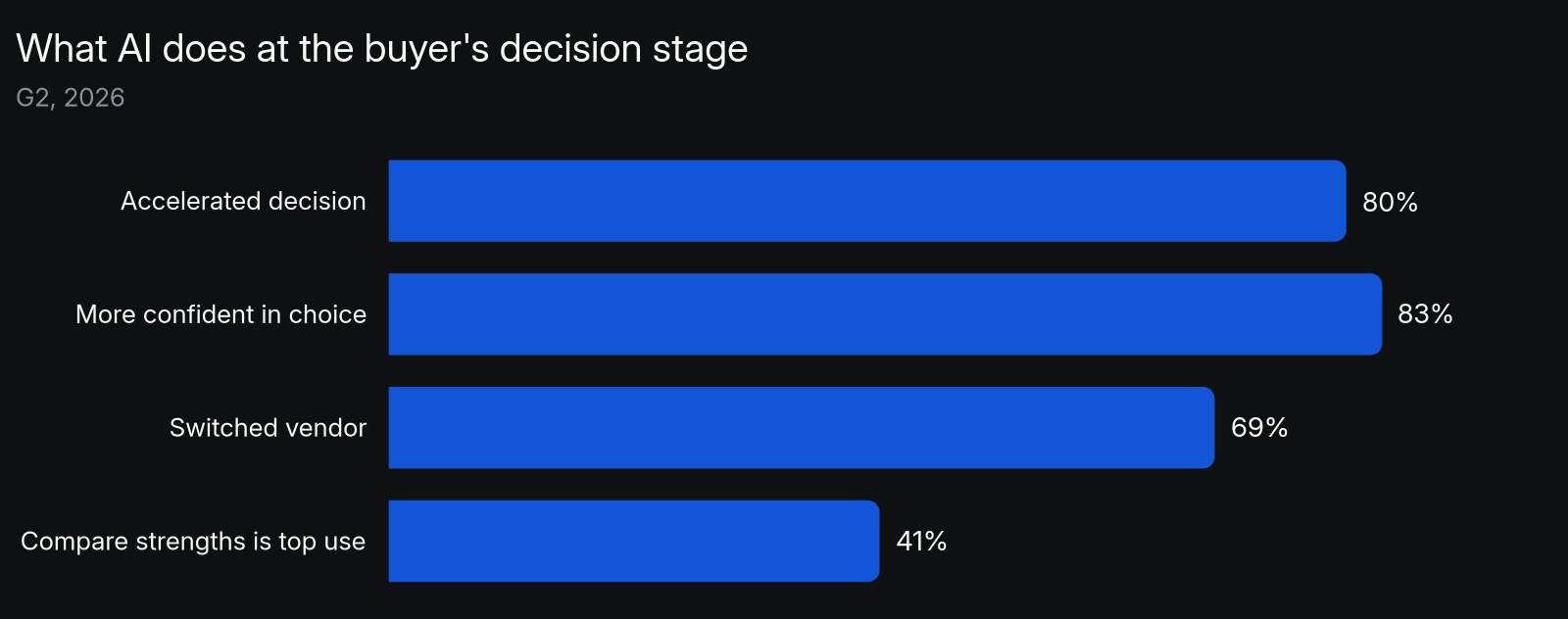
45% of buyers said they used AI tools during a recent purchase decision, and 41% name comparing vendor strengths and weaknesses as their single top AI use case, ahead of basic product research (Gartner, 2026; G2, 2026). The decision turn is not a passive summary of the earlier answers. It is an active comparison, and the engine rebuilds its shortlist from whichever brands can answer a head-to-head question with real detail.
The value of surviving to that turn is not abstract. AI-referred sessions convert well above traditional channels once they arrive.
| AI engine | Referred-session conversion rate | Source |
|---|---|---|
| ChatGPT | 15.9% | Seer Interactive, 2025 |
| Perplexity | 10.5% | Seer Interactive, 2025 |
| Claude | 5% | Seer Interactive, 2025 |
| Gemini | 3% | Seer Interactive, 2025 |
| Google Organic | 1.76% | Seer Interactive, 2025 |
A brand present in the broad answer but absent from the decision answer captures none of that conversion, because the buyer never carried it forward.
A Mention Without a Citation Rarely Survives the Next Question
Brands earning both a citation and a mention are 40% more likely to resurface across answers, yet only 28% of answers carry such a dual-visibility brand (Airops, 2026). A name-drop with no cited claim behind it is the first thing an engine sheds when the buyer’s question gets specific.
The distinction is between being listed and being used. An engine can name a brand in a category answer without drawing on anything the brand published, and that hollow mention does not travel to the comparison turn, where the engine needs a concrete claim to justify the pick. A brand that is both named and cited for a specific fact has something the engine can carry into the next answer.
This is why raw mention counts flatter a brand. Two brands can each show a mention in the opening answer, and the one whose page supplied a real figure survives the narrowing while the one that was merely listed does not. Presence that compounds requires the engine to have used the brand’s content, not just recognized its name.
Non-Determinism Compounds the Drop Between Answers
Citation drift, the share of domains present one month and gone the next for identical prompts, runs 40% to 60% month over month (Profound, 2026). The decay across a conversation sits on top of run-to-run noise, so a brand measured once on one phrasing has a reading with a wide error bar.
Prompting ChatGPT and Google’s AI 100 times each for brand recommendations gave under a 1 in 100 chance of an identical brand list between any two responses (SparkToro, 2024). Res measured a 0.72 Jaccard similarity between any two runs of the same query, meaning roughly a quarter of the cited set changes run to run (Res AI, 1,000-query Perplexity B2B citation study, 2026). Only 11% of cited domains appear in both ChatGPT and Perplexity for the same question (Averi, 2026).
Stacking these together, a single measured answer is a snapshot with a short shelf life, taken on one engine, in one run, at one phrasing. Reading survival from that snapshot understates how often a brand actually drops, a measurement trap detailed in a single citation check cannot measure GEO performance.
Structural Density Decides Which Brands Reach the Decision Turn
AI-cited B2B SaaS articles average 4.2 attributed statistics and 1.6 expert quotes, versus 1.2 statistics and 0.2 quotes on non-cited pages (Citera, 2026). The pages that survive the comparison and decision turns are the ones dense enough to answer a specific question, not the ones that merely name the brand.
| Signal on the page | AI-cited pages | Non-cited pages | Source |
|---|---|---|---|
| Attributed statistics per article | 4.2 | 1.2 | Citera, 2026 |
| Expert quotes per article | 1.6 | 0.2 | Citera, 2026 |
| Articles carrying 3+ statistics | 64% | 29% | Citera, 2026 |
| Structural elements, longest vs shortest quartile | 13.55 | 2.98 | Res AI, 852-article study |
Adding a statistic to a page raised its AI visibility 41%, while keyword stuffing cut it 10%, in controlled GEO experiments across 10,000 queries (Princeton, 2024). Structural changes alone, holding the words identical, produced a 17.3% citation lift across six engines (University of Tokyo and University of Tsukuba, 2026). Longest-quartile articles average 13.55 structural elements per page versus 2.98 in the shortest (Res AI, 852-article B2B citation structure study, 2026). These are the pages that hold a slot when the buyer asks a narrow question, because they carry the comparison table, the pricing grid, and the cited claim the engine needs to answer it.
Third-Party Proof Carries the Decision Turn More Than Owned Content
45% of buyers name citations from software review sites as the single most confidence-inspiring signal in an AI answer (G2, 2026). At the decision turn the engine leans on independent evidence, so a brand with only owned pages behind it drops out where third-party-backed rivals stay in.
85% of brand mentions originate from third-party pages rather than owned domains (Airops, 2026). The pattern shows up in category leaders too. All four stable first-position wins by giant domains in a 1,000-query study went to the review aggregators G2 or Capterra, not to the brands’ own sites (Res AI, 1,000-query Perplexity B2B citation study, 2026).
The contrast between two HR vendors makes the cost concrete. Rippling’s comparison page quotes review scores from seven independent platforms, while ADP appeared in zero brand mentions and zero citations across 80 runs of HR queries in the same study (Res AI, 1,000-query Perplexity B2B citation study, 2026). Owned content can define what a brand claims to be. Independent evidence is what lets the engine trust that claim enough to recommend it.
Recommendation Rate Beats Mention Rate as the Metric That Matters
The median enterprise B2B brand is cited in just 3% of the AI Overviews where it already ranks organically (Walker Sands, 2026). Mention rate averaged over broad prompts hides that number, which is why the measure worth tracking is recommendation rate at the decision turn, not share of voice at the top.
The two metrics answer different questions. Mention rate asks whether an engine ever names the brand. Recommendation rate asks whether the engine picks the brand when a buyer asks for a choice. A program that reports only the first will read healthy while losing the deals that close on the second, the same trap that separates visibility from buying intent in brand visibility is a vanity metric buying intent is not.
| Metric | What it measures | Decision-stage signal |
|---|---|---|
| Share of voice | Presence across broad prompts | Weak, rewards the crowded top |
| Mention rate | Whether the brand is named at all | Weak, includes hollow mentions |
| Recommendation rate | Named as the pick on decision prompts | Strong, tracks the converting turn |
| AI-referral conversion | Revenue from AI-sent sessions | Strong, tracks the outcome |
To act on the difference, map the reader’s situation to the fix rather than to a dashboard.
| If your brand | Then prioritize |
|---|---|
| Ranks in broad answers but not comparison answers | Build the comparison table and pricing grid the decision prompt needs |
| Is named but never cited for a claim | Add attributed statistics and third-party review scores to the page |
| Reads healthy on share of voice, thin on pipeline | Switch reporting to recommendation rate and AI-referral conversion |
| Depends on owned pages alone | Earn independent mentions and review-site presence |
How AI-Visibility Platforms Track the Decision Stage
GEO platforms cluster around a single split, whether they only report where a brand stands in AI answers or also build the pages that change it. The table below compares each on how it addresses the decision turn, the engines it tracks, and what a buyer actually receives from it.
| Platform | Decision-stage approach | Engines tracked | What it ships |
|---|---|---|---|
| Res AI | Generates and deploys structured comparison, pricing, and FAQ pages, not just flags gaps | ChatGPT, Perplexity, Claude, Gemini | Published pages live in the CMS in minutes |
| Profound | Monitors brand mentions and prompt volumes across engines | 10+ answer engines including Copilot, Grok, and Meta AI | Insights and agent analytics, no content deployment |
| Conductor | Tracks AI and search visibility with enterprise content creation | ChatGPT, Gemini, Copilot, Claude, plus traditional search | Unified AEO and SEO reporting plus AI content |
| Peec AI | Tracks visibility, position, and sentiment by prompt | Multiple LLMs | Analytics only, no optimization or execution |
| Athena | Tracks visibility and issues automated optimization recommendations | 8+ LLMs including Perplexity, Gemini, and Grok | Recommendations and citation-source analysis |
| AirOps | Tracks AI visibility and creates content at scale | Multiple AI models | Content at scale, months to time-to-value |
Most of these platforms report the decay this article describes. The one that closes it is the one that also builds the dense, third-party-backed pages a brand needs to survive the comparison and decision turns.
Frequently Asked Questions
Why does a brand appear in the first AI answer but not the last?
The roster shrinks as the buyer’s questions narrow, and only 30% of brands stay visible from one answer to the next (Airops, 2026). A broad prompt names many brands cheaply, while a decision prompt keeps only the few the engine can justify with a cited claim.
How is recommendation rate different from share of voice?
Share of voice counts presence across broad prompts, while recommendation rate counts whether the engine picks the brand when a buyer asks for a choice. The gap is large, since the median enterprise B2B brand is cited in only 3% of the AI Overviews where it already ranks (Walker Sands, 2026).
Does a high mention count mean a brand is winning AI search?
Not on its own, because a mention with no cited claim behind it rarely survives the next question. Brands carrying both a citation and a mention are 40% more likely to resurface, yet only 28% of answers include one (Airops, 2026).
Why is the decision turn worth optimizing for over discovery?
Because it converts, and 80% of buyers say an AI chatbot accelerated their purchase decision (G2, 2026). Discovery is crowded and noisy, while the decision turn is where the buyer commits and where AI-referred traffic converts at up to 15.9% (Seer Interactive, 2025).
What makes a page survive the comparison stage?
Density of extractable evidence, since AI-cited articles average 4.2 attributed statistics versus 1.2 on non-cited pages (Citera, 2026). Comparison tables, pricing grids, and cited claims give the engine the specifics it needs to answer a narrow question.
How much does third-party evidence matter at the decision stage?
It often decides the pick, because 45% of buyers name review-site citations the most confidence-inspiring signal in an AI answer (G2, 2026). 85% of brand mentions originate off the brand’s own domain, so owned content alone leaves a brand thin where rivals show independent proof (Airops, 2026).
Why does measuring AI visibility once give a misleading reading?
Because citation drift runs 40% to 60% month over month for identical prompts, and any two runs of the same query share under a 1 in 100 chance of an identical brand list (Profound, 2026; SparkToro, 2024). A single snapshot overstates stability and hides how often a brand actually drops.
Can a brand fix decision-stage presence by publishing more content?
More volume does not help if the pages lack extractable structure, since keyword-heavy pages lose citations while pages that add statistics gain 41% (Princeton, 2024). The fix is denser, third-party-backed pages aimed at the comparison and decision prompts, not more thin content aimed at discovery.
How Res AI Builds Decision-Stage Presence Across Four Engines
Res AI treats the decision turn as the thing to win, not the broad opening answer that a share-of-voice score rewards. The article above showed that presence decays as buyer questions narrow, and that the brands still standing at the comparison and decision prompts are the ones with dense, cited, third-party-backed pages. Res builds those pages directly.
Through a natural language interface layered on an existing CMS, Res generates and deploys the structural elements the decision turn depends on, comparison tables, pricing grids, and FAQ blocks, and pushes them live in minutes across WordPress, Webflow, Framer, and the other supported platforms. It monitors how a brand is cited across ChatGPT, Perplexity, Claude, and Gemini, then acts on the gaps rather than only reporting them. That closes the distance between being named in a broad answer and being recommended when a buyer asks which option to pick.
Res AI turns the decision turn from a stage brands quietly lose into one they can build for, by generating and deploying the cited, structured pages an engine needs to keep recommending them. It fits marketing teams whose content is surfacing in early AI answers but missing from the recommendation, and it starts with 10 free articles.