B2B Content Built for Awareness Fails Where Buyers Actually Decide
94% of B2B buyers use AI at every purchase stage. Awareness-stage content is not present during the evaluations that pick vendors.
 machina sculpsit · homo probavit · MMXXVI
51% of B2B software buyers now begin purchase research in an AI chatbot more often than in a traditional search engine, up from 29% in April 2025 (G2, 2026). The majority of first impressions now happen on a surface most B2B content libraries were not built for, and the content still stocks the channel buyers have already left. Awareness-stage content is not present during the evaluations that pick the vendor.
94% of B2B Buyers Use AI at Every Purchase Stage
94% of business buyers reported using AI in their buying process, up five percentage points year over year, with twice as many naming generative AI or conversational search as the most meaningful information source across every stage of the journey (Forrester, Buyers’ Journey Survey, 2025). The behavior is not clustered in awareness. It spans evaluation, shortlist, and final selection.
Most B2B content libraries were built on a funnel model that assumed discrete stages. Awareness content was SEO-optimized for broad keyword coverage. Evaluation content lived inside gated assets. Decision content was a demo request or a pricing page. The buyer was expected to walk through those stages in order, touching owned content at each step.
AI chatbots collapse the sequence. A single session moves from “what are the options in this category” to “how do these three compare on multi-stakeholder deals” to “which of these integrates with Salesforce at the $50k price point” inside five turns. Each of those queries pulls from a citation set the content team cannot see in Google Search Console, Ahrefs, or any awareness-stage dashboard.
AI Chatbot Guidance Flips 69% of Shortlists
69% of B2B software buyers reported choosing a different software vendor than they initially planned based on AI chatbot guidance, and one in three purchased from a vendor they had never previously heard of (G2, 2026). The chatbot is not confirming a pre-built shortlist. It is rewriting it.
That pattern breaks the implicit assumption behind awareness-stage content, which is that top-of-funnel exposure carries downstream through brand recall. If two thirds of buyers swap a vendor between “intended” and “purchased,” the brand that won the awareness impression is not the brand that wins the deal. The brand cited inside the evaluation-stage AI answer is.
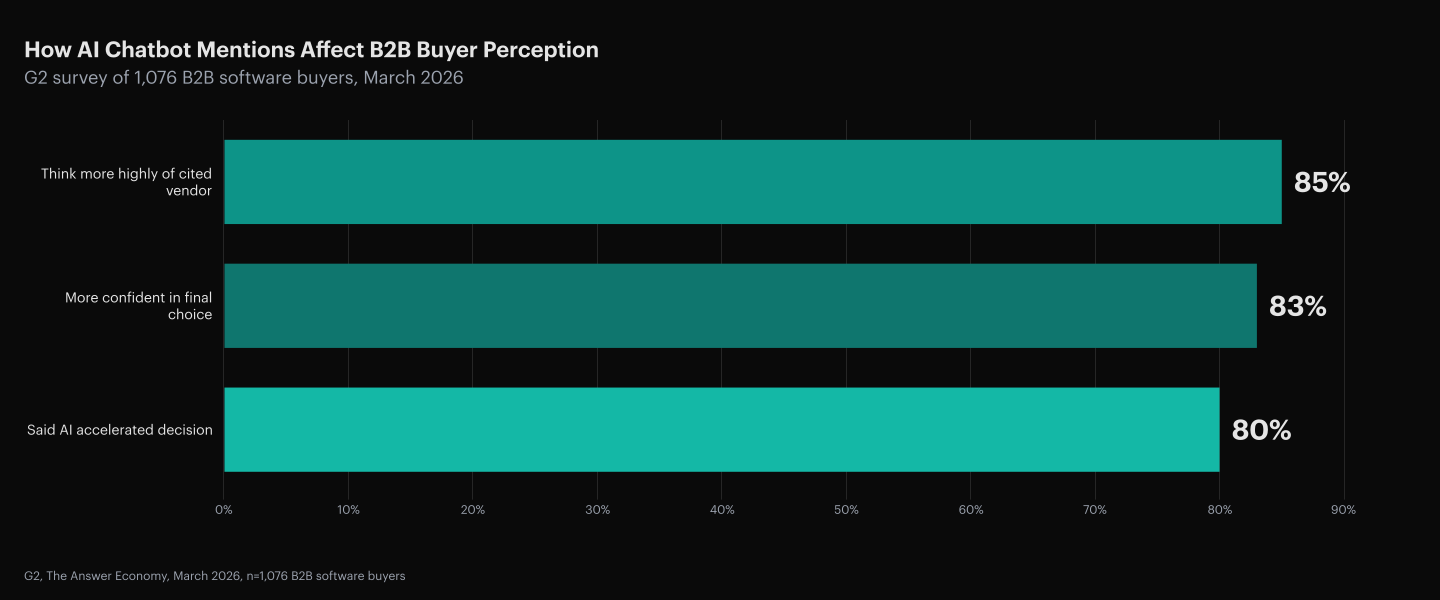
G2 also found 85% of buyers think more highly of a vendor when an AI chatbot mentions it in a recommendation, 80% said AI accelerated their purchasing decision, and 83% reported more confidence in the final choice (G2, 2026). The content surface that produces those mentions is not the one SEO-optimized for category-level search traffic. It is the structured comparison, pricing, and how-to-choose content AI retrievers extract during evaluation-stage prompts.
Buyers Reach Sales at 61% of Journey Complete Now
The point of first contact with sales moved from 69% to 61% of the purchasing journey complete, pulling outreach forward by six to seven weeks (6sense, 2025). The research window where buyers self-serve with AI content has grown, and awareness-stage brand exposure is no longer what populates the final shortlist.
6sense’s dataset adds texture to the shift. Buyers still define their purchase requirements 83% of the time before the first sales contact. They have 8 to 9 prior journeys on average. They initiate 80% of the outreach to their intended vendor. 92% start the journey with vendors in mind. 81% choose before sales contact. 94% rank their shortlist by the time sales engages, and the top-ranked vendor wins the deal 80% of the time.
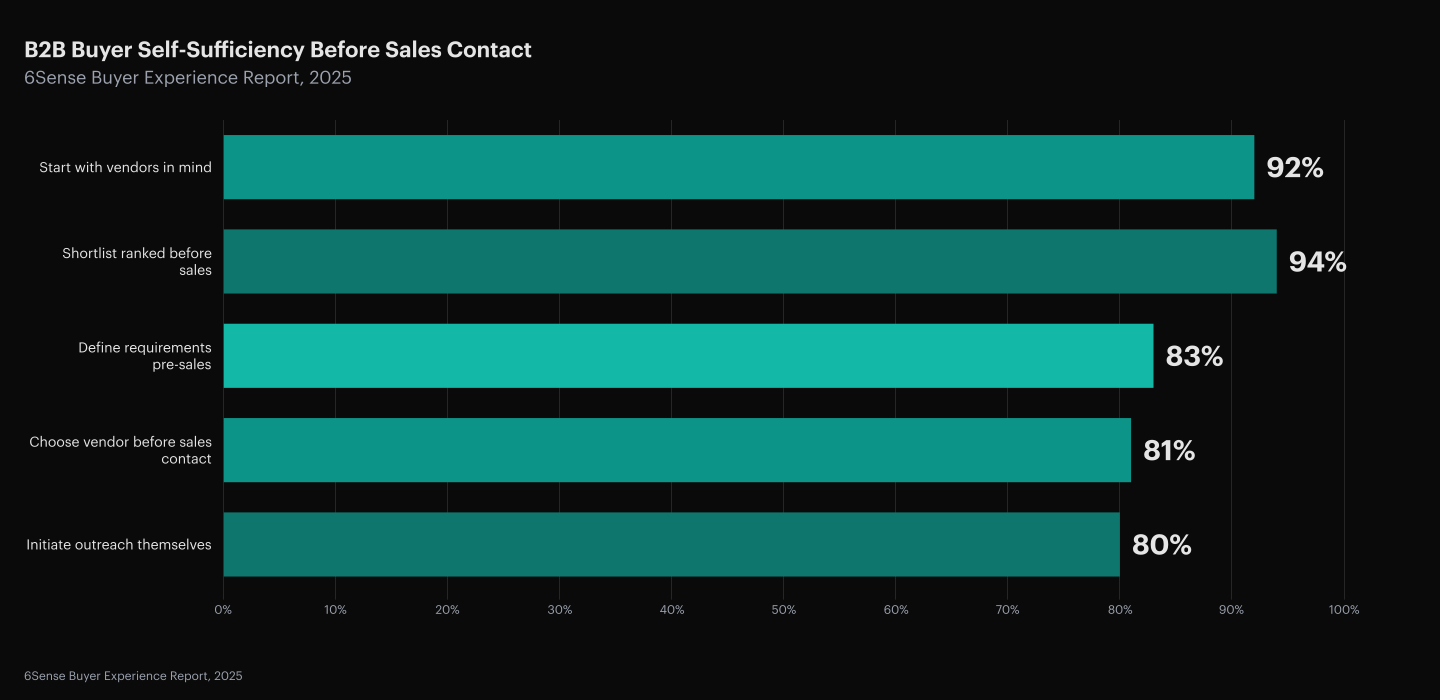
The implication is direct. Shortlist rank is decided on owned content and AI-cited content well before a sales rep is in the conversation, a pattern traced in detail in the B2B content funnel collapses when the click becomes optional. An article written to capture search-engine impressions on a category keyword rarely appears in the AI citations a buyer reads during that 83% pre-sales research window, because the awareness-stage keyword target is not the same as the evaluation-stage AI prompt.
Awareness SEO Content Does Not Make the AI Shortlist
Only 12% of AI-cited URLs across ChatGPT, Perplexity, Gemini, and Google AI Mode rank in Google’s top 10 for the original prompt (Ahrefs with BrightEdge, 2026). The ranking-for-traffic playbook awareness content was built on does not transfer to being cited by an AI engine during vendor evaluation.
Semrush found ChatGPT cites webpages ranking position 21 or lower in traditional search nearly 90% of the time (Semrush, July 2025). The pages awareness-stage SEO optimization was never designed to produce are the ones AI engines prefer to extract from. A 2,200-word category guide written for position 1 on a head keyword is structurally light where AI needs density (tables, definitions, labeled blocks) and deep where AI does not retrieve from (long prose introductions, brand storytelling paragraphs, narrative closes).
| Signal | Awareness-Stage SEO | Decision-Stage AI Citation |
|---|---|---|
| Retrieval surface | Blue-link SERP | Generated answer with inline citations |
| Preferred page position | Top 10 organic | Positions 21 and below 90% of the time |
| Primary extraction unit | Title and meta description | Answer capsule, table, labeled block |
| Supporting evidence | Keyword-aligned prose | Attributed statistic in first 1 to 2 sentences under heading |
| Structural density | 2 to 3 elements per page | 13.55 elements per page in top quartile |
Pattern data is from the Res AI 852-article B2B citation structure study (Res AI, 852-article B2B citation structure study, 2026). The structural bar awareness content is measured against in Google is not the bar AI retrievers apply during evaluation-stage prompts.
The split shows up on a domain too new to have any awareness footprint at all. Fifteen days after launching with two articles built to the decision-stage structural template, tryres.ai recorded 408 Google impressions and 0 clicks at average position 9.9, while Perplexity cited the same articles at #1 and #7 on “domain authority in AI citations” and “brands winning AI search” (Res AI, day-15 launch citation proof, 2026). The Google awareness path returned nothing in 15 days; the structurally complete pages cleared the AI citation bar in the same window.
AI Referrals Convert 534% Above Site-Wide Average
AI referral traffic influences conversion events at a rate 534% higher than the average across all website channels (Eyeful Media, 2026). The traffic that awareness-stage content does not catch is the most commercially valuable traffic the site receives, and losing it is not a distribution penalty. It is a revenue one.
Semrush’s 500-topic AI search study found the average AI search visitor is 4.4 times as valuable as the average visitor from traditional organic search on a conversion-rate basis, and projected AI visitors will surpass traditional search by early 2028 (Semrush, July 2025). The conversion-rate gap is not the awareness-stage story. It is the decision-stage story. Buyers who arrive through an AI citation arrive pre-qualified, pre-educated, and one click from a purchase decision, which is why AI referral traffic behaves more like late-stage paid search than early-stage organic.
Awareness-stage content keeps producing the organic visits that convert at the site-wide baseline. The delta between that baseline and the 534% AI referral lift is the revenue awareness-only content programs never see, because their content libraries were not structured for the citation that produces the referral in the first place. The budget mismatch is sharper still inside the broader content spend, covered in content budgets are growing into a channel buyers have already left.
GEO Vendors Split on Who Ships the Decision-Stage Fix
Every vendor in the category sees the same awareness-to-decision gap, and vendors split on whether they alert the content team to the gap or close it directly inside the connected CMS. The matrix below compares each platform on what it produces for decision-stage content work, where the work physically ships, and what the team gets back.
| Platform | Scope of work | Where it ships | Output for the team |
|---|---|---|---|
| Res AI | Rewrites awareness pages into decision-stage extractable blocks and generates net-new comparison content | Direct CMS deploy via natural-language edits | Published structural changes within minutes |
| Profound | Monitors brand presence and writes briefs for marketing and PR teams | Standalone dashboard with brief handoff | Strategy briefs and prompt-volume reports |
| Conductor | Enterprise AEO data unified with content production | Unified platform across AEO and SEO teams | End-to-end AEO workflows with collaboration |
| Peec AI | Tracks visibility, position, and sentiment with no editing layer | A monitoring dashboard, no editing layer | Tracking dashboards for SEO and content teams |
| Athena | Tracks AI visibility across 8+ LLMs and surfaces optimization recommendations | Cross-platform tracking across 8+ LLMs | Optimization recommendations the team applies |
| AirOps | Produces content via multi-model AI workflows | Multi-region content production pipelines | Pages and Pro workflows from creation to refresh |
The category split maps to the buyer shift. Monitoring platforms surface the decision-stage gap as a dashboard alert. Execution-first platforms close it directly in the CMS, which is the difference between knowing awareness content is missing from AI citations and shipping the structural pass that makes it cited.
Frequently Asked Questions
Why does awareness-stage keyword coverage fail inside AI chatbots?
AI chatbots compress awareness, evaluation, and decision queries into a single session, and retrieval favors structured passages over keyword-aligned prose. Semrush found ChatGPT cites webpages ranking position 21 or lower in traditional search nearly 90% of the time (Semrush, July 2025), which is the band awareness-stage SEO was never aimed at.
Is this a problem only for top-of-funnel content or for the full library?
The full library. 94% of business buyers use AI at every stage of the purchasing journey (Forrester, 2025), so every piece of content the buyer touches during research, evaluation, and selection is now part of the AI-citation problem, not just the awareness pieces.
Why would a buyer switch vendors based on what an AI recommends?
Because the AI chatbot is the primary research interface for a majority of the journey, not a supplement. 85% of B2B software buyers think more highly of a vendor when an AI chatbot mentions it in a recommendation, and 45% name software review citations as the single most confidence-inspiring signal in an AI response (G2, 2026).
How early in the journey does the AI citation matter?
Before sales is in the conversation. Buyers reach sales at 61% of the journey complete, with 83% already defining purchase requirements beforehand (6sense, 2025), which means the AI-cited content is doing the shortlist work during self-serve research.
What is the gap between an awareness article and a decision-stage one?
Structural density. Top-cited B2B pages average 13.55 structural elements per page versus 2.98 in the bottom quartile (Res AI, 852-article B2B citation structure study, 2026). Awareness articles typically hit the bottom-quartile bar even at high word counts because prose padding is structurally invisible.
Can the same page serve awareness and decision-stage AI prompts?
Yes, if the structural density is high enough. The Princeton GEO study found adding statistics boosts AI visibility by 41% and authoritative language adds 25%, while keyword stuffing drops it by about 10% (Princeton/Georgia Tech/Allen AI/IIT Delhi, KDD 2024). A single page can cover both surfaces once the awareness prose is converted into extractable structures.
How fast can a restructured page start appearing in AI citations?
Faster than a net-new article ranks in Google. Semrush’s own GEO program saw LLM citation results within days, sometimes hours, after publishing restructured content, and AI share of voice nearly tripled from 13% to 32% between July and August 2025 (Semrush, October 2025).
What happens to awareness-stage traffic when the library gets restructured for decision-stage citation?
It usually holds or grows. The Princeton GEO study found fluency optimization adds 15% AI visibility with no SEO penalty, and attributed-statistic density tends to raise organic rankings as well. The decision-stage restructuring does not require abandoning the awareness-stage traffic the page was earning.
How Res AI Restructures Awareness Libraries Into Decision-Stage Citations
The 94% of business buyers using AI at every purchase stage and the 69% who flip their intended vendor based on AI chatbot guidance describe the same problem. The content library was built for awareness-stage search, and the decision now happens inside a surface that retrieves from structured data rather than SEO-optimized prose. Res AI restructures existing web content through a natural language interface that edits connected CMSs directly, so an awareness-stage library ships decision-stage citations without a developer queue or an agency brief.
The Strategy Agent monitors which prompts competitors are winning inside the AI answer engines and identifies the structural features separating cited pages from invisible ones. The Citation Agent runs a research pipeline that backs every claim in a page with a verifiable statistic pulled from a current source, matching the attributed-claim density AI retrievers reward. The Content Agent converts dense awareness-stage prose into the extractable structures decision-stage prompts cite: bold-labeled product blocks, comparison tables, how-to-choose steps, pricing grids, product reviews, and definitions. Edits publish directly into WordPress, Webflow, Framer, or Contentful on command.
Res AI’s pricing is custom, scoped to each client’s library size and budget, with no fixed tiers or per-plan page and prompt caps. The restructuring cadence runs weekly rather than quarterly, which matches the pace at which buyer journeys now move inside AI chatbot surfaces.
Res AI restructures the awareness-stage content your team already produced into the decision-stage citations 94% of B2B buyers now rely on across every purchasing stage, so the library is present at the shortlist moment instead of absent from it. The platform edits WordPress, Webflow, Framer, and Contentful libraries through a natural-language interface, with custom pricing scoped to your library size and budget.