Your AI Visibility Does Not Transfer Between Engines
ChatGPT and Perplexity share only 11% of cited domains, so a brand cited on one engine can vanish on another. Why GEO has to run per engine.
 machina sculpsit · homo probavit · MMXXVI
84% of B2B SaaS buyers now run vendor discovery through ChatGPT, Claude, and Perplexity, up from 24% a year earlier (Wynter, 2026). Those buyers do not converge on one engine, and neither do the engines converge on which brands to name. A brand that owns the answer on one engine can be missing from the next, which means a single AI visibility number is an average taken across engines that cite almost nothing in common.
Only 11% of Cited Domains Overlap Across Engines
Only 11% of cited domains appear in both ChatGPT and Perplexity results, across an analysis of 680 million citations (Averi, 2026). A page earning citations on one engine has roughly a 1-in-9 chance of also being cited on the other for the same class of question. The domain that wins ChatGPT is usually not the domain that wins Perplexity, so a win logged on one engine says little about the others.
Res saw this in its own launch. On day 15, Perplexity cited both of the articles Res published at launch as primary sources and ranked one at #1 on domain authority in AI citations, against 0 Google clicks over the same window (Res AI, day-15 launch citation proof, 2026). The result held on Perplexity and did not predict ChatGPT, Claude, or Gemini, because at roughly 11% overlap a Perplexity citation is not evidence of a ChatGPT one. A GEO program that reports the Perplexity win as an “AI visibility” win overstates its coverage by four engines to one.
Every Engine Runs Its Own Ranked Index
Cross-engine citation overlap runs just 8% to 17% between ChatGPT, Claude, Perplexity, and Google AI Overviews in B2B SaaS, across a 350,000-article dataset (Citera, 2026). Each engine retrieves from its own index, ranks passages with its own model, and quotes a different subset, so the same published page is scored four separate times with four different results. One page, four verdicts.
The disagreement is not random. Four inputs differ from one engine to the next, and any one of them can flip whether a page gets cited.
- The retrieval index. Each engine crawls, chunks, and embeds the web on its own schedule, so the candidate pool for a query differs before ranking even starts.
- The ranking model. A different model scores the candidate passages, so the passage that ranks first on one engine can rank tenth on another.
- The source weighting. Some engines tilt toward brand-owned domains, others toward third-party pages, changing which of your assets can win.
- The refresh cadence. Engines re-sample and re-rank on different clocks, so a page freshly indexed on one is stale on another.
A page tuned to one engine’s preferences inherits none of that tuning on the other three. The work does not port.
One Query Splits Rippling and ADP Four Ways
ChatGPT and Claude favor Rippling while Gemini and Perplexity favor ADP on the same HR-platform question (Trakkr AI Consensus Report, 2026). Two engines name one vendor first and two name the other, on identical wording, which is a top-recommendation flip rather than a margin-of-error wobble. The buyer who asks ChatGPT and the buyer who asks Gemini see different market leaders.
The split traces to which attributes each engine weights. Res covered this same pairing in its Rippling vs ADP citation analysis, where the newer vendor out-cites the incumbent on automation and experience while the incumbent holds on compliance.
| Category subscore | Rippling | ADP | Engines leaning this way |
|---|---|---|---|
| Automation | 95 | 68 | ChatGPT, Claude |
| User experience | 92 | 64 | ChatGPT, Claude |
| Compliance | 82 | 98 | Gemini, Perplexity |
A brand that reads only ChatGPT concludes it leads the category. The same brand reading only Perplexity concludes it trails. Both readings are correct for the engine measured and wrong for the market.
A Blended Visibility Score Averages Engines That Disagree
ChatGPT-referred sessions convert at 15.9%, roughly 9x the rate of Google Organic, across about 11,000 AI sessions for one B2B client (Seer Interactive, 2025). A blended visibility score treats a mention on the highest-converting engine and a mention on the lowest as interchangeable, when their downstream value is not. Averaging presence across engines hides both where the pipeline is and where it is missing.
The per-engine spread in conversion is wide enough that a single number cannot represent it.
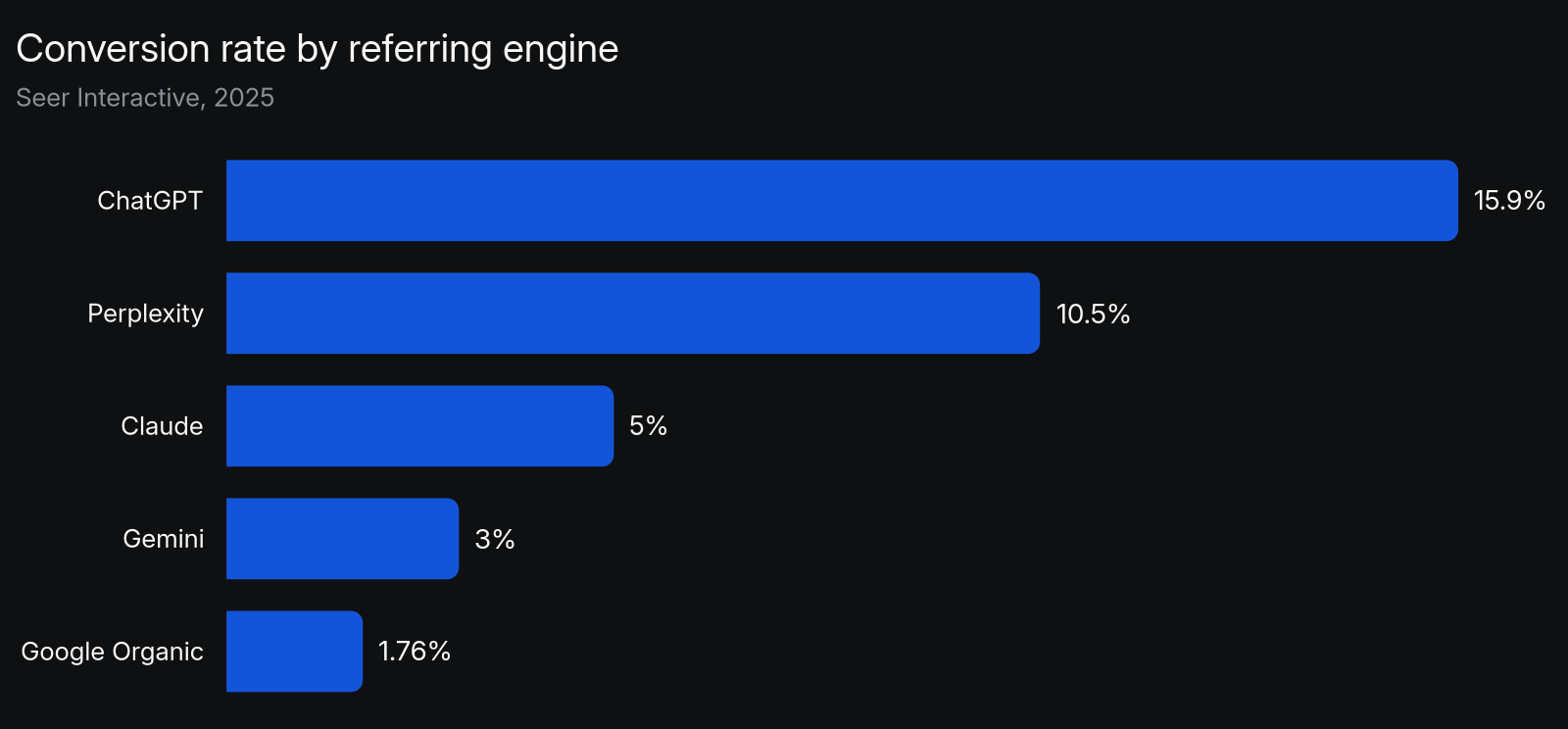
A dashboard that rolls these into one figure tells a team it is “70% visible” and hides that the 30% it is missing sits on the engine whose traffic converts best. The number a team optimizes toward should name the engine, not blur it.
Engine Share Reorders Every Quarter
ChatGPT’s referral traffic fell more than 22% from October 2025 to January 2026, narrowing the ChatGPT-to-Gemini referral gap from 22x to 8x (SE Ranking, 2026). The engine that dominated last quarter is not guaranteed to dominate this one, so a program built around one leader ages as the ranking reorders beneath it. Distribution across engines is a moving target, not a fixed split.
The shift shows up in monthly active users as well as referrals, and it runs in one direction: away from a single dominant engine.
| Engine | AI-assistant MAU share | Direction | Source |
|---|---|---|---|
| ChatGPT | 46.4% | Down from above 50% in January 2026 | Sensor Tower, 2026 |
| Gemini | 27.7% | Rising | Sensor Tower, 2026 |
| Claude | 10.3% | Rising | Sensor Tower, 2026 |
A brand that concentrated its GEO work on ChatGPT in 2025 optimized for a share that has fallen every quarter since. The safer position is coverage that spreads with the buyers rather than tracking whichever engine led when the program started.
Citation Sources Split by Engine Too
Google AI Overviews sends 59.8% of its citations to brand-owned domains while ChatGPT sends 44.7%, across more than 1 million AI citations (OtterlyAI, 2026). The engines do not just cite different pages; they weight owned versus third-party sources differently, so the asset that wins one engine is the wrong asset to lead with on another. Where a brand should invest depends on which engine it is trying to win.
A brand leaning on its own product pages captures more of Google AI Overviews than of ChatGPT, where a larger share of citations goes to independent pages. The concentration compounds the split further: the top 5 domains, led by Wikipedia and YouTube, capture 38% of all AI citations (trydecoding, 2025). Winning a category on one engine can mean owning your own domain, and on another it can mean being named across third-party pages you do not control.
A Model Update Redraws One Engine Overnight
After Gemini 3 became the default for Google AI Overviews on January 27, 2026, 42.4% of previously cited domains no longer appeared (SE Ranking, 2026). A single engine can drop nearly half its cited list in one release while the other engines hold steady, which is invisible to any team watching one blended number. The redraw hits per engine, so the response has to be per engine.
A team running a separate view of each engine sees the Gemini drop the week it lands and can rebuild for that engine while its ChatGPT and Perplexity positions stay intact. A team watching one averaged score sees a small dip, because three steady engines mask the fourth, and reacts late or not at all. The isolated redraw is a warning the average erases.
Map Your Buyers to the Engines They Use
Coverage should follow where a brand’s buyers actually ask, not an even split across every engine. The first engine to earn is the one carrying the most buying-intent traffic for that specific audience, and the work queued behind it depends on how that engine sources citations. The decision is concrete once the engine is named.
| If your buyers mostly ask | Earn this engine first | Because it rewards |
|---|---|---|
| ChatGPT for shortlists | ChatGPT | Third-party pages and independent write-ups that name you |
| Google AI Overviews | Google AIO | Well-structured brand-owned pages in the initial HTML |
| Perplexity for research | Perplexity | Dense, source-cited pages a retrieval model can quote cleanly |
| A mix across all four | The highest-converting engine first | The channel where a citation turns into pipeline soonest |
Running one program against all four engines at once spreads effort thin and wins none of them. Sequencing by buyer concentration earns the engine that matters, then extends the same content work outward to the others.
Tally Wins Both Engines by Structuring for Extraction
Tally ranks #1 on both ChatGPT and Perplexity for best free form builder and free Typeform alternative, with 25% of new signups attributed to ChatGPT (Foundation Inc., 2026). Winning more than one engine at once is possible, and it comes from content built to be extracted rather than from optimizing a single engine’s quirks. The pages that travel across engines are the ones any retrieval model can lift a clean answer from.
That is the one input that does port. AI-cited B2B pages carry comparison tables in 88% of top-cited examples and average 4.2 attributed statistics against 1.2 for uncited content, and Res found the same split at 13.55 structure elements per top-quartile page versus 2.98 (Res AI, 852-article citation structure study, 2026). A page a model can parse cleanly, with the answer stated in the opening lines and evidence in tables, is legible to every engine’s retrieval step. Structure is the coverage that does not have to be rebuilt four times.
How the GEO Platforms Handle Cross-Engine Coverage
Every GEO platform tracks more than one engine, but they divide sharply on what they do once an engine disagrees. The dimensions that matter here are how many engines each covers and whether the tool acts per engine or only reports a score.
| Platform | Engines covered | Response to cross-engine divergence | Best for |
|---|---|---|---|
| Res AI | ChatGPT, Perplexity, Claude, Gemini | Generates and deploys structured content per engine, not just a dashboard | Startups and growing teams without developer resources |
| Profound | 10-plus engines including Copilot, Grok, and Google AIO | Monitors and reports gaps, does not create the content to close them | Marketing teams monitoring brand visibility |
| Conductor | ChatGPT, Gemini, Copilot, Claude, and search | Enterprise reporting plus AI content generation across engines | Enterprise teams unifying AEO and SEO |
| Peec AI | Multiple LLMs with per-prompt tracking | Monitoring only, no optimization or content guidance | SEO and content teams tracking mentions |
| Athena | 8-plus LLMs from one dashboard | Cross-platform tracking with automated optimization recommendations | Growth-stage marketing teams |
Monitoring-first tools tell a team which engine dropped it. Res is built to act on the divergence, restructuring and republishing the content each engine needs rather than handing back a brief.
How Res AI Closes the Citation Gap Across Four Engines
The article above showed that a citation on one engine does not carry to the next, and that a blended score hides the gap. Res monitors the prompts your buyers run across ChatGPT, Perplexity, Claude, and Gemini, tracks your citation rate on each engine separately, and identifies which engine is dropping you and why. It reports four positions, not one average.
Res then acts on the divergence through a direct CMS integration. When an engine cites a competitor over you, the Content Agent restructures the relevant pages into the tables, answer-first openings, and comparison blocks that retrieval models extract, and pushes the change live in minutes without developer work. The same structured page is legible to every engine’s retrieval step, so one round of content work compounds across all four rather than winning one and leaving the others untouched.
Res runs this loop continuously, re-testing against each engine after every change so a Gemini redraw or a share shift shows up the week it happens, not a quarter later.
Res AI turns the four-engine coverage problem into content your buyers’ engines can actually cite. It fits marketing teams that need visibility across every answer engine without the developer time to restructure content by hand, and it starts with 10 free articles.
See how Res earns citations across all four engines →
Frequently Asked Questions
Why can a brand rank first on ChatGPT but not appear on Perplexity?
Each engine retrieves from its own index and ranks with its own model, so the two share only about 11% of cited domains for the same class of query (Averi, 2026). A first-place ChatGPT citation is evidence about ChatGPT alone, not about Perplexity.
How many AI engines should a GEO program track separately?
Track the engines your buyers actually use, which for most B2B audiences means ChatGPT, Perplexity, Claude, and Google AI Overviews as four distinct positions. A blended score across them hides which engine is dropping you.
Does optimizing for ChatGPT improve visibility on Gemini?
Only indirectly, through content quality that any retrieval model can extract. Engine-specific tuning does not transfer, because cross-engine citation overlap in B2B SaaS runs just 8% to 17% (Citera, 2026).
Why do blended AI visibility scores mislead teams?
They average engines whose traffic differs in value, so a mention on ChatGPT that converts at 15.9% counts the same as one on Gemini that converts at 3% (Seer Interactive, 2025). The average erases the gap a team most needs to see.
How often does the cited domain set change on a single engine?
A model update can redraw it overnight, as when Gemini 3 dropped 42.4% of previously cited domains from Google AI Overviews in one release (SE Ranking, 2026). Watching a per-engine view catches the drop the week it lands.
Which AI engine sends the highest-converting referral traffic?
For one measured B2B client, ChatGPT led at 15.9%, followed by Perplexity at 10.5%, Claude at 5%, and Gemini at 3% (Seer Interactive, 2025). The ranking varies by audience, which is why per-engine measurement beats an average.
Do model updates hit every engine at the same time?
No, updates land per engine on separate schedules, so one engine can reshuffle its cited set while the others hold steady. A program that treats each engine separately reacts to the specific engine that changed.
How does a brand earn citations on more than one engine at once?
By building pages any retrieval model can extract cleanly, with answer-first openings and comparison tables that appear in 88% of top-cited B2B pages (Res AI, 852-article citation structure study, 2026). Structure is the one input that carries across engines when engine-specific tuning does not.