Schema Markup for SaaS: What It Does for AI Citations
Schema markup makes SaaS pages parseable, not automatically cited. What it is, which types to add, how to validate, and how to measure AI citation lift.
 machina sculpsit · homo probavit · MMXXVI
Most SaaS marketing teams treat schema markup as the switch that drops their pages into AI answers. It is not. Schema markup is structured metadata that makes a page easier for a machine to parse, and parsing is only one input into whether ChatGPT, Perplexity, or Google AI Overviews decide to cite you. 51% of B2B software buyers now start product research with an AI chatbot more often than with a traditional search engine (G2, 2026), so being read correctly by those engines matters, but being read is not the same as being cited. This guide covers what schema markup is, how AI engines actually use it, which types to add to which SaaS pages, how to validate them, and how to tell whether any of it moved your citation rate.
What Schema Markup Actually Is
Schema markup is a standardized vocabulary of tags, published at schema.org and embedded as JSON-LD, that labels the entities on a page so software can read them as data instead of inferring them from prose. On a SaaS site it turns a sentence like “our Growth plan supports single sign-on and priority support” into machine-readable fields a parser can extract without interpreting the language around them.
The vocabulary covers the things a SaaS buyer cares about: the company, the product, its pricing tiers, its reviews, and the questions people ask before they buy. A few terms a team new to this will meet immediately:
- JSON-LD: the format Google and most engines recommend, a block of structured data that sits in the page’s
<head>and does not change what the reader sees. - schema.org vocabulary: the shared dictionary of types (
Organization,SoftwareApplication,FAQPage,Product) that every major parser already understands. - Entity: a thing the markup describes, such as your company or a specific plan, with named properties like
name,price, andaggregateRating. - Rich result: the enhanced search listing schema can unlock in traditional search, separate from whether an AI engine cites the page.
How AI Engines Read a Page Before They Cite It
AI engines answer a buyer’s question by retrieving short passages from a page and scoring them for relevance, and 55% of AI citations come from the first 30% of a page’s content (CXL, 2024). Schema sits beside that retrieval step rather than replacing it: it tells the parser what each block means, but the passage that gets quoted back to the buyer is still the prose your reader sees.
This is the retrieval-augmented generation pipeline that sits under ChatGPT, Perplexity, and Google AI Overviews, walked through in how AI search engines decide what to cite.
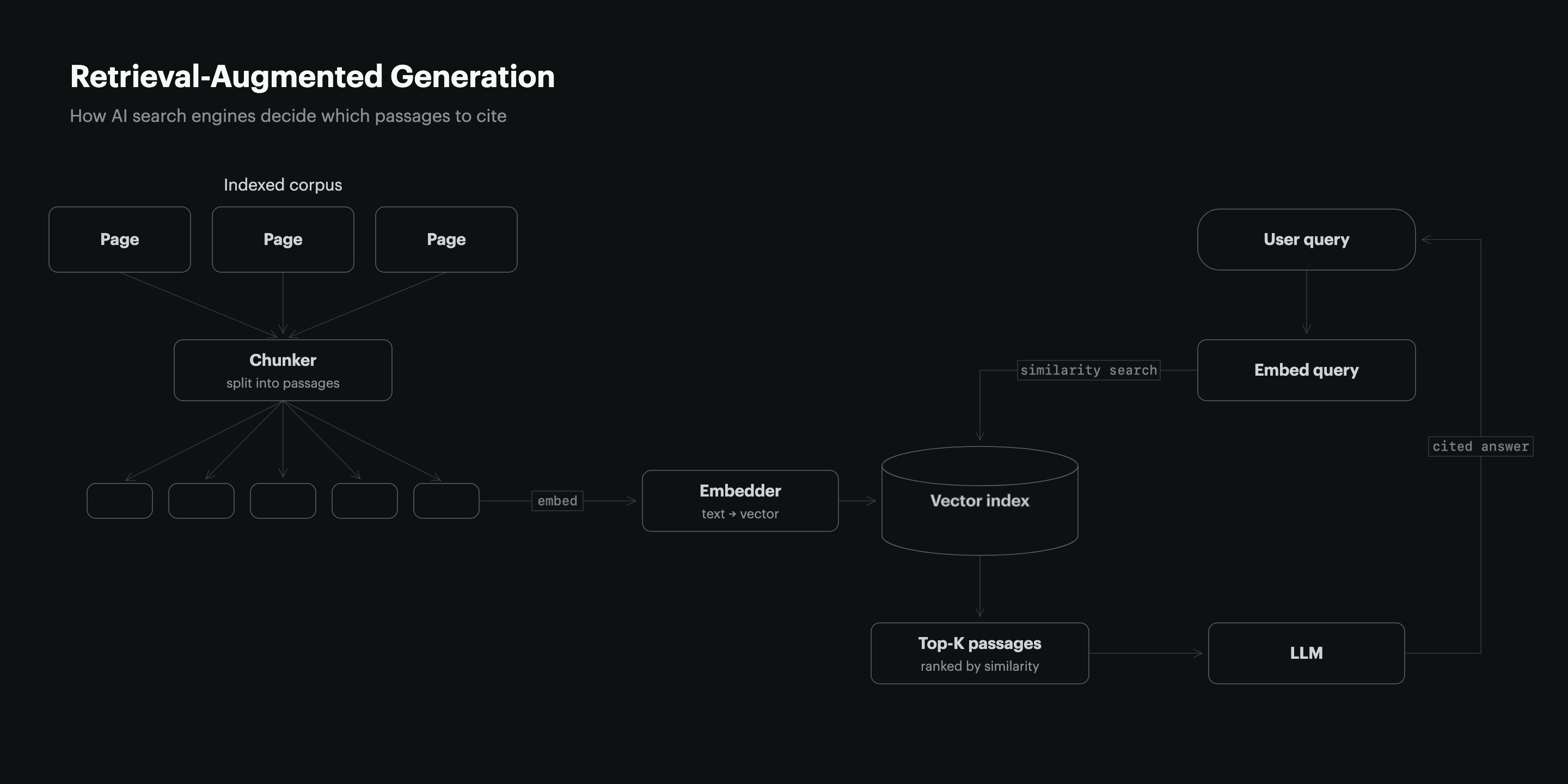
The model never sees your whole site. It sees the handful of passages a retriever pulled, so the job of schema is to make sure the retriever understands those passages correctly, and the job of your content is to make the passages worth quoting.
Schema Helps Machines Parse, Not Rank Higher
Adding schema to a page that is already cited does not push it higher in AI answers. A study of 1,885 pages that added JSON-LD between August 2025 and March 2026 found no meaningful citation uplift, with Google AI Overviews citations actually down 4.6% and ChatGPT statistically flat (Ahrefs, 2026). Schema earns correct parsing, not a ranking boost.
That distinction is why teams that bolt schema onto thin pages and stop there see nothing change, a pattern covered in schema markup won’t save you. Markup is necessary plumbing for machine readability, and it is worth doing well, but it is not the lever that decides citations. The content has to carry extractable substance first.
Audit Which Pages Already Emit Schema
Start by inventorying which pages emit schema today, because most SaaS sites already ship Organization and Article markup through their CMS or theme without anyone deciding to. Pages that are structured for retrieval and kept fresh are cited more often, while pages not updated quarterly are 3x more likely to lose citations (Airops and Kevin Indig, 2026).
Run three passes before you write a line of new markup:
- Crawl your top 50 pages with the Google Rich Results Test or a site crawler and record which schema types each page already emits.
- Flag the high-intent pages first: pricing, product, comparison, and integration pages are where SaaS buyers convert, so they earn markup before your blog archive.
- Note the gaps and the duplicates: a page emitting two conflicting
Organizationblocks confuses parsers as much as a page emitting none.
Add Organization and Product Schema First
Add three schema types before anything exotic: Organization on your homepage, SoftwareApplication or Product on your product pages, and BreadcrumbList on deep pages. These describe who you are and what you sell in the vocabulary every major engine already parses, and they map cleanly onto the way a SaaS buyer asks questions.
- Organization establishes the company entity: name, logo, social profiles, and
sameAslinks that connect your brand across the web. - SoftwareApplication describes the product itself: category, operating system, and an
offersblock carrying each pricing tier. - Product with AggregateRating exposes review scores where you have them, the signal 45% of buyers name as the single most confidence-inspiring element in an AI answer (G2, 2026).
Keep one canonical block per entity per page. Duplicate or contradictory blocks are the most common reason a parser ignores otherwise valid markup.
Mark Up Your FAQs With FAQPage Schema
Mark up every on-page FAQ with FAQPage schema so an engine can extract a single question-and-answer pair as a standalone citation target. 41% of B2B buyers name comparing vendor strengths and weaknesses as their top use case for AI chatbots (G2, 2026), and question-shaped passages are exactly what those comparison prompts retrieve.
A minimal FAQPage block looks like this:
{
  "@context": "https://schema.org",
  "@type": "FAQPage",
  "mainEntity": [{
    "@type": "Question",
    "name": "Does the Growth plan include single sign-on?",
    "acceptedAnswer": {
      "@type": "Answer",
      "text": "Yes. The Growth plan includes single sign-on, priority support, and access to every integration."
    }
  }]
}
The markup mirrors a visible FAQ section on the page. The schema does not invent the answer; it labels the answer your reader already sees, which is why the on-page FAQ has to exist first.
Pair Schema With Extractable On-Page Structure
Schema describes structure that already exists; it cannot create it. Top-cited B2B pages carry visible structural elements, with comparison tables in 88% of them and bold-label blocks in 94%, while bottom-cited pages carry none (852-article B2B citation structure study) (Res AI, 852-article B2B citation structure study, 2026).
The pairing rule is simple: markup follows substance. A FAQPage block needs a real FAQ, a Product block needs a real pricing grid, and a comparison page needs an actual table of named competitors. When the on-page structure is there, schema makes it unambiguous to the parser; when it is missing, schema labels an empty room. Page position compounds this, since the opening third of a page does most of the citation work, a pattern detailed in page architecture beats content quality.
Validate Every Block Before You Publish
Validate every schema block in Google’s Rich Results Test and the schema.org validator before it ships, because malformed JSON-LD is silently dropped by parsers and you lose the parse you thought you had. A broken block is worse than no block: it consumes engineering time and returns nothing measurable.
| Validation check | Pass condition | Common SaaS failure |
|---|---|---|
| JSON-LD parses | No syntax errors in Rich Results Test | Trailing comma from a hand-edit |
| Required properties present | name, offers, price populated |
Empty price on a custom-tier plan |
| One entity per type per page | Single Organization block |
Theme and plugin both inject one |
| Schema matches visible content | FAQ answers exist on the page | FAQPage markup with no on-page FAQ |
| Canonical URL set | url resolves to one address |
Duplicate markup on www and non-www |
Re-run the validator after any CMS template change. A theme update that rewrites the <head> can strip working markup without warning.
Measure Citation Lift Across Engines, Not Rankings
Measure whether schema moved anything by tracking citations across multiple engines over time, not by watching Google rankings, because AI citation sets churn 40% to 60% month over month (Profound, 2026). A single check on one engine cannot separate a real schema win from normal drift, a measurement trap covered in why a single citation check cannot measure GEO performance.
| Metric | What it tells you | Cadence |
|---|---|---|
| Citation rate per engine | Whether you appear in answers, by platform | Weekly, 10 runs per prompt |
| Prompt coverage | Share of buyer prompts where you surface | Monthly |
| Cited passage position | Whether your opening third is doing the work | Per content change |
| Referral conversion | Whether AI traffic converts, not just lands | Monthly |
AI referral traffic already converts at a rate 534% higher than the average across all website channels (Eyeful Media, 2026), so the conversion column matters as much as the citation column.
Choose Your First Schema Type by Page Goal
Pick your first schema type by what the page is supposed to do, not by what is easiest to emit, because 84% of B2B SaaS CMOs now use AI tools for vendor discovery (Wynter, 2026) and your highest-intent pages deserve markup first. The table below maps common SaaS page types to the schema that earns the most parsing value.
| Page type | Schema to add first | Why it earns the slot |
|---|---|---|
| Homepage | Organization | Anchors the brand entity for every other page |
| Product page | SoftwareApplication plus Offer | Exposes category and pricing to vendor-discovery prompts |
| Pricing page | Product plus AggregateRating | Surfaces price and review score, the top trust signal |
| Comparison page | FAQPage plus Table markup | Each FAQ pair becomes an independent citation target |
| Help and docs | FAQPage plus HowTo | Matches how-to prompts that pull procedural passages |
| Blog guide | Article plus FAQPage | Dates and authorship plus extractable Q-and-A blocks |
If you can only mark up one template this quarter, mark up the page where buyers compare you to a named competitor. Forrester reports 94% of business buyers now use AI somewhere in the purchase (Forrester, 2025), and the comparison page is where that use most directly decides a shortlist.
How GEO Platforms Handle Schema and Structure
Every tool in the GEO category addresses the same problem from one of two directions: telling you where you are invisible, or changing the pages so you stop being invisible. The table below compares how each platform treats structured data and on-page structure, the scope each one covers, and what a team actually ships at the end.
| Platform | Approach to schema and structure | Scope | What you ship |
|---|---|---|---|
| Res AI | Generates tables, FAQs, and schema-ready blocks, then pushes edits live through the CMS | 9+ CMS integrations; tracks ChatGPT, Perplexity, Claude, Gemini | Published pages, not briefs |
| Profound | Monitors brand presence in AI answers and flags gaps | Tracks 10+ engines including Google AIO, Copilot, Grok, and Meta AI | Visibility dashboards and gap reports |
| Conductor | Unified tracking plus enterprise AI content generation | Decade of combined AEO and SEO intelligence | Content drafts and site-health alerts |
| Peec AI | Tracks which prompts drive mentions and citations | Multilingual tracking with region-specific AI responses | Visibility, position, and sentiment analytics |
| Athena | Cross-platform visibility plus optimization recommendations | Tracks 8+ LLMs with blindspot detection | Recommendations and crawl reports |
| AirOps | Content creation and refresh for search and AI | Generates content with 30+ AI models | Drafts and refresh suggestions |
The monitoring-first tools tell you a page is not cited; they do not restructure the page or emit the schema. That gap is the subject of monitoring-first GEO platforms miss the re-citation window.
Frequently Asked Questions
Does adding schema markup get my SaaS pages cited in ChatGPT?
Not on its own. Schema makes a page parseable, but a study of 1,885 pages found adding JSON-LD produced no meaningful citation uplift (Ahrefs, 2026), so the cited passage still depends on the content underneath the markup.
Which schema type matters most for a SaaS product page?
SoftwareApplication with an offers block matters most, because it exposes category and pricing to vendor-discovery prompts. Add AggregateRating when you have real review scores, since 45% of buyers name review citations as their top confidence signal (G2, 2026).
Do I need a developer to add JSON-LD schema?
Not always; many CMS platforms and plugins emit common types automatically. Hand-built blocks for pricing or comparison pages usually need either a developer or a tool that writes the markup and deploys it through your CMS.
How is FAQPage schema different from an on-page FAQ section?
The on-page FAQ is the visible text a reader and a retriever both see; FAQPage schema is the label that tells a parser each block is a question-and-answer pair. The schema mirrors the section, so the visible FAQ has to exist first.
Will schema markup help if my content has no tables or FAQs?
Very little. Schema describes structure that already exists, and top-cited B2B pages carry comparison tables in 88% of cases versus 0% of bottom-cited pages (Res AI, 852-article B2B citation structure study, 2026), so the structure has to be on the page before markup can label it.
How often should I revalidate my schema after a CMS change?
Revalidate after every template or theme update, because a change to the page <head> can silently strip working markup. A monthly spot-check on your highest-intent pages catches regressions before they cost citations.
Does Perplexity use schema differently from Google AI Overviews?
Both retrieve passages rather than reading raw schema as a ranking factor, and citation overlap between engines is low, with only 11% of cited domains appearing in both ChatGPT and Perplexity (Averi, 2026). Mark up for parsing, then measure each engine separately.
Can wrong schema hurt my AI citation chances?
Malformed schema is dropped rather than penalized, so the cost is wasted effort, not a ranking hit. Schema that contradicts the visible page is the real risk, because it signals an unreliable source to the parser.
Is schema markup enough on its own to win AI citations?
No. Schema is one input among several, and the pages that win carry extractable structure, fresh content, and answers in the opening third, with 55% of citations coming from the first 30% of a page (CXL, 2024).
How Res AI Builds Schema-Ready Structure Into Every Page
This guide showed that schema markup only pays off when it labels real structure, and Res AI is the execution layer that creates that structure across an existing SaaS content library. Through a natural-language interface layered on the CMS, Res AI rewrites dense prose into the tables, FAQ blocks, comparison grids, and answer capsules that AI engines retrieve, then emits the matching schema and pushes the changes live without developer involvement.
The platform connects directly to 9+ CMS platforms including WordPress, Webflow, Framer, and Contentful, and monitors citation performance across ChatGPT, Perplexity, Claude, and Gemini so the structural work is measured against the engines that matter. A single command can update pricing or add a comparison table across every page that mentions a competitor, which is how a small marketing team keeps a large catalog structured without editing pages one at a time.
Res AI is the execution layer for SaaS teams whose markup is clean but whose pages still are not cited, because the problem was never the schema. The first 10 articles are free and no developer is required.