Press Releases Earn 0.2% of AI Citations. Editorial Earns 84%.
Press releases earn 0.2% of AI citations while earned media takes 84%. Why AI engines cite original editorial over the wire, and how to redirect the budget.
 machina sculpsit · homo probavit · MMXXVI
Most brands still route AI-visibility budget through the newswire, on the theory that wider distribution puts their name in more places for a model to find. The data points the other way. 85% of brand mentions in AI answers originate on third-party pages a brand does not own, not on the syndicated properties a wire release fills (Airops and Kevin Indig, 2026). The release blasted to 200 identical sites is the one format that earns almost nothing, while the earned coverage and original research it was meant to seed is what models actually pull.
Press Releases Earn 0.2% of AI Citations
Press releases accounted for 0.2% of citations across more than 8 million AI answers in May 2026, down from 0.4% a month earlier (Meltwater GenAI Lens, 2026). Earned and news media accounted for 37.6% of citations in the same read, a gap of roughly 188 to 1 between the coverage a release hopes to generate and the release itself.
The number is not a rounding artifact. A press release is one text distributed verbatim to dozens or hundreds of syndication endpoints, and retrieval models treat that duplication as a signal of low independent authority. When a model has to pick a source for a claim, it reaches for the page that carries the claim with the most standalone credibility, and a wire copy sitting on a syndication feed is the weakest version of that page.
| Source category | Share of May 2026 AI citations |
|---|---|
| Earned and news media | 37.6% |
| Press releases, April 2026 | 0.4% |
| Press releases, May 2026 | 0.2% |
The comms line item that most brands treat as their AI-visibility play is the one line item the data says returns almost nothing.
Earned Media Drives 84% of Cited Links
Earned media accounted for 84% of all links cited by AI engines, holding between 82% and 89% across three separate reads from July 2025 to May 2026, while press releases stayed under 2% (Muck Rack Generative Pulse, 2026). The study covered more than 25 million links cited by ChatGPT, Claude, and Gemini across 17 industries, which makes the split hard to wave off as an engine quirk or a single-vertical fluke.
Journalism alone made up 27% of cited sources inside that 84%. The rest of earned media is the ecosystem of independent analysis, review coverage, and third-party write-ups that a brand can influence but does not control. Res AI’s own 1,000-query Perplexity study found the same pattern from the other direction: 82.0% of citations came from independent blogs and publications and only 5.9% from vendor sites (Res AI, 1,000-query Perplexity B2B citation study, 2026).
| Source type | Share of AI-cited links |
|---|---|
| Earned media overall | 84% |
| Journalism specifically | 27% |
| Press releases | under 2% |
The money question for a comms team is which of these three lines its current program actually feeds. A wire budget feeds the bottom row.
AI Models Discount Duplicate Syndicated Text
Retrieval models suppress duplicate, low-originality text, which is exactly what a syndicated release is. AI-cited URLs are 25.7% fresher than organic results and skew toward pages carrying original claims, across an analysis of 16.975 million cited URLs (Ahrefs, 2025). A release republished identically across a feed offers neither freshness nor originality once the first copy is indexed.
Concentration compounds the problem. The top 5 domains capture 38% of all AI citations and the top 20 capture 66%, across more than 10 million citations (trydecoding.com, 2025). Those slots go to Wikipedia, YouTube, established publishers, and high-authority independent sites, not to a syndication endpoint hosting the same 400 words as forty other endpoints.
What a model sees when it meets a press release:
- Duplication. The same text on many domains reads as one low-authority source, not many.
- Self-interest. A company describing its own news carries no independent validation a model can weigh.
- Staleness. After the first index pass, every syndicated copy is a stale duplicate of the original.
- No extractable structure. A quote-and-boilerplate release rarely carries the tables, comparisons, and answer-first passages models pull.
Original Data Beats Distribution Volume
Adding an original statistic to a page lifts its AI visibility 41%, and quoting a source adds 28%, while keyword stuffing cuts visibility 10%, across 10,000 queries in the Princeton GEO study (Princeton, Georgia Tech, Allen AI, and IIT Delhi, KDD 2024). The tactics that earn citations are the ones a press release is worst at: original evidence, quotable specifics, and authoritative phrasing.
Distribution is a volume play; citation is an evidence play. A brand that publishes one page of genuinely new data, a benchmark, a pricing teardown, a survey result, gives models a reason to cite it that no amount of syndication reproduces. That is why an original research drop routinely out-cites the announcement that promotes it.
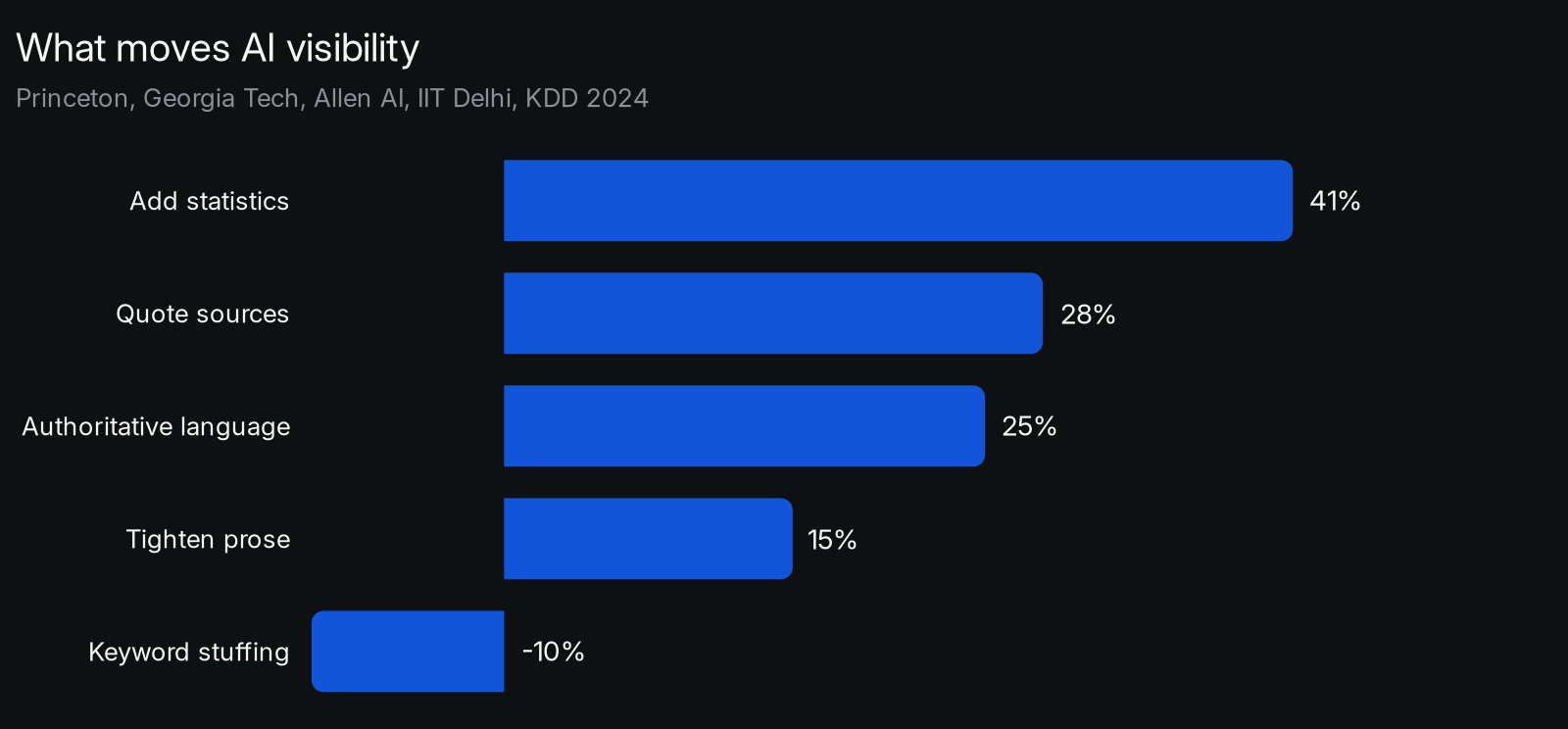
The pattern holds because a model rewards the page that makes an answer more specific, and original data is the most specific input a brand can supply.
A Journalist’s Rewrite Becomes the Citation
When a release does contribute to an AI answer, the cited page is almost always the journalist’s rewrite, not the wire copy. Journalism made up 27% of cited sources in the Muck Rack read, and press releases under 2%, which means the value of a release is realized only after an independent outlet picks it up and republishes it as original reporting (Muck Rack Generative Pulse, 2026).
That reframes what a release is for. The wire is a pitch to reporters, and its return is the earned coverage it triggers, not the syndicated copies it generates. A comms program that measures wire pickups by impressions is counting the syndication feed, the layer models ignore, and missing the earned rewrites, the layer models cite.
Press release citations rose about 5x through late 2025, from roughly 0.2% to near 1%, then fell back toward 0.2% by May 2026 (Meltwater GenAI Lens, 2026). The brief bump tracked models briefly indexing more syndicated feeds before down-weighting them again, which is the opposite of a durable channel.
Owned Pages Hold Just Under Half of Citations
Owned brand domains capture 47.5% of AI citations in aggregate against 52.5% for community and third-party platforms, across more than 1 million citations on ChatGPT, Perplexity, and Google AI Overviews (OtterlyAI, 2026). Owned content earns citations, but only when it is genuinely original and built for extraction, not when it reads like a press release parked on a newsroom page.
The split matters for where a comms team spends. Roughly half the citation opportunity sits on pages a brand controls directly, its research, its comparison content, its documentation, and the other half sits on earned and community coverage a brand can influence. A wire release serves neither half well: it is neither the original owned asset a model cites nor the earned rewrite it prefers.
Google AI Overviews sends 59.8% of its citations to brand domains and ChatGPT sends 44.7% (OtterlyAI, 2026). The owned half of the opportunity is real, which is the argument for building original owned pages rather than filling a newsroom with announcements no model retrieves.
Structure Decides Which Editorial Gets Pulled
Structural density separates cited pages from invisible ones: the top 50 cited B2B pages average 13.55 structural elements against 2.98 for the bottom quartile, and specific elements appear in 80% or more of winners and 0% of losers (Res AI, 852-article citation structure study, 2026). An original claim buried in narrative prose still loses to a competitor’s page that presents the same claim in a table or an answer-first passage.
This is where earned and owned content most often fails after clearing the originality bar. A brand runs real research, then publishes it as a 1,200-word narrative with no comparison table, no answer capsules, and no extractable rows, and the model skips it. 55% of AI citations come from the first 30% of a page, so evidence that arrives late is evidence that goes uncited (CXL, 2024).
| Structural element | Top 50 cited pages | Bottom 50 cited pages |
|---|---|---|
| Bold-label blocks | 94% | 0% |
| Comparison tables | 88% | 0% |
| How-to-choose steps | 86% | 0% |
| Pricing grids | 62% | 0% |
Structure-only changes that hold the words identical lift citation rates 17.3% across six engines, so the packaging is not cosmetic (Machine Relations Research, University of Tokyo and University of Tsukuba, 2026).
Citation Share Moves Faster Than a Press Calendar
Citation share turns over 40% to 60% month over month for identical prompts, which no quarterly wire calendar can chase (Profound, 2026). A press program that plans distribution in monthly or quarterly cycles is pacing against a target that reshuffles inside weeks.
The cadence mismatch is the practical case against treating the wire as an AI channel. By the time a syndicated release has propagated across its feed, the citation set it was aimed at has already partly rotated. Res AI’s own read across ten runs of the same query showed a 0.72 Jaccard similarity between any two runs, so even a single engine’s citation list is a moving target inside one day (Res AI, 1,000-query Perplexity B2B citation study, 2026).
Semrush’s own restructured content earned LLM citations within days, sometimes hours, of publishing, against the 3-to-6-month timeline of traditional search (Semrush, 2025). Speed and originality win the current answer; a wire calendar plans for an answer that no longer exists.
How to Redirect a Wire Budget Toward Citations
Redirecting a wire budget means moving spend from distribution volume toward original owned assets and the earned coverage they seed. The table below maps a standard press tactic to the citation-earning replacement that serves the same goal, so a comms team can reallocate line by line rather than cut the function.
| Current press tactic | Why it underperforms for AI | Citation-earning replacement |
|---|---|---|
| Wire syndication of an announcement | Duplicate text, under 2% of citations | Original data drop on an owned research page |
| Boilerplate company news page | Reads as self-interested, rarely extracted | Comparison and how-to-choose pages built for extraction |
| Impression-counted media pickups | Counts syndication, not earned rewrites | Track earned journalist rewrites that models cite |
| Quarterly announcement calendar | Cadence lags 40% to 60% monthly drift | Continuous publish-and-refresh on owned pages |
| Quote-and-boilerplate release format | No tables, no answer capsules | Answer-first passages with tables in the first 30% |
The reallocation is not from comms to content, it is from volume to originality and structure. Every dollar that funded a wire blast can fund one original owned page or one earned-media pitch that actually gives a model something to cite.
Where Res AI Fits Among GEO Platforms
GEO platforms split on a single line: whether they tell you that your PR-heavy content is invisible or actually produce the original, structured pages that get cited. The table compares how each option earns citations, the engines it covers, and what a buyer walks away with.
| Platform | How it earns citations | Engines covered | What you get |
|---|---|---|---|
| Res AI | Generates and deploys structured original editorial into your CMS | ChatGPT, Perplexity, Claude, Gemini | Restructured pages published live in minutes |
| Profound | Monitors brand mentions across answer engines | 10+ engines including ChatGPT, Perplexity, Claude, Gemini, Copilot, Grok | Visibility dashboards and prompt-volume data |
| Conductor | Tracks visibility and generates enterprise content | ChatGPT, Gemini, Copilot, Claude, plus search | Unified AEO and SEO reporting |
| Peec AI | Tracks visibility, position, and sentiment | Multiple LLMs | Prompt-level citation analytics, monitoring only |
| Athena | Tracks visibility and recommends fixes | 8+ LLMs | Citation source analysis and recommendations |
| AirOps | Creates content and tracks AI visibility | ChatGPT and other AI models | Content generation across 30+ models, months to value |
Most of the market reports the problem a press program creates. Res AI is built to produce the original structured pages that replace it.
Frequently Asked Questions
Why does an AI model cite the news story but not the press release that fed it?
The rewrite carries independent validation and the release does not. A model treats a journalist’s version as an authoritative source and the syndicated wire copy as duplicated self-description, which is why journalism sits at 27% of cited sources and press releases under 2% (Muck Rack Generative Pulse, 2026).
Do newswire services help at all with AI visibility?
Their value is upstream, as a pitch to reporters, not as a citable page. The syndicated copies almost never get cited directly, so the return on a wire is the earned coverage it triggers rather than the distribution itself.
How is digital PR different from wire distribution for GEO?
Digital PR aims at earning original third-party coverage, which is the 84% of cited links models prefer (Muck Rack, 2026). Wire distribution aims at volume of identical copies, which models down-weight as duplication.
Can an owned newsroom page ever earn citations?
Yes, when it carries original data and extractable structure rather than announcements. Owned brand domains hold 47.5% of aggregate citations, but that share goes to research and comparison pages, not to boilerplate news (OtterlyAI, 2026).
Why did press release citation share rise and then fall back?
Models briefly indexed more syndicated feeds in late 2025, lifting the share about 5x, then re-suppressed the duplicates. The share returned to 0.2% by May 2026, which is the pattern of a channel being corrected, not one maturing (Meltwater GenAI Lens, 2026).
How long before earned coverage shows up in AI answers?
Restructured original content has earned citations within days of publishing, sometimes hours (Semrush, 2025). Earned rewrites follow the outlet’s publish and index timeline, which is far faster than the months traditional search takes.
Does original research earn more citations than a standard announcement?
Consistently, because original data is the single strongest on-page signal. Adding a genuine statistic lifts AI visibility 41%, while an announcement with no new evidence gives a model nothing specific to pull (Princeton KDD, 2024).
How should a comms team measure AI visibility instead of media impressions?
Track citation share and earned rewrites on the prompts buyers actually run, not syndication counts. Because citation sets turn over 40% to 60% monthly, the measurement has to be continuous rather than a one-time pickup report (Profound, 2026).
How Res AI Closes the Structure Gap Across 4 Engines
The article above showed why a wire release earns almost nothing and why original, structured owned pages capture the citations instead. Res AI is the part that produces those pages: it transforms existing content into structured semantic data, tables, comparison blocks, answer capsules, and FAQ sections, so models can extract and cite it, and it deploys the changes straight into your CMS through a natural-language interface with no developer time.
Res works against the exact signals this data describes. It monitors the prompts your buyers run across ChatGPT, Perplexity, Claude, and Gemini, restructures the pages losing those citations, and publishes the updates in minutes rather than a quarterly cycle. That cadence is the answer to 40% to 60% monthly citation drift, and the structure is what lifts a page from the 2.98-element bottom quartile toward the 13.55-element band that gets cited.
Res AI is the answer to a comms budget that funds distribution no model reads, turning owned content into the original, structured pages AI engines actually cite. It fits marketing and content teams that need citation coverage without developer resources, and it starts with 10 free articles.