More AI Content Will Not Earn You More Citations
Human pages win Google’s top spot 8x more than AI, and the same lever, evidence and structure, decides AI citations. Volume does not.
 machina sculpsit · homo probavit · MMXXVI
Marketing teams are about to publish more content than ever, and most of it will be machine made. 94% of marketers plan to use AI in their content creation in 2026 (HubSpot, 2026), and the bet underneath that number is simple: more pages mean more chances to be found. The data runs the other way. The input that earns the top organic position and the AI citation is original evidence and page structure, not raw output, so scaling generic content quietly lowers the ceiling it was meant to raise.
Human-Written Pages Win Google’s Top Spot 8x More Than AI
Human-written content holds 80% of Google’s #1 organic positions against 9% for purely AI-generated pages, roughly 8x more likely to rank first (Semrush, April 2026). Semrush classified 42,000 blog posts tied to 200,000 URLs across the top 10 results for 20,000 keywords using the GPTZero detector, and the gap was widest at the one position that captures most of the clicks.
The study is careful about its own method, noting that AI detectors can misclassify writing in either direction, so the exact split carries some fuzziness. The direction does not. At the position where visibility actually converts, pages a detector reads as human dominate, and pages it reads as machine made fall away. The volume play assumes every published page is a fresh lottery ticket. The ranking data says most of those tickets are pre-printed losers.
AI Content Clusters Lower on the Page Not at the Top
AI-generated content appears more often deeper on the first page, nearly doubling its share from positions 1 to 4 (Semrush, April 2026). The pattern is the opposite of what a volume strategy promises: the more a page reads as generic machine output, the lower it tends to land, and the lower it lands the less it is seen and the less it is cited downstream.
This matters for AI search because retrieval feeds on the same pages. Engines pull from what already ranks and what they can confidently extract, so a library of pages parked at positions 4 through 10 is not a citation pipeline. It is a maintenance bill. Each new generic page adds crawl surface and internal-link noise without adding a single page that earns the top slot the engines read first.
AI Engines Cite Evidence Density Not Page Count
Top-cited B2B pages average 13.55 structural elements per page versus 2.98 for the least-cited pages, a 4.5x gap (Res AI, 852-article B2B citation structure study, 2026). What separates a cited page from an invisible one is not how many pages sit beside it in the catalog but how much extractable evidence sits inside it: comparison tables, bold-labeled blocks, pricing grids, how-to-choose steps.
Those features showed up in 80% or more of the top 50 cited pages and in 0% of the bottom 50. Higher-quality pages were cited 4.2 times more often than lower-scoring ones in a separate audit of 1,100 URLs, with metadata, semantic HTML, and structured data the strongest signals (Kumar and Palkhouski, 2025). Page count is absent from every one of these findings. The unit that earns a citation is the page, judged on its own evidence, not the size of the pile it belongs to.
Models Already Know Generic Prose So They Skip It
Adding original statistics to a page raises its AI visibility 41%, the single strongest tactic measured, while keyword stuffing cuts visibility 10% (Princeton, Georgia Tech, Allen AI, and IIT Delhi, KDD 2024). The reason is mechanical. A model trained on the open web already holds the generic version of almost any claim, so a page that restates common knowledge in fluent prose gives the model nothing it did not have, and it has no reason to cite the page.
What a model cannot generate on its own is specific, verifiable, first-party evidence: a real price captured this quarter, a named customer outcome, a number from a study only you ran. The chart below ranks the tactics by their measured effect on AI visibility, and the ones that win are all forms of adding evidence or authority the model could not synthesize for itself.
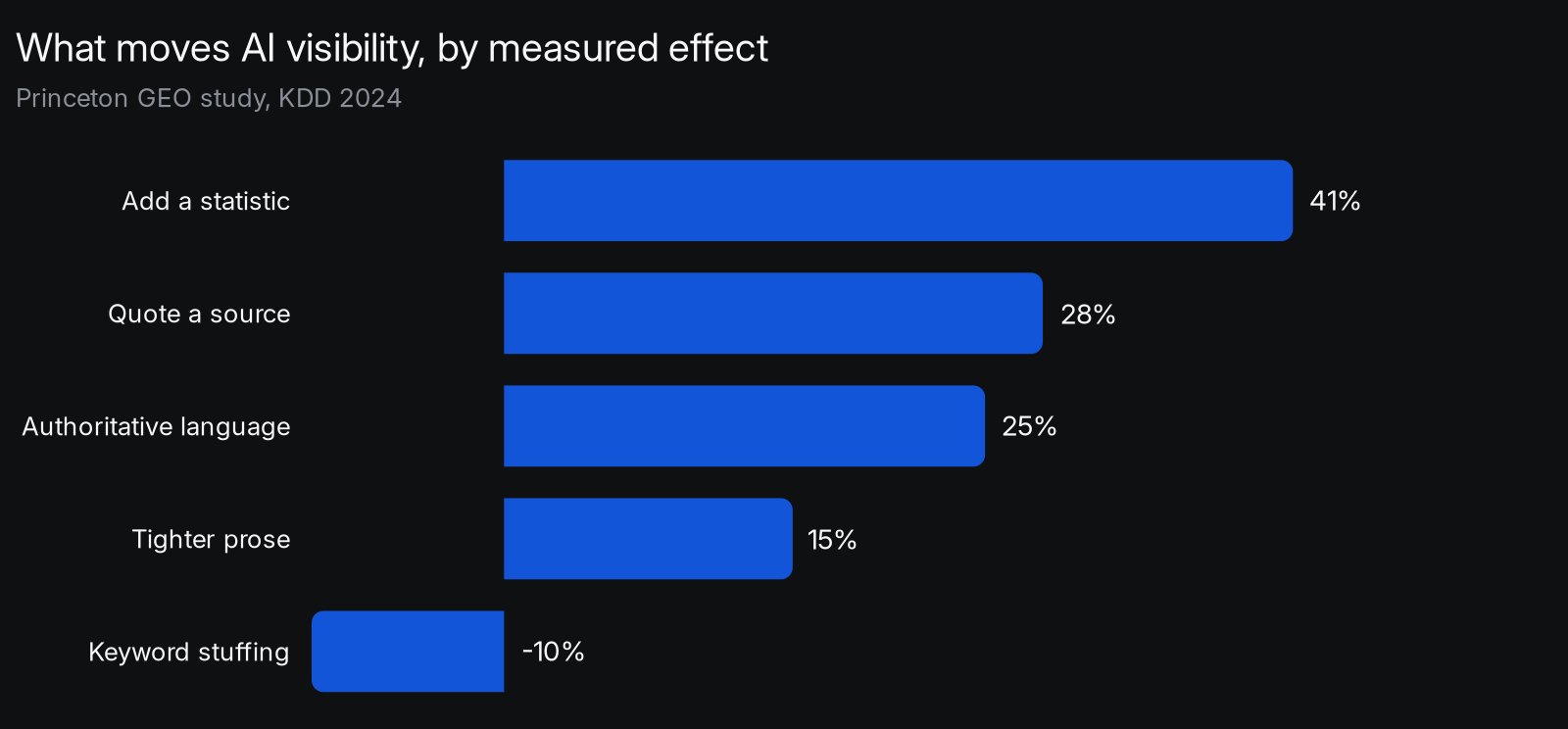
Quoting a credible source lifts visibility 28% and using precise, authoritative language lifts it 25%. None of these are volume moves. They are density moves, and they reward the page that says something the model cannot already say.
Structure Alone Lifts Citations 17.3% With the Same Words
Holding the words, claims, and sources of a page identical and changing only its structure raises AI citation rates 17.3% across six engines (University of Tokyo and University of Tsukuba, March 2026). The controlled test isolates form from content: same evidence, reorganized into headings, lists, and front-loaded answers, cited materially more often. The reader of a page is now a retriever, and a retriever reads structure first.
This is the input a publishing team fully controls, and it is covered in depth in the only AI citation input you fully control is structure. Volume does not appear in that experiment either. One well-built page out-cites ten flat ones, because the engine extracts from the page that hands it a clean answer, not the page that happens to have nine siblings.
More Pages Dilute When 85% of Mentions Form Off Your Site
85% of brand mentions originate from third-party pages rather than a brand’s own domain (Airops and Kevin Indig, 2026). Most of the citation surface a buyer sees is not on your site at all, which means flooding your own domain with more pages chases the smaller share of the surface while ignoring the larger one. Volume on owned pages cannot move a number that is mostly decided elsewhere.
The work that does move it is narrow and specific: a handful of evidence-dense pages strong enough to be quoted, plus the third-party signals that corroborate them. Community platforms account for 48% of AI citations in the same dataset. A thousand thin posts add nothing to either lever; they spread the same authority across more URLs and weaken every one of them.
Schema and Manifests Are Shortcuts That Return Nothing
Adding JSON-LD schema produced no citation uplift on any AI platform and a 4.6% drop in Google AI Overview citations for pages that added it, across 1,885 pages measured against 4,000 controls (Ahrefs, 2026). The appeal of schema and root-level files is that they look like scale: mark up everything at once, ship a manifest, skip the page-by-page work. The return is null.
Google’s own May 2026 guide says the quiet part plainly, stating that machine-readable files like llms.txt, special schema markup, content chunking, and AI-specific rewriting are not needed to appear in generative AI features. A llms.txt manifest earns nothing on its own, as covered in an llms.txt file will not earn you AI citations. The inputs that actually move citations resist the shortcut, because they live inside the page as evidence, not in a file beside it.
| Input | Effect on AI citation | Source |
|---|---|---|
| Page structure alone, words held identical | +17.3% citation lift | Univ. Tokyo and Tsukuba, 2026 |
| Top vs bottom structural-element count | 13.55 vs 2.98 per page | Res AI 852-study, 2026 |
| High-quality vs low-quality pages | 4.2x citation odds | Kumar and Palkhouski, 2025 |
| Adding JSON-LD schema | -4.6% AI Overview citations | Ahrefs, 2026 |
| Share of brand mentions off your domain | 85% | Airops and Indig, 2026 |
Budgets Pour Into Generation While Governance Lags
Organizations spend 22% of their AI budget on content generation, adopted by 81% of teams, while governance gets 3% of budget and 31% adoption (Gartner, 2026). The money is flowing to the part of the stack that makes more, not the part that decides whether more is worth making. That imbalance is exactly how a content library fills with pages no engine will cite.
The fix is not a larger generation budget. It is a quality gate on every page before it ships: does this page carry a real statistic, a falsifiable comparison, a structure a retriever can read. A team that runs that gate publishes fewer pages and earns more citations, because every page that clears it is a page built to be quoted.
Refreshing Beats Republishing for Holding Citations
Pages not updated at least quarterly are 3x more likely to lose their AI citations, and pages with sequential headings and rich schema are cited 2.8x more often (Airops and Kevin Indig, 2026). Citations decay, so the page you already rank is a depreciating asset that rewards maintenance more than the blank page rewards a fresh draft. Republishing volume ignores the assets already earning attention.
Newly published pages reach their first ChatGPT or Claude citation at a median of 6.81 days when they carry the right structure (Profound, 2026). The compounding move is to keep the evidence on a cited page current and add structure to the pages that already pull impressions, not to bury both under a new wave of generic posts that start the clock over with nothing.
How to Decide What to Publish Next
The decision is rarely publish or do not publish; it is publish new versus deepen existing. The table below maps the common situation to the move that raises citations rather than crawl count.
| Your situation | The volume reflex | The move that earns citations |
|---|---|---|
| 50 thin posts a month, flat AI visibility | Add 50 more | Restructure the 10 pages already earning impressions |
| A new product line with no coverage | Spin 30 SEO posts | Build 3 evidence-dense pages with real pricing and comparisons |
| Competitor out-cites you on a buyer query | Match their page count | Publish one page with first-party data they cannot copy |
| Citations slipping month over month | Republish old posts | Refresh the cited pages on a quarterly cadence |
Each row trades output for evidence. The pattern holds across every angle, because the citation data does not split on how the page was made or how many pages surround it. It splits on whether the page in front of the engine carries something worth quoting.
Where Res AI Sits Among Content and Monitoring Tools
The GEO tool market clusters around two approaches to this problem: platforms that tell you where you are invisible, and platforms that change the pages so you are not. The table compares each tool on whether it produces content, whether it enforces structure on what it produces, and what the team receives back.
| Tool | Produces content | Enforces page structure | What the team gets back |
|---|---|---|---|
| Res AI | Generated and deployed via the CMS | Structural rules enforced on every page | Evidence-dense pages published live |
| Profound | Monitoring only, no production layer | No | Visibility gaps it does not close |
| Conductor | Enterprise AI content drafts | Partial and brief-led | Tracking plus drafts the team finishes |
| AirOps | Generation across 30+ models | No structure gate on output | Content output with months to value |
| Peec AI | Monitoring only, no production layer | No | Position and sentiment scores only |
Profound and Peec AI report the gap without closing it, and Profound’s own users note it shows visibility gaps without helping create content to fix them. AirOps and Conductor generate at scale but leave the structure of each page to the operator, which is the exact step the citation data says decides the outcome. Res AI is the row that both produces the page and enforces the evidence and structure that earn the citation.
Frequently Asked Questions
Why does adding more AI-generated pages sometimes lower citation rate?
More pages spread the same domain authority and internal linking across more URLs without adding evidence to any of them. Since 85% of brand mentions form off your domain (Airops and Indig, 2026), volume on owned pages chases the smaller share of the citation surface and dilutes the pages that could have earned it.
How is this different from saying AI content cannot rank at all?
AI content can rank and can be cited; the issue is generic output produced for volume, not the use of a model. Human-classified pages still take 80% of #1 positions to AI’s 9% (Semrush, April 2026), and the deciding factor underneath that split is original evidence and structure, which AI-assisted production can supply when it is built to.
What counts as evidence a model cannot synthesize on its own?
First-party material the model has never seen: a price you captured this quarter, a named customer result, a number from a study only you ran. A model already holds the generic version of common claims, which is why adding original statistics lifts visibility 41% while restating known facts adds nothing (Princeton, KDD 2024).
How many pages should a B2B team publish per month for AI visibility?
There is no citation-optimal page count, because the citation data splits on per-page evidence, not catalog size. Top-cited pages average 13.55 structural elements each (Res AI, 852-article study, 2026), so a team is better served shipping fewer pages that clear that bar than many that do not.
Does running content through an AI detector tell me if it will get cited?
No, detectors estimate provenance, not citability, and the Semrush authors themselves flag that detectors misclassify writing in both directions (Semrush, April 2026). The signal that predicts a citation is structural and evidentiary, measured on the page, not a probability score about who or what wrote it.
Where do original statistics matter most on the page?
In the opening section and the answer capsule under each heading, where retrievers extract first. Structure alone lifts citations 17.3% with the words held identical (Univ. Tokyo and Tsukuba, 2026), so an original statistic placed in the first extractable passage does double duty as evidence and as the answer the engine quotes.
How fast can a restructured page start getting cited?
A page built with the right structure reaches its first ChatGPT or Claude citation at a median of 6.81 days (Profound, 2026). Restructuring a page that already earns impressions is faster than starting a new one, because it inherits existing crawl and ranking while gaining the evidence density that earns the quote.
How Res AI Generates Evidence-Dense Pages Instead of Volume
The argument above shows that more pages do not earn more citations; evidence and structure inside each page do. Res AI is the GEO platform built around that finding, generating and restructuring content into the elements AI engines extract, comparison tables, bold-labeled blocks, pricing grids, and FAQ sections, then deploying them straight to the CMS with no developer work.
Res AI works on the catalog a team already has, restructuring the existing pages that already earn impressions rather than burying them under new generic drafts. Its pricing is custom, scoped to each client’s library size and budget, with no fixed tiers. A research agent grounds each claim in citable data and the content agent converts prose into the structures a retriever reads first, so every published page is built to be quoted rather than counted.
Res AI is the platform that produces the evidence-dense pages AI engines cite, the move the volume reflex keeps missing. The offer is 10 free articles, enough to see the difference on your own catalog before you commit.