AI Search Runs a Dozen Hidden Searches Behind Every Prompt
AI engines split each prompt into 9 to 11 hidden sub-queries before answering, so citation is won across the fan-out, not the phrase your buyer typed.
 machina sculpsit · homo probavit · MMXXVI
AI search engines do not run the query your buyer types. Google’s AI Mode and ChatGPT rewrite a single prompt into a fan-out of parallel sub-queries, pull sources for each one, then stitch a single answer from the pile. The instability is visible from outside the model: prompting an engine 100 times to recommend products returns less than a 1 in 100 chance of an identical brand list across any two answers (SparkToro, 2024). Optimizing for the phrase the buyer typed, and measuring your visibility on it, both miss the larger set of searches the engine actually ran.
How One Prompt Becomes a Fan-Out of Searches
AI engines decompose each prompt into an average of 9 to 11 fan-out sub-queries before they answer, with 59% of prompts triggering 5 to 11 searches and 24% triggering 12 to 19 (Seer Interactive and Nectiv via Ahrefs, 2026). The engine runs these in parallel, retrieves content for each, and synthesizes one response from all of them.
Google documents this directly as the query fan-out technique inside AI Mode: it takes the buyer’s question, derives related and follow-up searches, runs them at once, and weighs the combined pool against its ranking signals. ChatGPT and Perplexity do the same thing under different names. The buyer sees one box and one answer. Behind it sit a dozen searches the buyer never wrote and never saw.
A single buyer intent fans into a handful of recurring sub-query categories, and a page that answers more of them gets pulled into more of the retrieval slots. This is why the RAG pipeline that decides what to cite scores your page against many derived searches, not the one a keyword tool shows you.
The Literal Query Is Only a Sliver of the Set
Over 95% of fan-out sub-queries carry no recurring search volume, which means traditional keyword research cannot see them (Seer Interactive via Ahrefs, 2026). The phrase your buyer types is searchable and trackable; the dozen the engine derives from it mostly are not.
A keyword-led content plan optimizes the one input you can measure and ignores the ten you cannot. The sub-queries are reformulations, comparisons, and follow-ups the model invents to cover the intent, so they read like natural questions rather than search-volume keywords. GEO has no keyword unit to optimize against precisely because the real targets never show up in a volume report. Building toward the fan-out means writing for the cluster of questions a real buyer would ask next, not the head term they started with.
Fan-Outs Drift From the Source Prompt Almost Every Time
The searches an engine runs differ from the literal prompt 98.3% of the time, measured across 1.1 million shopping query fan-outs (ALM Corp, March 2026). The buyer asks one thing; the engine asks roughly a dozen adjacent things, and rarely is one of them the verbatim prompt.
That drift is not noise to optimize away. It is how the engine builds a complete answer, pulling definitions, comparisons, prices, and edge cases that the buyer implied but did not spell out. In the same dataset, 83% of ChatGPT product carousel items matched the Google Shopping top 40, so the fan-out is reaching into adjacent ranked inventory rather than re-running the one query verbatim (ALM Corp, March 2026). A page tuned to match the typed prompt word for word is optimizing for the one search the engine is least likely to run.
More Sub-Queries Pull More Sources Into Each Answer
The average AI Overview now pulls from 15.22 sources, up 31.8% from 11.55 after the Gemini 3 rollout (SE Ranking, 2026). A wider fan-out means more retrieval slots per answer, and more slots means more rivals competing inside the same response your buyer reads.
The growth runs one direction. As engines decompose prompts more aggressively to answer multi-part questions, the number of distinct pages feeding a single answer climbs, and the citation goes to whichever page best answered each derived search. Showing up for the head term buys you one slot. The other fourteen go to the pages that answered the rest of the fan-out, which is where most of the visibility in any given answer now lives.
One Page Cannot Win a Dozen Different Searches
Across 10 runs of the same query, an average of 8.2 unique brands appear but only 3.1 show up in all 10, a 0.72 Jaccard similarity between any two runs (Res AI, 1,000-query Perplexity B2B citation study, 2026). One page tuned to one phrasing wins one slot in one sub-query; the other searches go to whoever answered those.
The instinct from search is to pick a target query and rank for it. Under a fan-out that instinct caps your ceiling, because the answer the buyer reads is assembled from many searches and you only contributed to one. The pages that win across an answer are the ones carrying several extractable blocks, each one matched to a different derived search. The decision below maps the dominant sub-query type in a category to the page element that answers it.
| If your buyers mostly... | The fan-out skews toward... | Build this block first |
|---|---|---|
| weigh named vendors against each other | comparison and alternatives searches | a comparison table per rival |
| evaluate by company size or use case | fit-by-segment searches | a how-to-choose table |
| screen on cost before features | pricing searches | a public pricing grid |
| vet technical requirements | capability searches | a labeled feature block |
Structure Is What Survives the Fan-Out
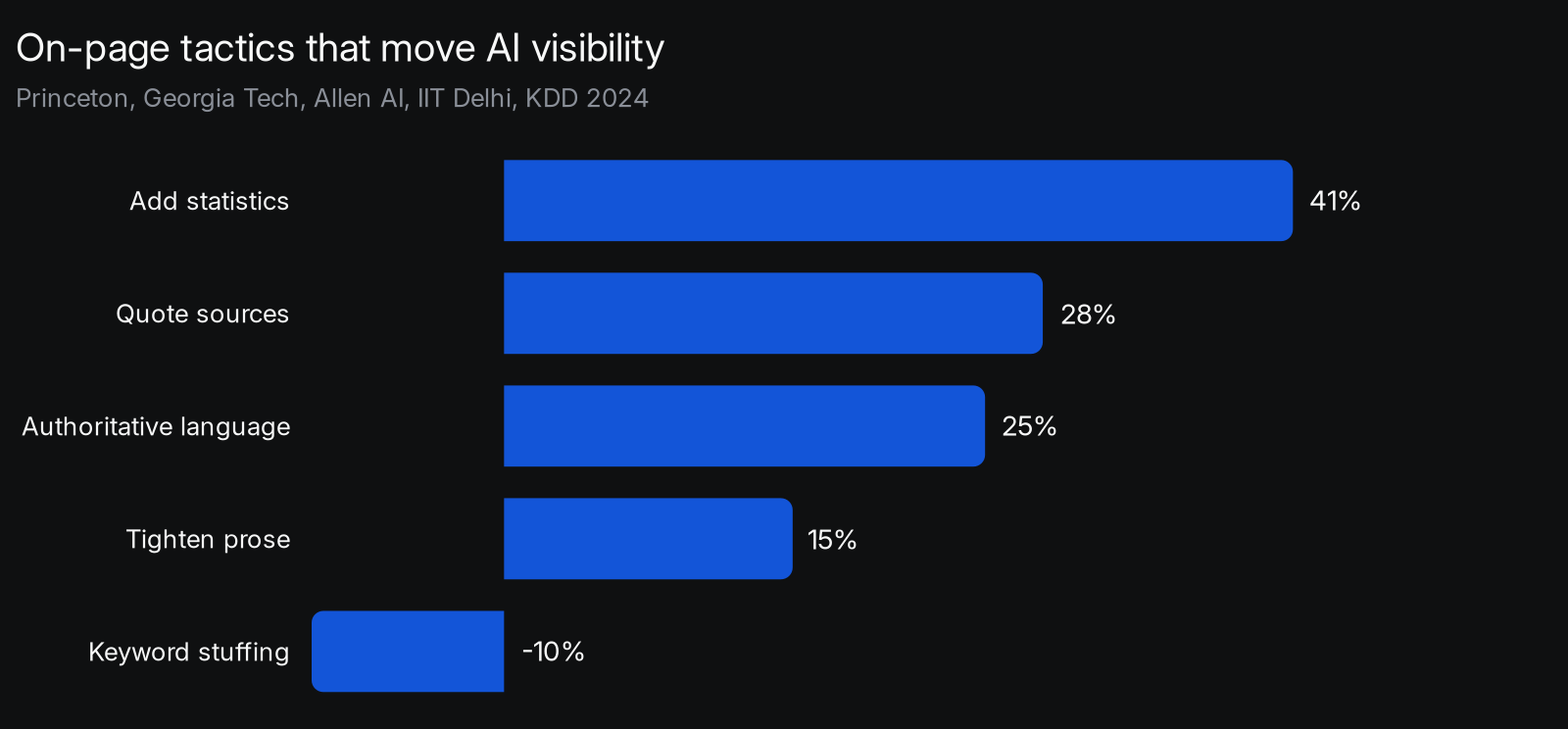
Adding a statistic to a page lifted its AI visibility 41%, the largest gain across nine tactics tested over 10,000 GEO-bench queries, while keyword stuffing cut visibility 10% (Princeton, Georgia Tech, Allen AI, and IIT Delhi, KDD 2024). What ranks for one phrasing does not transfer across a fan-out; what gets extracted for many does, and extraction tracks structure, not keyword match.
A table, a labeled stat, or a direct answer capsule is legible to a retrieval model whether it arrives via the head term or any of the derived searches around it. That portability is why structure is the one citation input you fully control: it earns citations across phrasings instead of betting on one. The gap is measurable on the page itself, where top-quartile cited articles average 13.55 structural elements against 2.98 in the bottom quartile (Res AI, 852-article B2B citation structure study, 2026). And 55% of AI citations come from the first 30% of a page (CXL, 2024), so the answer to each derived search should sit near the top of the block that addresses it, not buried below a narrative wind-up.
Measuring on the Typed Prompt Misreports Your Visibility
Citation drift, the share of domains present one month and gone the next for identical prompts, runs 40% to 60% month over month (Profound, 2026), so even a single sub-query is a moving target. Checking one literal phrasing on one day reports a sliver of the fan-out at a single point on a curve that swings every month.
A one-shot check answers the wrong question. It asks whether you appear for a phrasing the engine rarely runs, on a day that does not represent the month. The honest measurement tracks the cluster of sub-queries a buyer intent fans into, sampled across enough runs to separate signal from the run-to-run variance, which is why a single citation check cannot measure GEO performance at all.
| Measurement approach | Queries covered | Run-to-run blind spot |
|---|---|---|
| Literal-prompt snapshot | 1 of roughly 11 sub-queries | misses 40% to 60% monthly drift |
| Single phrasing, repeated | one search over time | still blind to the rest of the fan-out |
| Sub-query set, 10-run sample | the cluster the intent fans into | captures the 0.72 Jaccard variance |
Map the Sub-Queries Before You Write the Page
Comparing vendor strengths and weaknesses is the single most common reason buyers reach for an AI chatbot, named the top use case by 41% of them (G2, 2026), which tells you comparison and alternatives searches dominate most B2B fan-outs. Map the cluster one intent fans into first, then give each derived search its own answer capsule, table, or labeled block before you draft a word.
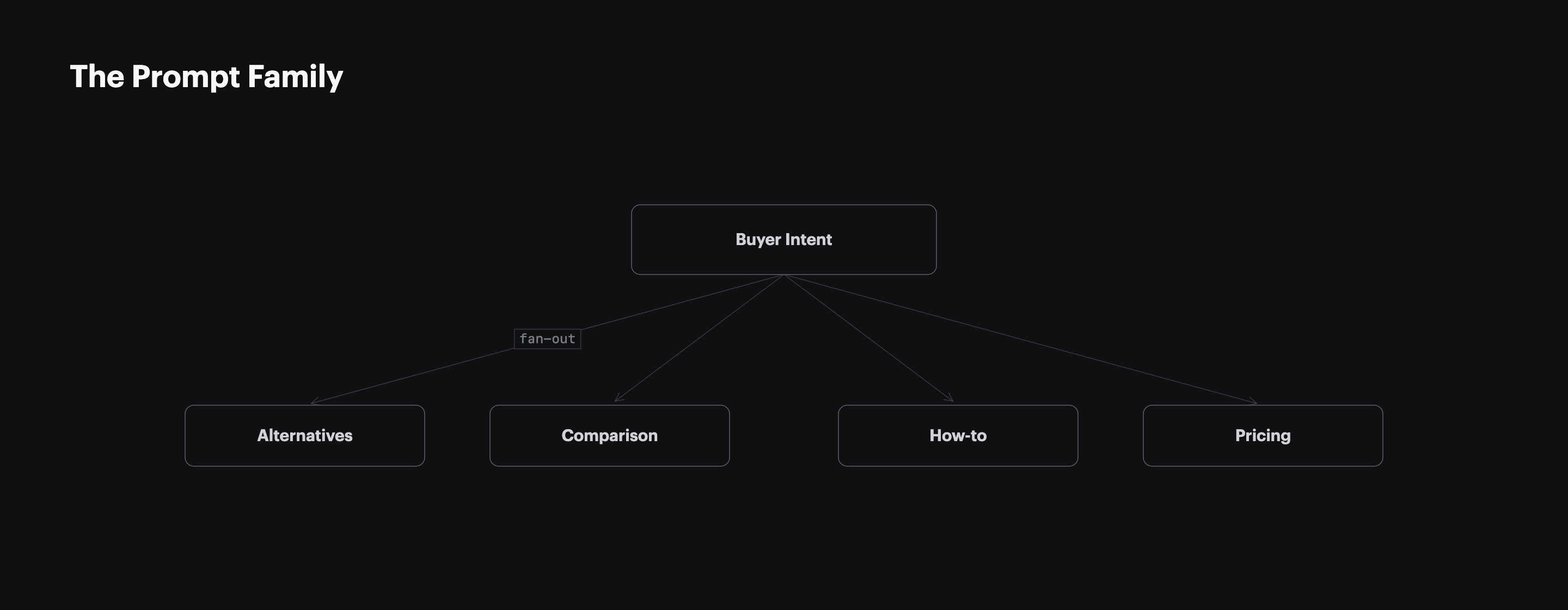
The recurring categories are consistent enough to plan against:
Alternatives. Searches of the form “X alternatives” or “tools like X,” answered by a comparison block that names real rivals.
Comparison. Head-to-head “X vs Y” searches, answered by a feature-and-price table with the differentiating cell called out.
How-to. Fit and selection searches like “best X for mid-market,” answered by a how-to-choose table mapping situation to priority.
Pricing. Cost searches like “X pricing per seat,” answered by a public pricing grid rather than a contact-sales wall.
A worked example makes the spread concrete. The HR prompt “best HRIS for mid-market companies” fans into the searches below, and the page that answers all of them collects citations the head term alone never would.
| Sub-query the engine derives | Buyer intent behind it | Page element that answers it |
|---|---|---|
| “HRIS vs payroll software difference” | definitional | a definitions block |
| “best HRIS for 200 to 500 employees” | fit by company size | a how-to-choose table |
| “Rippling vs Gusto vs BambooHR” | direct comparison | a comparison table |
| “HRIS pricing per employee” | cost screen | a public pricing grid |
| “HRIS with API and SSO” | technical fit | a labeled capability block |
Where the Fan-Out Sends Its Citations
85% of brand mentions in AI answers originate on third-party pages rather than your own domain, across roughly 15 million data points (Airops and Kevin Indig, 2026). The fan-out does not just multiply searches; it spreads them across owned pages, review sites, and community threads, so covering it means earning citations on pages you do not control as well as the ones you do.
Community platforms alone capture 52.5% of all AI citations against 47.5% for brand domains, with news sites accounting for 20.3% (OtterlyAI, 2026). A derived search for “X reviews” resolves to a review platform; a search for “is X worth it” often resolves to a forum thread. Owned structure wins the comparison, pricing, and capability searches in the fan-out, but the social-proof and sentiment searches resolve off-domain, which is why a complete program seeds third-party legibility alongside its own pages rather than treating the website as the whole job.
How GEO Platforms Handle the Query Fan-Out
Every GEO platform claims to optimize for AI search, but they split on whether they read the fan-out the engine runs or only the prompt you type in. The table below compares how each one treats the sub-query cluster, how many prompts it tracks, and what it actually hands you.
| Platform | How it treats the fan-out | Prompts tracked | What you get |
|---|---|---|---|
| Res AI | Generates answer coverage across the sub-query cluster and deploys it | 10 to 30+ monitored by plan | Live CMS edits across the page library |
| Profound | Reports demand with Prompt Volumes, then stops at the dashboard | 10+ engines monitored | Dashboards and agent analytics, no content creation |
| Peec AI | Tracks which prompts drive mentions and citations | 50 to 350 prompts by tier | Visibility, position, and sentiment analytics |
| Conductor | Tracks visibility and generates content in one platform | Enterprise, custom scope | Unified AEO plus SEO reporting |
| Athena | Analyzes citation sources across engines | 8+ LLMs tracked | Optimization recommendations |
The split is between reading the fan-out and acting on it. Monitoring tools report the prompts and the gaps; Res AI generates the blocks that answer the cluster and pushes them live, which is the difference between a report on the fan-out and coverage of it.
Frequently Asked Questions
How is query fan-out different from keyword variations?
Keyword variations are alternate phrasings of the same search a human might type, while fan-out sub-queries are new searches the engine derives on its own to cover parts of the intent the buyer never stated. The engine runs 9 to 11 of them in parallel for a typical prompt (Seer Interactive and Nectiv via Ahrefs, 2026), so the spread is wider and less predictable than a keyword list.
Why can keyword tools not show me my fan-out queries?
Over 95% of fan-out sub-queries have no recurring search volume, so they never appear in a keyword database built on aggregate search counts (Seer Interactive via Ahrefs, 2026). The engine generates them per prompt rather than pulling from a fixed list, which is why they are invisible to volume-based research.
Does optimizing for the fan-out mean publishing more pages?
Not necessarily, because the gain comes from depth on a page rather than count. A single page carrying a comparison table, a pricing grid, and a how-to-choose block answers several derived searches at once, and top-cited pages average 13.55 structural elements versus 2.98 for the rest (Res AI, 852-article B2B citation structure study, 2026).
How do I find the sub-queries an engine runs for my category?
Start from the buyer intent and list the adjacent questions a real buyer would ask next, grouped into comparison, alternatives, fit, pricing, and capability searches. Run the head prompt across engines several times and note which pages get cited, since the cited sources reveal which derived searches the engine actually ran.
Why do two runs of the same prompt cite different pages?
The engine generates a slightly different fan-out and weighs sources non-deterministically each time, so identical prompts return only a 0.72 Jaccard overlap between any two runs (Res AI, 1,000-query Perplexity B2B citation study, 2026). Stable visibility means answering enough of the cluster that you survive the variance, not winning one phrasing once.
Does fan-out happen on ChatGPT or only Google AI Mode?
Both, along with Perplexity and Gemini, since query decomposition is how retrieval-augmented engines assemble answers to multi-part questions. The names differ but the behavior is the same: one prompt becomes many searches, and the answer is synthesized from the pooled results.
How many sub-queries should one page try to answer?
Aim to answer the dominant cluster for one buyer intent rather than every possible search, which usually means four to six blocks covering comparison, alternatives, fit, and pricing. A page that answers the most-run searches for its intent collects more citations than one stretched thin across unrelated queries.
Why does structure beat keywords for fan-out coverage?
A labeled table or a stat-led answer capsule is extractable whether the engine arrives via the head term or any derived search, while keyword density only matches one phrasing. Adding a statistic lifted AI visibility 41% while keyword stuffing cut it 10% (Princeton, KDD 2024), so structure travels across the fan-out and keyword tuning does not.
How Res AI Covers the Whole Fan-Out Across Four Engines
The sections above showed that an engine answers a dozen derived searches, not the phrase your buyer typed, so a page tuned to one phrasing wins a single slot and loses the rest. Res AI builds the coverage that answers the cluster: it turns existing prose into the comparison tables, FAQ entries, pricing grids, and labeled blocks that get extracted across many sub-queries, then deploys those edits straight into your CMS through a natural-language command.
Its prompt monitoring tracks which searches your buyers run across all four major engines, ChatGPT, Perplexity, Claude, and Gemini, and feeds the winners back into the next round of edits, so your coverage widens toward the fan-out the engine actually runs instead of the one keyword you guessed at. The work happens on the content you already have, page by page, rather than as a brief handed off for someone else to write months later.
Res AI turns one buyer intent into coverage across the whole fan-out the engine runs, not the single phrase you guessed at. Start with 10 free articles and watch which sub-queries begin to cite you.