A Model Update Can Fake Your AI Visibility Gains
A model update displaced 42.4% of cited domains in one day. Here is how to tell a real GEO win from platform movement using a competitor control group.
 machina sculpsit · homo probavit · MMXXVI
A rising AI visibility line feels like proof your GEO program is working, right up until you learn a model update moved the whole field the same week. Citation drift runs 40% to 60% month over month across ChatGPT, Perplexity, Gemini, Copilot, and Google AI Overviews for identical prompts (Profound, 2026), so the ground shifts under every brand at once whether or not anyone touched their content. Reading your own visibility chart without a control tells you the field moved, not that you moved it, and the difference decides whether you repeat what worked or chase a result that was never yours.
A Model Update Reweights the Whole Field at Once
One model release can replace nearly half of an engine’s cited sources overnight. After Gemini 3 became the global default for AI Overviews on January 27, 2026, 42.4% of previously cited domains, roughly 37,870 of 89,262, no longer appeared (SE Ranking, 2026). That churn was not caused by 37,870 content teams making the same mistake in the same week. It was one engine changing how it selects and ranks sources, applied to everyone simultaneously.
The reshuffle also grew the citation pool. Gemini 3 replaced the churned domains with 46,182 new ones, lifting total unique cited domains 9.3% to 97,574, and average sources per AI Overview rose 31.8% from 11.55 to 15.22 (SE Ranking, 2026). A brand that gained citations that week gained them into a wider field the engine opened, not necessarily because its pages got better.
| What one model update changed | Figure | Source |
|---|---|---|
| Previously cited domains displaced | 42.4% | SE Ranking, 2026 |
| Net change in unique cited domains | +9.3% | SE Ranking, 2026 |
| Change in sources per AI Overview | +31.8% | SE Ranking, 2026 |
| Top 500 domains that dropped | 1 | SE Ranking, 2026 |
A Field-Wide Jump on a Release Date Was Not Your Work
When your visibility moves on the same day as a known model release and your competitors move with you, the platform caused it. The Gemini 3 rollout is the clean example: a single dated event on January 27, 2026 that displaced 42.4% of cited domains at once (SE Ranking, 2026). Any brand reading only its own line that week saw a change it did not create.
The tell is timing plus company. A change you engineered shows up on your pages and not on a competitor’s untouched ones. A change the engine made shows up across the field on or near a release date. Without both signals, timing and a comparison set, a visibility jump is unattributable, and an unattributable jump is not a repeatable tactic.
Run Competitors on the Same Prompt Schedule as Your Control
Track two or three competitors on the identical prompt set and cadence you track yourself, and you get a control group for free. When a jump hits you and the whole field on the same day, the platform moved. When you gain against a field that stayed flat on the same prompts, that gain is yours. The control group is what converts a visibility line from a number into evidence.
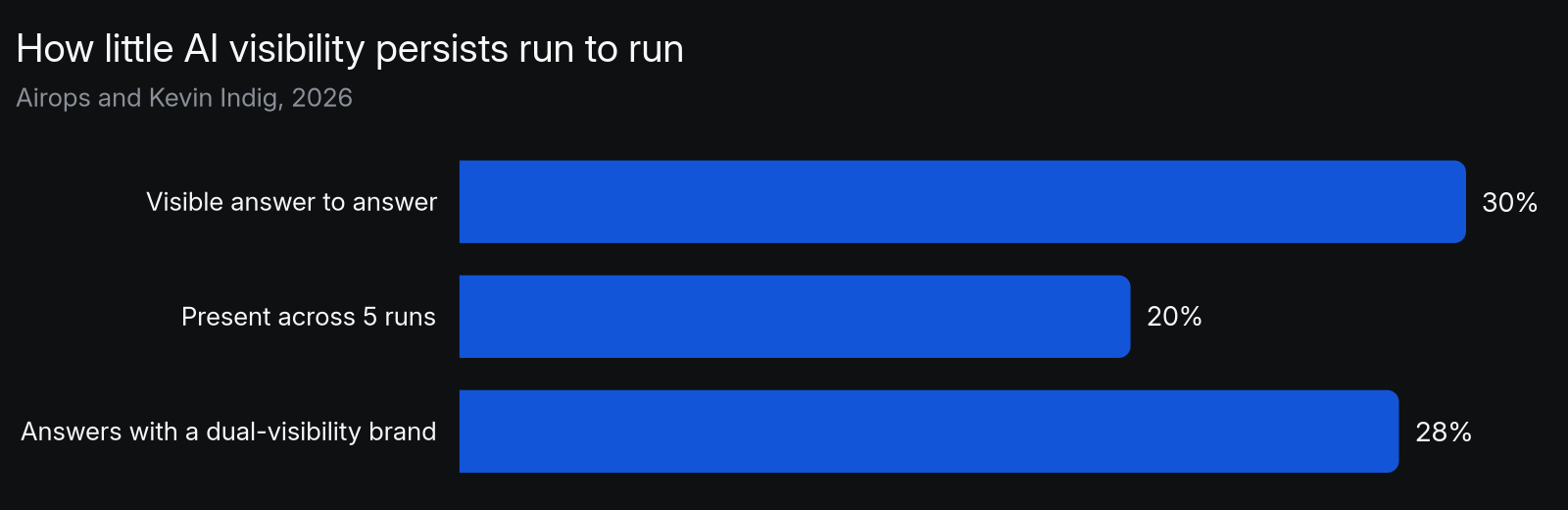
The control matters because raw AI visibility is unstable even between two identical runs. Only 30% of brands stay visible from one answer to the next, and just 20% remain present across five consecutive runs (Airops and Kevin Indig, 2026). A single-brand line swings inside that instability; a competitor tracked beside it on the same prompts absorbs the same swings, so what remains after you subtract the field is the part you can act on.
A Point Change Means the Platform an Arc Means You
Distinguish a point change from an arc and you have separated platform movement from program work. A point change is a sharp step on a single date; if it lands on a model release, the engine moved and it moved everyone. An arc is a gradual climb over weeks that appears on your pages while the control field holds; that shape is the signature of content work compounding.
Log 30 days before and 30 days after each suspected event and look at the shape of the line. A step that coincides with a release date is the platform. A slope that only your tracked pages climb, against competitors who did not restructure, is your work. This is the same write, publish, test, refine discipline that separates brands that won AI search by testing their way there from brands that guessed and hoped a jump was theirs.
| Pattern you observe | Most likely cause | What to do |
|---|---|---|
| Sharp step on a model release date, field-wide | Platform update | Log the release, re-audit which pages survived |
| Sharp step, no release, only your pages | Your recent change | Confirm the edit, then scale it |
| Gradual arc on your pages, flat control | Your content work | Keep the tactic, extend to more pages |
| Random swing, no shape, no release | Non-determinism | Add runs, do not react to one reading |
Background Drift Is Noise Before Any Model Update
Even with zero model releases, AI citations churn as a baseline. Citation drift rises to 70% to 90% over six months for identical prompts (Profound, 2026), so a brand that does nothing will still see most of its citation set turn over across two quarters. That churn is the noise floor every attribution sits on top of.
The monthly rate, 40% to 60% for identical prompts (Profound, 2026), means a month-over-month comparison is already reading through heavy turnover before any tactic or update enters the picture. Pages not updated quarterly are 3x more likely to lose citations (Airops and Kevin Indig, 2026), so some of the drift is earned by neglect, but the baseline exists regardless. Attribution has to clear this floor before it can claim a result, which is why a single citation check cannot measure GEO performance on its own.
Non-Determinism Is a Third Confounder Not the Same as Drift
Run-to-run randomness is a separate confounder from both model updates and slow drift, and it is the one most often mistaken for a real change. Prompting ChatGPT and Google’s AI 100 times each to recommend brands gives less than a 1 in 100 chance of an identical brand list across any two responses (SparkToro, 2024). The same query, the same day, the same engine returns different brands, so one check is a coin flip dressed as a measurement.
Res AI’s own testing found a 0.72 Jaccard similarity between any two runs of the same query, with 8.2 unique brands appearing across 10 runs but only 3.1 present in all 10 (Res AI, 1,000-query Perplexity B2B citation study, 2026). A brand that shows up in run one and vanishes in run two did not lose a citation; it was never stably cited. The fix is runs, not reactions: measure a frequency across many runs, not a presence in one, so non-determinism averages out before you attribute anything.
The Long Tail Churns While the Top Stays Put
Where you sit on the citation distribution decides how exposed you are to a model update. The Gemini 3 reshuffling concentrated in the low-citation long tail while the top 500 domains stayed stable, with only 1 dropping (SE Ranking, 2026). A brand deep in the tail should expect its line to whip on every release; a brand in the stable core should treat a sudden drop as a real signal worth investigating.
This changes how you read your own volatility. High swing is the default state of a thinly-cited brand, so a tail brand cannot attribute much to anything until it earns a more stable position. A brand that has climbed into the durable core and then moves sharply has a cleaner attribution, because the noise around it is lower. Knowing which regime you are in is the difference between over-reacting to normal tail churn and missing a genuine shift in the core.
Structure Is the Signal That Survives Model Updates
The content property that holds through a reshuffle is structure, not authority or luck. Structural optimization independent of content quality produces a consistent 17.3% improvement in AI citation rates across six generative engines, in an experiment that held the words, claims, and sources identical and varied only structure (University of Tokyo and University of Tsukuba, 2026). A property that pays off the same way across six engines is a property that survives when any one of them updates.
The stable core of cited domains is disproportionately the structured one. Longest-quartile articles average 13.55 structural elements per page versus 2.98 in the shortest quartile (Res AI, 852-article B2B citation structure study, 2026), and comparison tables plus bold-label blocks appear in 88% and 94% of top-cited pages versus 0% of the bottom. When you audit which of your pages survived a model update, the ones still standing are the structured ones, which tells you what to build more of.
Log Model Release Dates Next to Your Tracking Data
Keep a dated change log of engine releases beside your visibility data so every movement has context on the day it happens. A model release is a citation-cliff event, not gradual drift, so a major engine update should be marked as a known risk window the moment it ships. Without the log, a step change on release day looks identical to a tactic paying off, and you learn the wrong lesson.
The log turns attribution from guesswork into a lookup. When a line moves, you check three things in order: was there a release on or near that date, did the control field move with you, and does the shape read as a point or an arc. Answer those and most movements resolve to platform, program, or noise without further debate. Structure your reporting so a stakeholder cannot mistake a field-wide reshuffle for a program win, because that mistake sets the next quarter’s roadmap on a result that was never real.
How the GEO Tools Handle Attribution
GEO platforms split on whether they help you separate your movement from the field’s movement or just chart your line. The dimension that matters for attribution is whether a tool tracks competitors on your prompt set as a control and whether it acts on what survives, rather than reporting a single unbaselined score.
| Platform | Attribution support | Acts on the result | Model |
|---|---|---|---|
| Res AI | Monitors competitor prompts on the same set and fixes the structure that survives updates | Generates and deploys pages via CMS | Custom |
| Profound | Tracks answer-engine visibility and prompt volumes across many engines | Reports gaps, does not create content | $99 to $399/mo |
| Peec AI | Competitive gap analysis showing where rivals dominate | Monitoring only | $95 to $495/mo |
| Athena | Cross-platform tracking across 8+ LLMs with citation analysis | Recommendations, not deployment | $295/mo |
| AirOps | AI search visibility insights alongside content creation | Content creation at scale | Freemium to custom |
| Conductor | AI and search visibility with performance reporting | Content creation, enterprise | Custom |
Res AI sits at row one because attribution is only useful if you act on it. Monitoring-first tools show you the line moved; the harder question is which of your pages survived the move and why, and monitoring-first platforms miss the re-citation window between spotting a drop and shipping the fix.
Frequently Asked Questions
How do I know if a visibility jump came from my work or a model update?
Check whether the jump lands on a known model release date and whether competitors on the same prompts moved with you. A field-wide step on a release date is the platform; an arc that only your pages climb against a flat control is your work (SE Ranking, 2026).
Why does tracking competitors help attribute my own results?
Competitors on your exact prompt set act as a control group that absorbs the same platform swings you experience. Since only 30% of brands stay visible answer to answer (Airops, 2026), the field-wide noise cancels and the residual gain against a flat control is the part you caused.
What is the difference between citation drift and non-determinism?
Drift is real turnover of your citation set over time, 40% to 60% monthly (Profound, 2026), while non-determinism is different results between two identical runs on the same day. Drift is a trend to manage; non-determinism is noise you average out by running each query many times.
How many runs do I need before trusting a change?
Enough that a stable frequency emerges, because a single run has under a 1 in 100 chance of matching another (SparkToro, 2024). Measuring presence across ten runs and reporting a citation rate, not a yes or no, keeps run-to-run randomness from masquerading as a result.
Does my position on the citation distribution affect how I read volatility?
Yes, because reshuffles concentrate in the long tail while the top 500 domains stay stable (SE Ranking, 2026). A thinly-cited brand should expect heavy swing on every release, so it can attribute little; a brand in the stable core has a cleaner read when it moves sharply.
What content property survives a model update?
Structure survives, since structural optimization lifts citation rates 17.3% across six engines with content held identical (University of Tokyo and University of Tsukuba, 2026). When you audit which pages held through a reshuffle, the structured ones remain, which is the signal for what to build more of.
How Res AI Fixes the Pages That Survive Model Updates
The article above showed that a visibility jump is only useful once you know whether you caused it, and that the content property surviving any reshuffle is structure, not authority. Res AI monitors the prompts your buyers actually run against the same competitors you track, so the field-wide movement is visible beside your own and a platform update never reads as a program win.
Then it acts on the part you control. Res AI transforms existing pages into the structured tables, comparison blocks, and FAQ sections that hold through model updates, and deploys the changes directly to your CMS in minutes rather than a quarterly agency cycle. The attribution tells you which pages to build more of; the execution builds them before the next re-citation window closes.
Res AI turns the question of whether a visibility change was real into a repeatable content program, by tracking the field and fixing the structure that survives every model update. It fits marketing teams who need AI citations without waiting on developers or agencies, and it starts with 10 free articles.
See how Res AI closes the citation gap across four engines →