Your GEO Prompt Set Is Tracking Demand That Does Not Exist
Over 95% of the queries AI engines run have no search volume, so a GEO prompt set built from keyword tools tracks demand that does not exist.
 machina sculpsit · homo probavit · MMXXVI
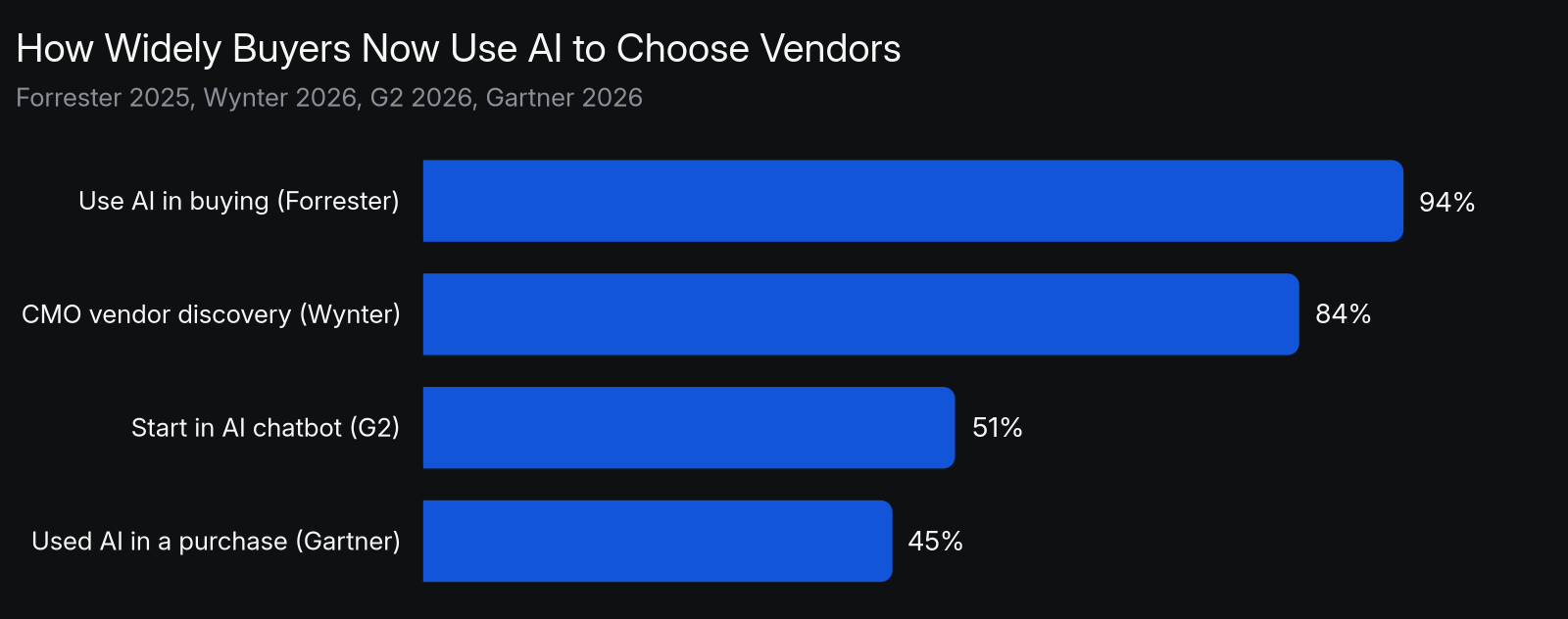
A GEO program can only be measured on the prompts it tracks, which makes the tracked prompt set the single most consequential input in the whole program, and most teams inherit it from a keyword tool without a second thought. That is a problem, because 51% of B2B software buyers now begin their research with an AI chatbot more often than with a traditional search engine (G2, 2026), and the queries they run there do not look like the keyword list a volume tool hands you. When the prompt set is wrong, every dashboard built on top of it is confidently reporting the answer to a question your buyers never ask.
The Prompts You Track Decide What You Can Win
The tracked prompt set is the aperture through which a GEO program sees the market, and 96% of B2B companies are invisible in early-stage AI-driven buyer discovery (2X AI Innovation Lab, April 2026). A brand that tracks only the ten prompts where it already appears will report healthy visibility while staying invisible on the hundred prompts that decide the deal. The prompt set does not just measure the program. It bounds what the program can ever find.
This is why prompt selection sits upstream of content, structure, and monitoring. Pick the wrong prompts and the best-structured page in your category earns citations for queries with no buyers behind them. The work of GEO starts one step before the content: deciding which questions to compete on.
Keyword Tools Miss 95% of the Queries AI Runs
Over 95% of the sub-queries AI search systems generate receive no recurring search volume, so they cannot be surfaced through traditional keyword research (Seer Interactive and Nectiv via Ahrefs, 2026). A keyword tool ranks the world by search volume, which means it is structurally blind to the exact queries that dominate an AI answer. The prompts with volume are the ones a keyword tool can see, and they are a small slice of what actually runs.
The consequence is a prompt set skewed toward high-volume head terms that AI engines rarely decompose into. Your buyers are asking comparison and fit questions in full sentences; your keyword tool is handing you two-word phrases ranked by a metric the engine does not use. The mismatch is not a matter of degree. It is a different unit of demand.
Keyword research does not transfer cleanly to GEO, because the keyword itself is the wrong atom. The prompt, and the family of phrasings around it, is the unit that matters.
AI Splits One Prompt Into a Dozen Hidden Searches
AI search engines decompose a single prompt into an average of 9 to 11 fan-out sub-queries before answering, with 59% of prompts triggering 5 to 11 searches and 24% triggering 12 to 19 (Seer Interactive and Nectiv via Ahrefs, 2026). One buyer question becomes a dozen retrieval events, each of which can pull a different set of sources. The prompt you track is not the query the engine runs. It is the seed for a fan-out you never see.
This is why tracking a single phrasing under-reports the surface a brand actually competes on. The engine runs a hidden fan-out behind every prompt, and a page can win the head prompt while losing all twelve of its sub-queries. A prompt set built for the visible query misses the invisible dozen underneath it.
The table below shows why the two sources of prompts diverge so sharply.
| Prompt source | What it captures | What it misses |
|---|---|---|
| Keyword-volume tools | Head terms with recurring search volume | The 95% of AI sub-queries with no volume |
| Sales calls and support tickets | Real buyer intent in the buyer’s own words | How buyers compress that language for a machine |
| Engine-tested phrasings | What actually surfaces sources today | Queries the team never thought to test |
Buyers Compress Their Language for a Machine
AI fan-out sub-queries differ from the source prompt 98.3% of the time in shopping contexts (ALM Corp, March 2026), which means the language a buyer uses with an engine rarely matches the language anywhere else. People phrase a question to a salesperson one way, type it into ChatGPT another way, and the engine then rewrites it a third way. A prompt set lifted verbatim from call transcripts tracks the first phrasing and misses the two that follow.
The fix is not to abandon call recordings and support tickets. Those are the only source of verified buyer intent, the actual problems your buyers are trying to solve. The move is to take the topic from the call and then test how that topic gets phrased inside the engine, rather than assuming the sales-call wording is the query.
Verified demand tells you what to compete on. Engine testing tells you how the question is actually asked. A prompt set needs both, because each covers the other’s blind spot.
One Phrasing Wins One Slot Only
Prompting ChatGPT and Google’s AI 100 times each to recommend brands gave less than a 1 in 100 chance of an identical brand list across any two responses (SparkToro, 2024), so a single phrasing checked once tells you almost nothing. AI answers are non-deterministic. The same prompt returns different brands on different runs, and a prompt set that logs one run per query is measuring noise.
In a 1,000-query Perplexity study, the Jaccard similarity between any two runs of the same query was 0.72, with 8.2 unique brands appearing across ten runs but only 3.1 appearing in all ten (Res AI, 1,000-query Perplexity B2B citation study, 2026). A brand can be cited on run three and absent on run four for a prompt that never changed. Tracking one phrasing once produces a visibility number with a wide error bar the dashboard never shows.
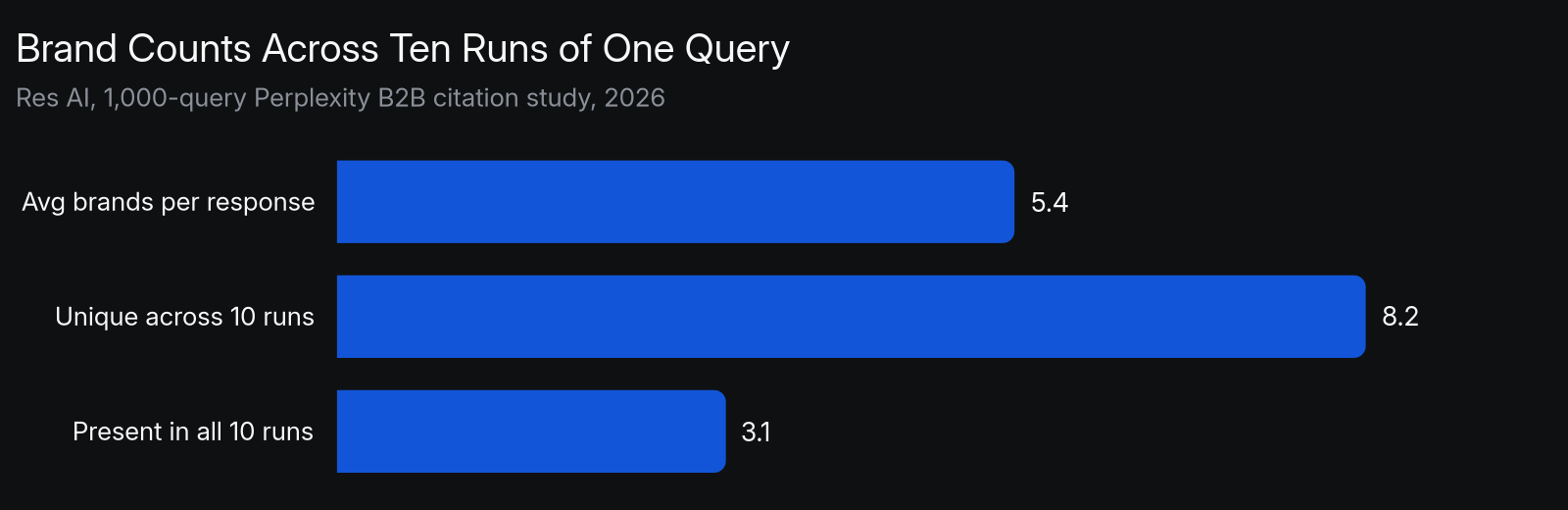
The takeaway for prompt-set design is that each tracked prompt needs multiple runs across multiple phrasings before its number means anything. One phrasing wins one slot on one run, and that slot moves.
Verified Buyer Demand Is the Input Keyword Tools Cannot Fake
84% of B2B SaaS CMOs now use AI and LLMs for vendor discovery, up from 24% a year earlier (Wynter, 2026), so the questions worth tracking are the ones real buyers bring to those tools. Keyword expansion invents plausible queries; it cannot confirm that a human ever asked one. Verified demand is the difference between a prompt someone actually runs and a phrase a tool generated because it was lexically adjacent.
The richest source of verified demand is already inside the company, in three places a keyword tool never sees.
- Sales-call recordings carry the questions buyers ask a rep out loud, at the moment of highest intent.
- Support tickets carry the fit and edge-case questions buyers raise once they are already evaluating.
- Win-loss notes carry the comparison questions that decided the deal, framed the way the buyer framed the choice.
Each of these is verified demand a keyword tool cannot manufacture, because a real person already asked it. The table below maps each internal source to the prompt family it surfaces and where that prompt sits in the buyer journey.
| Internal source | Prompt family it surfaces | Journey stage |
|---|---|---|
| Sales-call recordings | Problem and requirement questions | Early to mid |
| Support tickets | Fit, integration, and edge-case questions | Mid |
| Win-loss notes | Head-to-head comparison questions | Late |
| Sales objection logs | Pricing and switching-cost questions | Late |
Buyers also arrive with a shortlist already forming. 92% of buyers start with vendors in mind and 80% of deals close to the top-ranked vendor on the shortlist (6Sense, 2025), which means the comparison and fit prompts late in the journey are where citations convert. A prompt set weighted toward those verified, high-intent questions beats a broad keyword dump every time.
A Prompt Set Only Counts After You Test It
After Gemini 3 became the default model for AI Overviews, 42.4% of previously cited domains no longer appeared (SE Ranking, 2026), which means a prompt set validated once decays as the engines change underneath it. Testing is not a one-time setup step. The engine that surfaced your page in March can drop it in April without a single edit to your content.
A prompt belongs in the tracked set only after it has been run against the live engines and shown to return a real answer with real sources. A phrasing that no engine actually decomposes into is dead weight, and a phrasing that surfaced sources last quarter may be dead this quarter. The prompt set is a living list, re-tested on a cadence, not a spreadsheet frozen at onboarding.
This is the discipline keyword-derived prompt sets skip. They are generated once, loaded into a dashboard, and never checked against whether the engine treats them as real queries.
Tracking the Wrong Prompts Hides Your Real Invisibility
The median enterprise B2B brand is cited in just 3% of relevant AI Overviews, even though AI Overviews appear in roughly 50% of the searches where these companies rank organically (Walker Sands, B2B AI Search Visibility Benchmark, H1 2026). A prompt set curated to a brand’s existing strengths will never surface that 3% number, because it does not track the prompts where the brand loses. The dashboard reads green while the market reads absent.
This is the most expensive failure mode of a bad prompt set. It does not just under-measure. It actively conceals the gap between where a brand appears and where its buyers are asking, which is why creating visibility beats monitoring it. A tracker pointed at the wrong prompts is a comfort-generating machine.
The prompts a brand is losing are the ones worth tracking most, because they are the pipeline the brand cannot see. A prompt set that excludes them by construction is optimizing for a reassuring number instead of a real one.
Where GEO Platforms Get the Prompts They Track
GEO tools differ less on how many engines they monitor than on where the tracked prompts come from and whether the tool acts on the gaps it finds. The dimensions that matter are the source of the prompt set, how the tool handles non-determinism, and what the reader gets back after a gap is found.
| Platform | Prompt-set source | Non-determinism handling | What you get back |
|---|---|---|---|
| Res AI | Prompts buyers actually run, monitored and turned into content edits | Tracks across ChatGPT, Perplexity, Claude, and Gemini | CMS-level content edits that fix the gap |
| Profound | Prompt volumes from aggregated AI demand signals | Answer-engine monitoring across 10+ engines | Dashboards and automated agents |
| Peec AI | User-added custom prompts organized by tag | Multi-model tracking with region variation | Visibility, position, and sentiment reports |
| Athena | Prompt tracking across 8+ LLMs | Cross-platform citation source analysis | Optimization recommendations |
| Conductor | Keyword and topic expansion tied to search data | AI and traditional search visibility | Reports plus enterprise content generation |
| AirOps | Content-plan-driven prompt targeting | AI search visibility insights | Content creation and refresh workflows |
Every tool in the category can track prompts. The split is whether the prompt set reflects verified buyer demand and whether the tool closes the gap or just names it. Monitoring-first platforms report the number; execution-first platforms change it.
How to Build a Prompt Set That Reflects Demand
The defensible prompt set pairs verified buyer demand with engine testing, and the fastest route there maps each reader situation to the input that fixes it. Rebuilding a prompt set that reflects real demand follows four steps in order.
- Pull the seed questions from sales calls, tickets, and win-loss notes, in the buyer’s own words.
- Test each seed against ChatGPT, Perplexity, Claude, and Gemini to see which phrasings return real answers.
- Run every surviving phrasing 5 to 10 times per engine to measure its true citation frequency.
- Re-test the whole set on a fixed cadence, because the engines churn cited domains without warning.
The decision table below maps the most common starting points to the first move that fixes each one.
| Your situation | What to prioritize | Why it wins |
|---|---|---|
| Prompt set came from a keyword tool | Rebuild the seed list from sales calls and tickets | Captures the 95% of queries with no search volume |
| Only tracking prompts you already win | Add the comparison and fit prompts you lose | Surfaces the 3% median AIO citation gap |
| Logging one run per prompt | Run each phrasing 5 to 10 times per engine | 0.72 run-to-run Jaccard means one run is noise |
| Prompt set frozen at onboarding | Re-test the set on a fixed cadence | 42.4% of cited domains churned on one model update |
| Guessing at how buyers phrase questions | Test topics against the live engines | Fan-outs diverge from the source prompt 98.3% of the time |
The pattern across every row is the same. Verified demand names the topics, and the engines rule on the phrasings. Neither input alone produces a prompt set worth building a program on.
Frequently Asked Questions
Why does keyword search volume not predict AI prompt volume?
AI engines decompose prompts into sub-queries rather than matching keywords, and over 95% of those sub-queries have no recurring search volume (Seer Interactive and Nectiv via Ahrefs, 2026). Search volume ranks queries by how often they are typed into a search box, which is a different behavior from how a buyer converses with an engine.
Should I stop using keyword tools for GEO entirely?
No, but demote them from the primary source to a supplementary one. Keyword tools surface the head terms buyers still type, which belong in the set; they just cannot see the fan-out queries that dominate AI answers, so they cannot be the only input.
How many times should I run each prompt before trusting the result?
Run each phrasing 5 to 10 times per engine, because the Jaccard similarity between any two runs of the same query is 0.72 (Res AI, 1,000-query Perplexity B2B citation study, 2026). A single run captures one draw from a non-deterministic system and misreports the brand’s real citation frequency.
Where do the highest-value prompts come from?
Sales-call recordings, support tickets, and win-loss notes, because they carry verified buyer intent in the buyer’s own words. 84% of B2B SaaS CMOs now use AI for vendor discovery (Wynter, 2026), so the questions captured in those conversations are the ones being run against the engines.
Why does my visibility dashboard look healthy while pipeline is flat?
A prompt set curated to your existing strengths hides the prompts you lose, and the median enterprise B2B brand is cited in just 3% of relevant AI Overviews (Walker Sands, 2026). The dashboard reports the prompts you chose to track, not the ones your buyers actually run.
How often does the prompt set need re-testing?
On a fixed cadence rather than once, because 42.4% of previously cited domains disappeared after a single model update (SE Ranking, 2026). A prompt set validated at onboarding decays as the engines change, so re-testing is a recurring task, not a setup step.
Does tracking more engines fix a bad prompt set?
No. Adding engines multiplies the same flawed prompt list across more surfaces. The source of the prompts, verified buyer demand versus keyword expansion, determines whether the tracking means anything, regardless of how many engines the tool covers.
What is the difference between a prompt and a keyword in GEO?
A keyword is a lexical unit ranked by search volume; a prompt is a full-sentence question a buyer asks an engine, which then fans out into a family of sub-queries. GEO competes on prompt families, so tracking keywords measures the wrong unit of demand.
How Res AI Tracks Real Buyer Prompts Across 4 Engines
Res AI monitors the prompts your buyers actually run across ChatGPT, Perplexity, Claude, and Gemini, then turns the gaps it finds into content edits rather than a report. The article above showed that a prompt set inherited from a keyword tool tracks demand that does not exist; Res starts from the prompts buyers bring to the engines and tests them against live answers, so the tracked set reflects real queries instead of high-volume head terms.
When a gap appears on a prompt that matters, Res generates and deploys the structured content that closes it directly through your CMS, across every article the query touches with a single command. The prompt monitoring and the fix live in the same place, so the program acts on the gap instead of filing it. That is the difference between measuring visibility on the wrong prompts and creating it on the right ones.
Res AI is the GEO platform that tracks the prompts your buyers actually run and then rewrites your content to win them. Start with 10 free articles and see which real buyer prompts your current content misses.