The Product Pitch Section That Earns SaaS Citations in AI Search
How SaaS teams write a product pitch section AI engines cite: heading, problem-first opening, a real customer outcome, and where to place it.
 machina sculpsit · homo probavit · MMXXVI
Most SaaS content treats the product pitch as a closing ad: a paragraph that drops the brand name, lists three features, and points at a demo link. That paragraph is the part of the article AI engines are least likely to cite and buyers are most likely to discount. In a March 2026 survey of 1,076 B2B software buyers, 85% said they think more highly of a vendor when an AI chatbot mentions it in a recommendation (G2, 2026), so the pitch is worth getting right, but only when it reads as evidence instead of promotion.
This guide walks a SaaS marketer through what a product pitch section is, why AI engines extract it, the steps to write one that earns a citation, and how to tell whether it worked.
What a Product Pitch Section Actually Is
A product pitch section is the single dedicated H2, placed last before the call to action, that names your product and explains how it solves the specific problem the article documented; the 852-article B2B citation structure study found vendor-promotion blocks like it in 46% of the top 50 cited B2B pages and 0% of the bottom 50 (Res AI, 852-article B2B citation structure study, 2026). It is a section, written in the same evidence-led voice as the rest of the article, not a banner bolted onto the end.
The confusion for most teams is that a pitch section and a call to action are different things. The pitch section is prose that earns the recommendation. The call to action is the one-line route to the next step.
Every pitch section that gets cited carries four parts:
- The heading names the brand and one concrete mechanism, ideally with a number.
- The opening sentence restates the problem the article exposed, in the reader’s words.
- The body explains the mechanism that closes that gap, drawn from real product behavior.
- The proof ties the mechanism to a measurable customer outcome, not an adjective.
A reader who is new to this distinction tends to write a strong article and then a weak final paragraph that throws all four parts away. The rest of this guide treats those four parts as the work.
Why AI Engines Read the Pitch as an Answer
AI search engines retrieve and cite passages, not whole pages, so a pitch section gets extracted only if its opening sentence answers a question on its own. In a 100-page study of Google AI Overviews, 55% of citations came from the first 30% of content (CXL, 2024), which is exactly why a pitch sitting in the last fifth of the article has to work harder to be pulled into an answer.
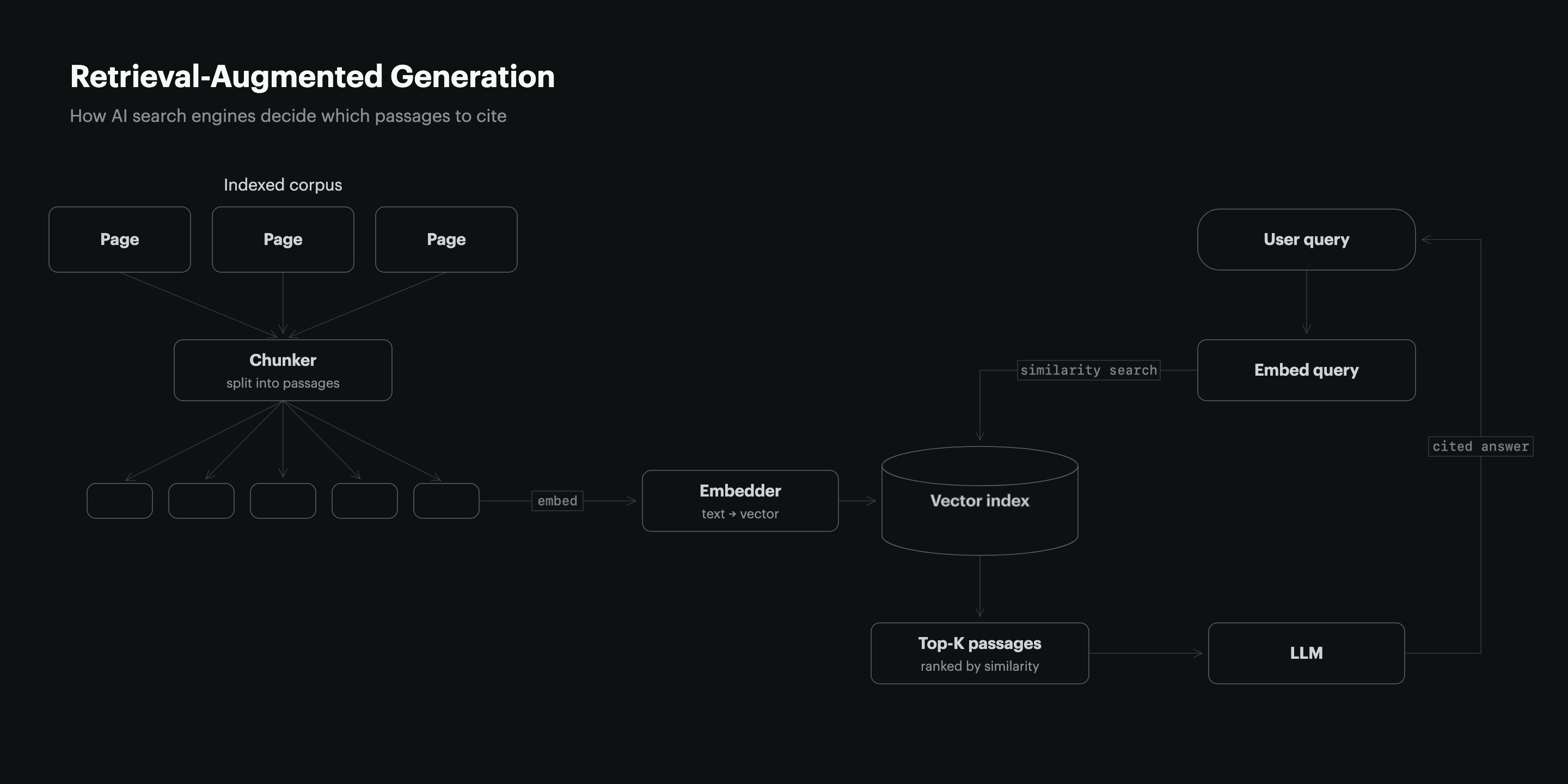
The mechanism is a retrieval pipeline. Your page is chunked into passages, each passage is embedded, and a buyer’s prompt is matched against those embeddings. The pitch section competes as its own chunk, scored on how directly its first sentence answers the prompt, not on how persuasive the whole section is.
That is why marking the section up helps the engine read the claim as a structured fact. A small block of JSON-LD that mirrors the heading claim gives the model a clean, attributable statement:
{
  "@context": "https://schema.org",
  "@type": "SoftwareApplication",
  "name": "Acme",
  "applicationCategory": "BusinessApplication",
  "description": "Cuts customer onboarding from 14 days to 2.",
  "offers": { "@type": "Offer", "price": "250", "priceCurrency": "USD" }
}
The prose carries the argument and the schema carries the same claim in a form the retriever can lift verbatim. Adding schema does not push an already-cited page higher (Ahrefs, 2026), so the prose is still the work; the markup only mirrors it.
How SaaS Buyers Judge a Pitch Inside an Answer
SaaS buyers extend more trust to a vendor an assistant surfaces, but only when the mention reads as earned. 69% of B2B software buyers reported choosing a different vendor than they first planned based on AI chatbot guidance (G2, 2026), so a pitch that gets cited can move a live shortlist rather than just decorate a page.
The buyer reading an AI answer is rarely problem-unaware by the time the pitch appears. 84% of B2B SaaS CMOs now use AI assistants for vendor discovery (Wynter, 2026), and they arrive at the pitch having already read the article’s evidence. A pitch that repeats marketing slogans loses the trust the evidence just built.
What survives that scrutiny is specificity. A claim a buyer can check, a price they can see, a customer they recognize, and a mechanism they can picture all read as evidence. Vague superlatives read as promotion and get mentally filed under noise.
Name the Brand and One Mechanism in the Heading
Write the heading so it names your product and one mechanism the reader can picture, with a number when you have one. A heading like “How Acme Cuts Onboarding From 14 Days to 2” gives the engine a self-contained claim to extract; “About Acme” or “Introducing Acme” gives it nothing.
The heading is the first thing both the retriever and the reader see, so it has to do double duty. It names the entity (the brand) and the mechanism (the specific thing the product does that the article’s problem requires). One mechanism, not a feature list. If the article was about onboarding friction, the heading names the onboarding mechanism, not the analytics dashboard.
Avoid splitting the heading with a colon into a title and a subtitle, and keep it under 12 words. A single clean claim outperforms a clever two-part headline because the retriever reads the whole heading as one unit.
Open With the Problem the Article Exposed
Open the section by restating the exact problem the article documented, in the reader’s words, before you name a single feature. This is the sentence the engine extracts, so it has to stand on its own as an answer to the buyer’s question.
The reason this works is sequencing. By the time a buyer reaches the pitch, 61% of the buying journey is already complete and most requirements are defined (6Sense, 2025). The opening sentence has to connect to a problem the reader already feels, not introduce a new one. A pitch that opens with “Acme is the leading platform for growth” has skipped the connection and reads as a non sequitur.
The fix is mechanical. Take the problem statement from the article’s strongest section, rephrase it as the reader would say it out loud, and lead the pitch with it. Only after the problem is named does the product enter the sentence, as the answer to that named problem.
Anchor the Pitch to a Real Customer Outcome
Tie the pitch to a measurable customer result, because an outcome is falsifiable and an adjective is not. Tally attributes roughly 25% of its new signups directly to ChatGPT after building structured comparison pages (Foundation Inc., 2026), the kind of concrete proof a pitch section should carry instead of a slogan.
The outcome belongs inside the body where the argument lives, not as a trailing line. If the article argued that structure drives citations, the proof is a structural outcome: Vercel grew ChatGPT-referred signups from under 1% to 10% over six months after restructuring its content for retrieval (Vercel, 2025). The number does the persuading; the writer does not have to.
A real outcome has three pieces: a named company, a specific change, and a number attached to it. Pull these from your own customer data or published case studies. If you do not have a customer outcome yet, cite a credible third-party result for the mechanism rather than inventing one, because a fabricated metric is the fastest way to lose a buyer who checks.
Cut First-Person Opinions and Hype Words
Strip every first-person opinion and every hype word from the section, and state product behavior as fact. Research on what AI engines reward is blunt: adding a verifiable statistic raised AI visibility by 41% while keyword stuffing cut it by about 10% (Princeton KDD, 2024).
“We believe,” “we think,” and “in our view” signal opinion, and opinion is not extractable as a fact. Replace them with the product behavior stated plainly. The table below maps the edits that move AI visibility, drawn from the same study.
| Edit to the pitch | AI visibility impact |
|---|---|
| Add a verifiable statistic | +41% |
| Quote a named source | +28% |
| Use plain authoritative language | +25% |
| Tighten and clarify the prose | +15% |
| Stuff in repeated keywords | -10% |
The pattern is consistent across the dataset: fact-dense, readable passages get cited and keyword-padded ones get suppressed (Princeton KDD, 2024). A pitch section written in flat declarative sentences with one real number per claim reads as authoritative to both the engine and the buyer.
Scan for the hype words that carry no falsifiable claim before you publish: vague superlatives, manufactured urgency, and category-defining boasts. None of them survive a buyer who is comparing vendors line by line, so cut them in favor of a number or a named customer.
Place the Pitch Last, Right Before the Call to Action
Position the pitch as the last H2 in the article, immediately before the call to action, with the FAQ and any methodology section ahead of it. Roughly two-thirds of top-cited pages place their FAQ in the final quarter of the article (Res AI, 852-article B2B citation structure study, 2026), and the pitch sits just after it so the analysis lands before the recommendation.
The order matters because a pitch that appears too early reads as a sales interruption. The reader has not yet seen the evidence, so the brand mention feels unearned. Placed last, the pitch is the conclusion the evidence has been building toward.
Run this placement checklist before publishing:
| Check | Pass condition |
|---|---|
| Section position | Last H2 before the CTA block |
| Heading | Names brand plus one mechanism, under 12 words |
| Opening sentence | Restates the article’s problem, no features yet |
| Proof | One named customer outcome with a number |
| Voice | No first-person opinion, no hype words |
If any row fails, the pitch is not finished. The CTA block follows the section as a separate two-sentence close, and never substitutes for the pitch itself.
Measure Whether the Pitch Earns Citations Across Engines
Judge the pitch by whether it earns citations across repeated runs and multiple engines, not by a single check. Asked to recommend brands 100 times, ChatGPT and Google returned the identical list less than 1% of the time (SparkToro, 2024), so one lucky citation tells you almost nothing about whether the pitch works.
AI citations also drift. Domains appearing in one month’s answers are absent the next 40% to 60% of the time for identical prompts (Profound, 2026), which means a pitch that gets cited in March can vanish by April without any change on your side. Measurement has to be continuous, not a one-time audit.
Track these signals to know whether the section is doing its job:
| Signal | How to measure it | Healthy pattern |
|---|---|---|
| Citation frequency | Run the buyer prompt 10 times per engine | Cited in a majority of runs |
| Engine coverage | Check ChatGPT, Perplexity, Gemini, Claude | Cited on more than one engine |
| Mention plus citation | Note when the brand is both named and linked | Both present, not just a mention |
| Freshness | Track time since last content update | Refreshed within the quarter |
Brands earning both a citation and a mention are 40% more likely to resurface across answers, yet only 28% of answers include such brands (Airops and Kevin Indig, 2026). The pitch that earns both is the one worth keeping.
Match the Pitch Format to Your Article Type
Match the pitch format to the article type, because the formats are not interchangeable. Listicles score 2.1 times higher than comparison articles on structural completeness (852-article B2B citation structure study, Res AI, 2026), which changes how the pitch should be shaped and how prominent the brand can be.
On an awareness-stage guide like this one, the pitch is soft: it names the mechanism and points to a starting offer. On a decision-stage comparison, the pitch can be direct, because the reader has already chosen to compare. The table below maps article type to the pitch shape that fits.
| Article type | Pitch shape | Why it fits |
|---|---|---|
| Awareness guide | Mechanism plus a low-friction offer | Reader is orienting, not buying yet |
| Comparison page | Direct, names the brand at position one | Reader is actively evaluating vendors |
| Listicle | Brand at entry one with a clear “best for” | Format invites a ranked recommendation |
| Common-mistakes | Mechanism framed as the fix for the mistakes | Reader is problem-aware, wants the cure |
| Playbook | Mechanism tied to the program’s deliverable | Reader is ready to act on a plan |
The deciding question is how far along the reader is. The closer to a decision, the more direct the pitch; the earlier the stage, the more the pitch leans on the mechanism and lets the offer stay light.
Where Res AI Sits Among GEO Content Tools
Teams writing pitch sections at scale cluster around a small number of tools, and they split on one axis: whether the tool only tells you that you are missing from AI answers or actually writes and ships the content that fixes it. The table below compares how each platform handles the pitch section, what it creates, and what the team gets back.
| Tool | Pitch-section approach | Content creation | What the team ships |
|---|---|---|---|
| Res AI | Generates and deploys the full section to your CMS | Structured blocks: tables, FAQs, pitch sections | Published page, live in minutes |
| Profound | Flags where the brand is missing from answers | Monitoring only, no content creation | Visibility dashboards and prompt volumes |
| Conductor | Enterprise AEO content workflow | AI content creation plus site-health checks | Briefs, generated drafts, reporting |
| Athena | Per-page optimization recommendations | Automated suggestions, not full drafts | Recommendations across 8+ LLMs |
| AirOps | Content optimized for AI and Google search | Generation at scale via 30+ models | Drafts at scale, months to value |
The monitoring-first tools surface the gap and hand you a brief. The execution-first approach writes the pitch section, marks it up, and publishes it, which is the difference between knowing your pitch is weak and having a stronger one live.
Frequently Asked Questions
Why does the product pitch section need its own heading instead of a closing paragraph?
A dedicated H2 becomes its own retrievable passage, while a closing paragraph gets absorbed into the section above it. Vendor-promotion blocks appear in 46% of top-cited B2B pages and 0% of the bottom 50 (Res AI, 852-article B2B citation structure study, 2026), and the heading is what makes the block extractable.
How is a pitch section different from the call to action that follows it?
The pitch section is evidence-led prose that earns the recommendation; the CTA is the one-line route to the next step. The pitch explains the mechanism and proof, and the CTA simply names the action without re-describing the product.
Should the pitch section include a price for a SaaS product?
Include a price when pricing is part of the buyer’s decision and you publish it openly, since 45% of buyers name review-site and pricing transparency as the most confidence-inspiring signals in an AI answer (G2, 2026). On an awareness guide, a starting price or a free-tier mention is usually enough.
How many statistics belong in a pitch section?
One verifiable customer outcome carries more weight than a stack of numbers, because adding a single statistic raised AI visibility by 41% while padding suppresses it (Princeton KDD, 2024). Lead with one outcome and let it breathe.
Where in the article should the pitch section go?
It is the last H2 before the CTA block, after the FAQ and any methodology section. Two-thirds of top-cited pages place the FAQ in the final quarter (Res AI, 852-article B2B citation structure study, 2026), and the pitch sits just behind it.
Why does my pitch get cited one month and disappear the next?
AI citations drift 40% to 60% month over month for identical prompts (Profound, 2026), so a cited pitch can vanish without any change on your page. Continuous measurement and quarterly refreshes are how teams hold a position.
Can I reuse the same pitch section across every article?
No, because the opening sentence has to restate the specific problem each article exposed. A reused pitch breaks the connection to the article’s argument and reads as boilerplate to both the engine and the buyer.
Does adding schema markup make the pitch more citable?
Schema mirrors the claim for the retriever but does not lift an already-cited page on its own (Ahrefs, 2026). Write the prose first, then add JSON-LD that restates the same claim in a structured form.
How do I know if buyers actually trust the pitch?
Track whether the brand earns both a mention and a citation across repeated runs, since dual-visibility brands are 40% more likely to resurface in later answers (Airops and Kevin Indig, 2026). A mention without a citation is a weaker signal than both together.
How Res AI Ships Citable Product Sections at Scale
The article above showed why most pitch sections fail: they read as ads, they sit unstructured at the end of the page, and they carry adjectives instead of outcomes. Res AI is the GEO platform that writes the pitch section as a structured, evidence-led block and publishes it straight to your CMS, so the section that names your product is built to the same standard as the 46% of top-cited pages that carry one (Res AI, 852-article B2B citation structure study, 2026).
Res AI works on the content you already have. Through a natural-language interface connected to WordPress, Webflow, Framer, and other major platforms, it restructures dense prose into the tables, FAQs, and pitch sections that AI engines extract, then pushes the changes live in minutes. The same workflow that fixes one article applies across an entire library with a single command.
The result is a pitch section that earns citations because it answers the buyer’s question first and names the product second, on every article rather than the one you had time to hand-edit.
Res AI turns the weak closing paragraph this guide warned about into a structured section AI engines actually cite. Start with 10 free articles to see your own content restructured for AI search.