The SaaS Guide to Earning Perplexity Citations
How SaaS teams earn stable Perplexity citations: answer capsules, comparison tables, attributed stats, and a refresh cadence, not domain authority.
 machina sculpsit · homo probavit · MMXXVI
More than half of B2B software buyers now open their research inside an AI chatbot rather than a search engine, with 51% starting in tools like Perplexity and ChatGPT (G2, 2026). For a SaaS team, the page Perplexity decides to cite is the page that enters the buyer’s shortlist, and the page it ignores never gets seen. Earning those citations is not about domain authority or backlinks; it is about structuring content the way Perplexity’s retrieval system reads it.
What Perplexity Citation Strategy Means for SaaS Teams
Perplexity citation strategy is the practice of structuring a page so Perplexity extracts and attributes it as one of the sources behind an answer. Each Perplexity response cites an average of 7.6 sources and names 5.4 brands, according to the 1,000-query Perplexity B2B citation study (Res AI, 1,000-query Perplexity B2B citation study, 2026). The goal is to be one of those 7.6, consistently, for the queries your buyers actually run.
Three terms recur across this guide:
- Citation is a source link Perplexity attributes underneath its answer. It is the asset you are competing for.
- Brand mention is your name appearing in the answer text without a link back to your page. Mentions help, but citations route the click.
- Retrieval target is any self-contained passage, an answer capsule, a table row, or an FAQ entry, that Perplexity can extract on its own without the rest of the page.
A SaaS team that treats the whole article as the unit of optimization misreads how Perplexity works. The unit is the passage, and a single page can hold dozens of them.
How Perplexity Retrieves and Ranks the Pages It Cites
Perplexity runs a retrieval-augmented pipeline: it converts a query into an embedding, pulls the passages closest to it from across the web, and writes an answer that cites the passages it actually used. Pages with sequential headings and rich schema are cited at 2.8 times the rate of pages without them (Airops, 2026). The page is never read top to bottom; individual passages compete to be retrieved.
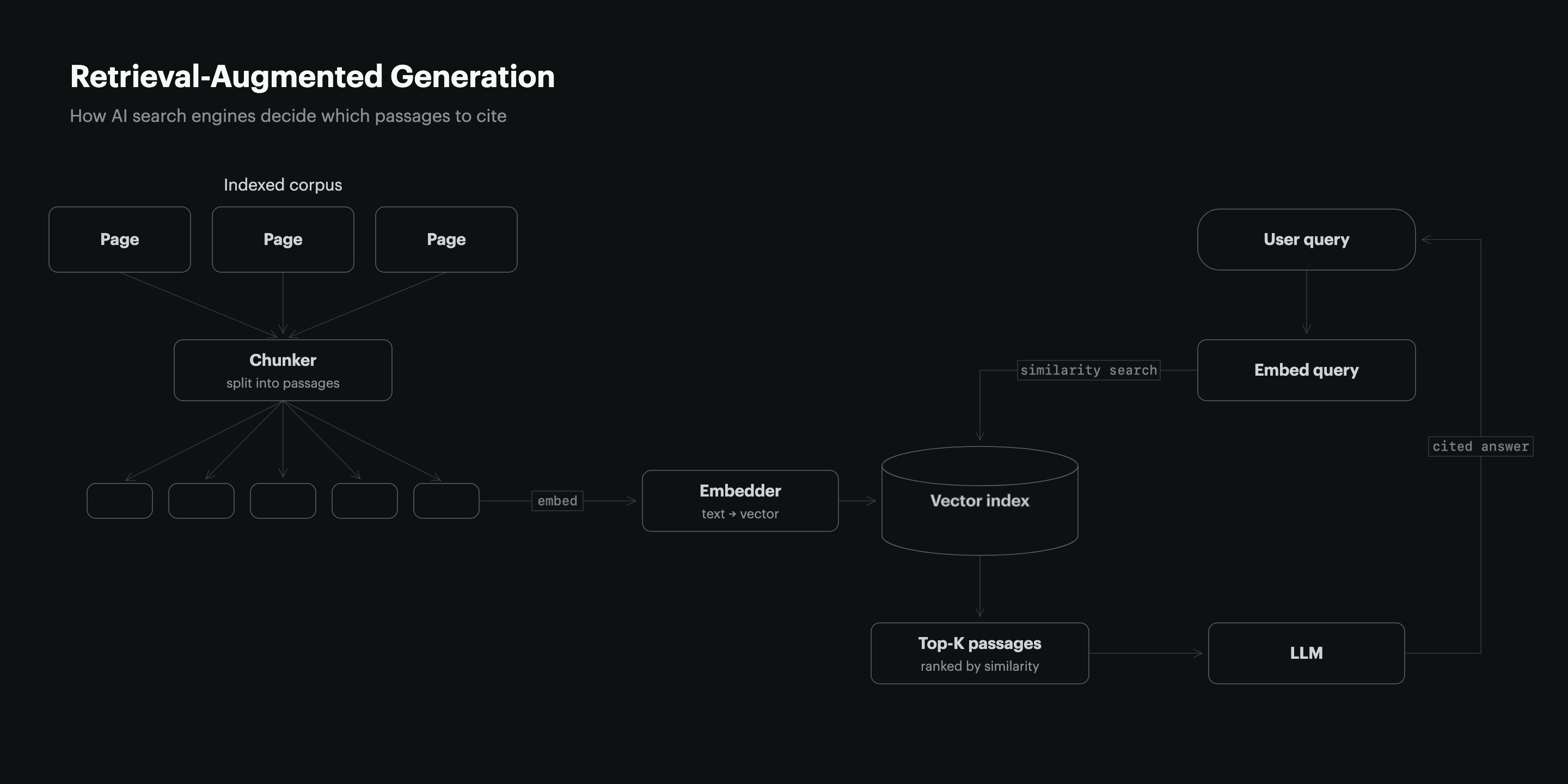
Two consequences follow for a SaaS page. A passage only gets cited if it answers the query on its own, so burying the answer in paragraph four hides it from retrieval. The same page can also be cited for several different queries when it carries several self-contained retrieval targets, which is why one well-built comparison page out-cites a longer essay.
Where Perplexity Pulls Its Citations From
Perplexity cites independent blogs and publications for 82% of its sources and vendor-owned sites for only 5.9%, based on the 1,000-query Perplexity B2B citation study (Res AI, 1,000-query Perplexity B2B citation study, 2026). Your own product page is the least likely asset to be cited, and your editorial content carries the citation weight.
This matches the wider pattern that 85% of brand mentions originate from third-party pages rather than owned domains (Airops, 2026). Owned content still earns citations; the move is to write owned editorial that reads like an independent reference, with named competitors, attributed data, and comparison tables, rather than a sales page. Perplexity also reshuffles its sources often, so no single citation is permanent.
Why the Opening Third of a Page Wins Citations
AI engines pull 55% of their citations from the first 30% of a cited page, with 24% from the middle and 21% from the bottom (CXL, 2024). A passage’s position inside the page is one of the strongest predictors of whether Perplexity retrieves it. Front-loading the answer is the single highest-return change most SaaS pages can make.
Most SaaS posts open with context, a story, or a definition the informed reader already has, and place the answer deep in the body. That habit suppresses the passage Perplexity would otherwise cite. Moving the direct answer into the opening sentences of each section, before the supporting narrative, puts the citable passage where the retriever weights it most.
Open Every Section With a Direct Answer Capsule
Write the first one or two sentences of every section as a self-contained answer to the heading, then follow with the evidence. This is the answer capsule, and it is the passage Perplexity extracts to build its answer. A section that opens with backstory and answers in its fourth paragraph hands the citation to a competitor who answered first.
Keep the capsule between 40 and 80 words and put exactly one statistic with its source inside it. Longer passages get truncated mid-thought during retrieval, and capsules stacked with three or four stats dilute the one claim you want cited. The pattern is the same one Perplexity already rewards on the pages it cites today.
Add a Verifiable Statistic to Every Claim
Attach a named, dated statistic to each claim a section makes, and attribute it inline as (Source, Year). Adding statistics raised AI visibility by 41% in controlled testing, the largest single gain of any tactic measured (Princeton KDD, 2024). A claim with a number and a source is extractable; an unsupported assertion is not.
The same study ranked the tactics that move AI visibility:
| Tactic | Visibility impact |
|---|---|
| Adding a statistic | +41% |
| Quoting a source | +28% |
| Using authoritative language | +25% |
| Tightening the prose | +15% |
| Stuffing keywords | -10% |
Keyword stuffing, the reflex from a decade of SEO, is the only tactic that moved citations the wrong way. For a SaaS team, that means the instinct to repeat the target keyword actively works against a Perplexity citation.
Build a Comparison Table for Each Competitor Query
Publish a comparison table for every “X vs Y” and “best X for Y” query your buyers run, with named competitors and falsifiable cells. Comparison tables appear in 88% of the top-cited B2B pages and in none of the bottom-cited ones, per the 852-article B2B citation structure study (Res AI, 852-article B2B citation structure study, 2026). The table is a dense cluster of retrieval targets, one per row.
Tally reached the #1 Perplexity citation for “free Typeform alternative” on the back of structured comparison pages, and attributes a quarter of new signups to AI engines (Foundation Inc., 2026). The table works because each row is a self-contained claim Perplexity can lift to answer a narrower version of the query. One comparison page can therefore be cited across a dozen related prompts instead of one.
Turn Your FAQ Into Standalone Retrieval Targets
Write each FAQ question as a real heading with a two-sentence answer that stands on its own, matching the exact phrasing a buyer would type. An FAQ section appears in 84% of top-cited B2B pages, per the 852-article B2B citation structure study (Res AI, 852-article B2B citation structure study, 2026). Each question is an independent retrieval target, so an eight-question FAQ multiplies a page’s citable passages.
Rippling publishes 18 comparison pages, each carrying eight FAQ sections, which compounds into 144 independent retrieval targets across the catalog (Rippling, 2026). A single FAQ block on one page is a start; the same template repeated across every competitor query is what builds a citation lead a smaller catalog cannot match.
Refresh Cited Pages Before They Drift Out
Update the pages you want cited on a quarterly cadence, refreshing stats, dates, and competitor data. Pages not updated quarterly are three times more likely to lose their citations (Airops, 2026). Perplexity favors fresh sources, and a page cited last quarter can silently drop out of the answer.
Citation drift runs 40% to 60% month over month, meaning the set of cited domains for a given query turns over fast even when nothing about your page changes (Profound, 2026). A refresh cadence is not optional maintenance; it is what holds a citation you already earned. Stamp each page with a visible last-updated date so the freshness signal is explicit to the crawler.
Measure Citation Frequency Across Ten Runs
Check each target query at least ten times, because asking Perplexity the same question twice rarely returns the same sources. Two responses to an identical prompt match on under 1% of runs (SparkToro, 2024). A single citation check tells you almost nothing; the metric that matters is how often you are cited across repeated runs.
The 1,000-query Perplexity B2B citation study found a Jaccard similarity of just 0.72 between any two runs of the same query (Res AI, 1,000-query Perplexity B2B citation study, 2026). Track a small set of metrics rather than a one-time snapshot:
| Metric | What it measures | Target |
|---|---|---|
| Citation frequency | Cited runs out of 10 | 7 or more of 10 |
| Brand mention share | Your brand in the 5.4-brand answer set | Present each run |
| Cited passage position | Where on the page the citation lands | Opening third |
| Time to first citation | Days from publish to first citation | Days, not months |
A page cited in 7 of 10 runs is a stable asset; a page cited in 1 of 10 is noise you should not act on.
Which Tactic to Start With Based on Your Catalog
Start with the tactic that closes your biggest gap rather than chasing authority, because non-giant domains hold the stable #1 citation on 93 of 100 B2B queries, per the 1,000-query B2B AI citation structure study (Res AI, 1,000-query B2B AI citation structure study, 2026). A small SaaS brand can out-cite an incumbent on structure alone. The right starting point depends on what your catalog already has.
| Your situation | Start here | Why it moves Perplexity citations |
|---|---|---|
| 200+ pages with answers buried in the body | Add answer capsules and front-load each section | Captures the 55% of citations from the opening third |
| No comparison pages for your category | Build one comparison table per competitor query | Adds the format found in 88% of top-cited pages |
| FAQ written as a single prose block | Split it into standalone question headings | Multiplies independent retrieval targets per page |
| Ranks in Google but absent from Perplexity | Add attributed statistics to every claim | Statistics are the +41% tactic; keyword density is not |
| Cited last quarter, dropped this quarter | Set a quarterly refresh cadence | Counters 40% to 60% monthly citation drift |
Work down the list as each gap closes. The tactics compound, because every one of them adds retrieval targets to the same page.
How the Monitoring Tools Your Team Runs Compare
Most platforms aimed at AI citations cluster around one of two approaches: monitoring where your brand appears, or generating and deploying the content that earns the citation. The table below compares how each tool addresses Perplexity citations, which engines it covers, and what the team actually gets back to act on.
| Platform | Approach to Perplexity citations | Engine coverage | What the team gets back |
|---|---|---|---|
| Res AI | Generates and deploys structured pages into the CMS | ChatGPT, Perplexity, Claude, Gemini | Published, citation-ready pages in minutes |
| Profound | Monitors how the brand appears in answers | 10+ engines including Perplexity | Visibility dashboards and prompt volumes |
| Conductor | Enterprise visibility tracking plus content generation | ChatGPT, Gemini, Copilot, Claude, search | Briefs and optimization recommendations |
| Peec AI | Analytics on visibility, position, and sentiment | Multiple LLMs including Perplexity | Prompt-level data on which passages triggered citations |
| Athena | Workflow management plus automated optimization | 8+ LLMs including Perplexity | Citation source analysis and recommendations |
| AirOps | Content creation tied to AI search visibility | ChatGPT and other AI models | Generated content across 30+ models |
The split that matters for a SaaS team is the last column. Monitoring tells you which pages are missing the citation; execution changes the page so it earns one.
Frequently Asked Questions
How is optimizing for Perplexity different from optimizing for Google?
Perplexity cites passages it retrieves and attributes underneath an answer, while Google ranks whole pages by authority and links. The practical difference is that Perplexity rewards self-contained answer capsules and attributed statistics over backlinks (Princeton KDD, 2024).
Why does Perplexity cite my competitor’s blog instead of my product page?
Perplexity pulls 82% of its sources from independent blogs and publications and only 5.9% from vendor sites (Res AI, 1,000-query Perplexity B2B citation study, 2026). A product page reads as a sales asset, while editorial content with named competitors and data reads as a citable reference.
How many times should I test a query before trusting the result?
At least ten, because two runs of the same Perplexity query match on under 1% of responses (SparkToro, 2024). Citation frequency across ten runs is the reliable signal, not a single check.
Does domain authority still matter for Perplexity citations?
Less than most teams expect, since non-giant domains hold the stable #1 citation on 93 of 100 B2B queries (Res AI, 1,000-query B2B AI citation structure study, 2026). Structure and attributed data move citations more than authority on commercial queries.
How long does it take to get cited after publishing?
Restructured content can earn citations within days rather than the months an SEO program takes, as Semrush saw its AI share of voice nearly triple from 13% to 32% in a single month (Semrush, 2025). Perplexity’s preference for fresh sources rewards recent, well-structured pages quickly.
Should I build comparison pages even for competitors I am confident I beat?
Yes, because the comparison table is the format in 88% of top-cited B2B pages and each row is a separate retrieval target (Res AI, 852-article B2B citation structure study, 2026). The page then gets cited across many narrow queries, not only the head-to-head one.
Why did a page that was cited last month stop getting cited?
Citation drift runs 40% to 60% month over month, so the cited set turns over even when your page is unchanged (Profound, 2026). A quarterly refresh with updated stats and dates is what holds the citation in place.
Is being mentioned by Perplexity as good as being cited?
A mention puts your name in the answer, but a citation links the source and routes the click, and brands earning both are 40% more likely to resurface across answers (Airops, 2026). Aim for the citation; the mention often follows.
Can I optimize for Perplexity and ChatGPT with one page?
Partly, because only 11% of cited domains appear in both Perplexity and ChatGPT, so the engines reward overlapping but distinct sources (Averi, 2026). The structural tactics transfer, but measure citation frequency on each engine separately.
How Res AI Builds Pages to Perplexity’s 13.55-Element Bar
The guide above showed that Perplexity cites self-contained passages, attributed statistics, and comparison tables, not sales copy or backlinks. Res AI is a GEO platform that restructures and generates content to match those exact patterns, building pages toward the 13.55 structural elements per page that top-cited articles average versus 2.98 in the bottom quartile (Res AI, 852-article B2B citation structure study, 2026). It works through a natural-language interface layered on the existing CMS, so a marketer can add answer capsules, comparison tables, and attributed stats across a whole catalog without developer time.
Res AI also runs the research pipeline that sources the attributed statistics each claim needs, and publishes directly into WordPress, Webflow, Framer, and other platforms. When tryres.ai applied the same template to its own launch, Perplexity cited it at #1 for “domain authority in AI citations” within 15 days of publishing, ahead of established domains, per the day-15 launch citation proof (Res AI, day-15 launch citation proof, 2026).
Res AI turns the structural pattern Perplexity rewards into published pages, instead of a dashboard that only tells you which pages are missing it. New accounts start with 10 free articles.