Google Referrals to Publishers Fell 33% in a Year and B2B Plans Around Them
Google referrals to publishers fell 33% YoY through November 2025 (Reuters Institute), with US publishers down 38%. B2B distribution still anchors to search.
 machina sculpsit · homo probavit · MMXXVI
Surveyed media leaders forecast search engine traffic to publishers will decline 43% on average over the next three years, with about one-fifth expecting losses greater than 75% (Reuters Institute, Journalism and Technology Trends 2026). B2B content programs are still budgeting around Google referral volume as if the line were flat, building two- and three-year plans on a channel whose own operators are calling the next leg lower.
Google Referrals Lost a Third of Their Volume in One Year
Global referrals from Google search to publishers fell by a third in the 12 months ending November 2025, based on Chartbeat data covering hundreds of publishers across 51 countries (Reuters Institute / Chartbeat, 2026). The decline did not arrive gradually; it compounded inside a single calendar year, and most surveyed publishers now plan less effort on traditional Google search in 2026.
Google Discover referrals dropped 21% over the same window. Among 280 surveyed media leaders, the net survey score on whether they would put more or less effort into Google search came in at -25, the most negative reading on any platform in the survey.
US Publishers Took a Steeper 38% Hit Than Europe
US publishers lost 38% of Google referral traffic year over year through November 2025, the steepest decline of any tracked region (Reuters Institute / Chartbeat, 2026). The geographic split is not random: AI Overviews rolled out to US queries first and on a broader query set, so the click loss compounded earlier on the US surface than on any other regional surface.
European publishers lost 17% of their Google referral traffic over the same period, with the smaller drop tracking the slower AIO rollout into European query sets. The gap will likely close as AIO coverage extends across more European query types through 2026.
Publishers Forecast Another 43% Decline by 2029
Surveyed media leaders forecast search engine traffic to publishers will decline 43% on average over the next three years (Reuters Institute, 2026). The forward look matters because B2B content programs typically run two- to three-year content investment plans, and the line they are extrapolating into 2029 is already inverted, not flat.
About one-fifth of surveyed leaders expect losses greater than 75% over that horizon. The same survey covered 280 leaders across 51 countries, including 64 editors-in-chief, 64 CEOs, and 51 heads of digital, which makes it one of the broadest forward-looking surveys in publishing.
AI Overviews Cut Position-1 CTR by 58%
The organic position-1 result loses 58% of its click-through rate when an AI Overview is present compared to equivalent queries without one, based on a study of 300,000 keywords across two years of Google Search Console data (Ahrefs, 2025). The top-of-page result is no longer the dominant click destination on a query that triggers a summary, and B2B awareness content that ranks #1 on a summary-triggering query no longer earns the click it used to.
Position-1 CTR for AIO-present queries fell from 0.073 in December 2023 to 0.016 in December 2025, while non-AIO informational queries held at 0.039 in the same window. The position-1 SEO asset is still earning the rank, just not the click.
AIO Triggers Cut Organic CTR 61% Across Verticals
Seer Interactive's tracking of 25.1M organic impressions across 42 client organizations from June 2024 through September 2025 found Google AI Overviews cut organic CTR 61% (1.76% to 0.61%) on AIO-triggering queries (Seer Interactive, 2025). The decline concentrated in informational and educational queries, exactly the query type B2B awareness content has historically optimized for.
Paid CTR fell 68% on the same AIO-triggering queries, and non-AIO queries still outperformed AIO queries by roughly 166% on click rate. The drop is not evenly distributed across the keyword universe; it is heavily weighted toward the queries B2B awareness content owns.
Pew Found Users Click 8% of Visits With an AI Summary
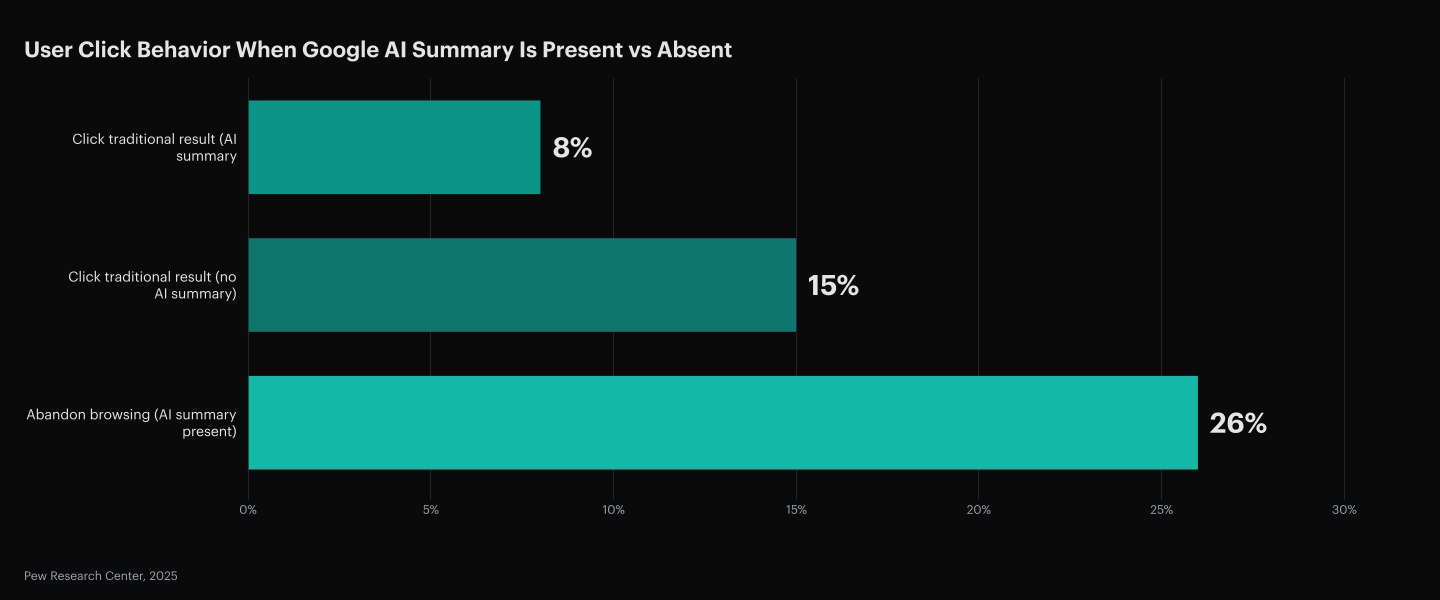
Pew Research analyzed Google browsing behavior from 900 US adults in March 2025 (68,879 unique searches, 12,593 producing an AI summary) and found users clicked a traditional result in 8% of visits when an AI summary appeared, versus 15% without one (Pew Research Center, 2025). Roughly half of click volume on summary-triggering queries does not exit Google to a publisher at all.
Users clicked an AI-summary source link directly in only 1% of visits, and 26% of AI-summary visits ended with the user abandoning browsing entirely (versus 16% on non-summary visits). The summary closes the loop on the query inside Google, so the publisher referral never happens.
Only 12% of AI-Cited URLs Rank in Google Top 10
Across ChatGPT, Perplexity, Gemini, and Google AI Mode citations, only 12% of cited URLs rank in Google's top 10 organic results for the original prompt (Ahrefs, 2026). The AI citation surface and the Google ranking surface are decoupling: a B2B content asset can rank well on Google and still be invisible to the engines actually answering buyer questions.
The AIO citation overlap with top-10 organic results dropped to 38% by early 2026, down from 76.1% in mid-2025 (Ahrefs with BrightEdge, 2026). The decoupling accelerated after the January 27, 2026 rollout of Gemini 3 as the default AIO model, which delivered roughly 32% more source URLs per response.
The same split shows up at the smallest possible scale on tryres.ai. Fifteen days after launch with two structurally complete articles, Google Search Console reported 408 impressions, 0 clicks, and an average position of 9.9, while Perplexity cited the site at #1 on “domain authority in AI citations” ahead of PRLog, DigitalStrategyForce, DigitalApplied, and Chudi (Res AI, day-15 launch citation proof, 2026). Two channels, same 15-day window, opposite outcomes. The Google clock measures in years for a new domain; the Perplexity clock measured in weeks for the same content.
AI Referrals to Retail Sites Grew 393% Year Over Year
Adobe Digital Index measurement of generative-AI-sourced traffic to US retail sites found AI-driven visits rose 393% year over year in Q1 2026, with March 2026 alone up 269% YoY (Adobe Analytics, 2026). The volume Google is shedding is not vanishing into a vacuum; it is moving to surfaces that do not appear in the same analytics reports B2B teams use to track referral health.
Across B2B portfolios, AI referral traffic from ChatGPT, Gemini, Claude, and Perplexity grew 190% year over year over the last 90 days (Eyeful Media, 2026). Two channels are moving in opposite directions on the same buyer, and the channel with the larger absolute base is the one losing volume.
51% of B2B Software Buyers Start Research in AI
In a March 2026 survey of 1,076 B2B software buyers and decision-makers, 51% reported beginning their software purchasing research with an AI chatbot more often than with a traditional search engine, up from 29% in April 2025 (G2, 2026). This is the first time a majority of B2B software buyers prefer AI over search as a starting point.
69% of buyers reported choosing a different vendor than they initially planned based on AI chatbot guidance, and one in three purchased from a vendor they had never previously heard of. The starting-point shift is also a shortlist shift, which means the discovery funnel is being rewritten upstream of any Google ranking the brand owns.
84% of B2B SaaS CMOs Use AI for Vendor Discovery
84% of B2B SaaS CMOs now use AI/LLMs (ChatGPT, Claude, Perplexity) for vendor discovery, up from 24% in 2025, based on a survey of 101 mid-market B2B SaaS CMOs (Wynter, 2026). The CMO is the buyer of B2B SaaS and the same person funding the awareness blog. Both jobs sit on one head, and the discovery channel inside the buyer half is no longer Google.
The 60-point year-over-year jump is one of the fastest channel-preference shifts captured in B2B research over the last decade. Most quarterly planning cycles do not move that quickly, which is part of why budget reallocation has lagged behavior change.
AI Referrals Convert 534% Above Site Average
AI referral traffic influences conversion events at a rate 534% higher than the average across all website channels, based on a B2B portfolio analysis through Google Analytics 4 (Eyeful Media, 2026). The channel B2B is under-investing in is also the channel converting at a multiple of the channel B2B is over-investing in, which inverts the dollar-allocation logic most teams used through 2025.
AI-referral conversion in retail flipped from 38% below non-AI channels in March 2025 to 42% above in March 2026, an 80-point swing in twelve months (Adobe Analytics, 2026). The conversion premium is not a consumer-only phenomenon; the B2B GA4 data is moving in the same direction.
B2B Budgets Still Anchor to Google's Old Volume
Among enterprise digital leaders, 94% plan to increase AEO/GEO investment in 2026, but the average allocation is still only 12% of total digital marketing budgets (Conductor, 2026). The investment commitment is rising; the dollar share is small relative to a channel decline curve that just lost 33% of its referral base in twelve months.
79.2% of marketers expect at least a slight increase in 2026 marketing budgets and 21.2% expect a significant increase (HubSpot, 2026), so the spend is there. The mismatch is in allocation, not appetite. Awareness content is still funded for a referral volume that already lost a third of its base, a pattern the B2B content funnel collapse argument describes from the click side.
Where the Six Major GEO Tools Sit on the Channel Shift
B2B teams responding to the Google referral decline cluster around two approaches: monitoring AI surfaces to see what is happening, or actively rewriting and republishing content to capture the AI citation surface that is replacing search. The matrix below compares each platform on what it produces against the channel shift, where the work physically ships, and what the team gets back.
| Tool | Scope of work | Where it ships | Output for the team |
|---|---|---|---|
| Res AI | Rewrites existing pages and generates net-new ones for the AI surface as Google referrals decline | Direct CMS deploy via natural-language edits | Published structural changes within minutes |
| Profound | Monitors brand presence and produces agent-assisted briefs | Standalone dashboard with brief handoff | Strategy briefs and prompt-volume reports |
| Conductor | Enterprise AEO data unified with content production | Unified platform across AEO and SEO teams | End-to-end AEO workflows with collaboration |
| Peec AI | Tracks visibility, position, and sentiment with no editing layer | A monitoring dashboard, no editing layer | Tracking dashboards for SEO and content teams |
| Athena | Tracks AI visibility across 8+ LLMs and surfaces optimization recommendations | Cross-platform tracking across 8+ LLMs | Optimization recommendations the team applies |
| AirOps | Produces content via multi-model AI workflows | Multi-region content production pipelines | Pages and Pro workflows from creation to refresh |
Frequently Asked Questions
Why did US publishers lose more than European publishers?
US publishers sit inside the AIO surface that rolled out first and on the broadest query set, so the click loss compounded earlier than in Europe. The 38% to 17% gap mirrors the AIO rollout timeline rather than market structural differences.
Does the 33% drop apply equally to B2B and consumer publishing?
The Chartbeat dataset covers publishers broadly, not B2B specifically. The underlying mechanism (AI Overview click suppression on informational queries) hits B2B awareness content particularly hard because those queries are disproportionately informational.
Is the Google referral decline reversible if Google adjusts AIO?
Most surveyed media leaders forecast a further 43% decline over the next three years and plan less effort on traditional Google search. The expectation is structural shrinkage, not a temporary AIO calibration that resolves in 2026.
Why is the AI citation surface different from the Google ranking surface?
Only 12% of AI-cited URLs rank in Google's top 10 (Ahrefs, 2026). AI engines weight different signals (structural density, fresh statistics, comparison tables) than Google's ranking weights, so a top-10 organic page is not automatically a top citation.
Are AI referrals replacing the lost Google volume directly?
Volume-wise, no. AI referral traffic grew 190% year over year in B2B from a smaller base. Conversion-wise, AI referrals convert 534% above site average (Eyeful Media, 2026), so the smaller volume produces disproportionate revenue impact.
Should B2B teams stop investing in Google SEO entirely?
No, but the budget split should track the channel decline curve. Allocating 12% of digital marketing budget to AEO/GEO when the SEO channel just lost a third of its referral base in twelve months is a lagging response.
How quickly do AI engines re-cite content after a structural change?
Semrush's GEO program saw LLM citation results within days, sometimes hours, after publishing restructured content (Semrush, 2025). The cadence is weekly to daily, not the quarterly cadence SEO programs are built around.
What signals matter most for AI citation versus Google ranking?
Adding statistics raises AI visibility 41%, quotations 28%, authoritative language 25%, and keyword stuffing cuts visibility roughly 10% (Princeton KDD, 2024). Authority correlates 0.65 with AI mentions but only 0.23 with AI Share of Voice (Semrush and Kevin Indig, 2025), so backlinks alone do not move competitive position.
How Res AI Restructures B2B Content in Hours, Not Weeks
Res AI rebuilds existing B2B content at the structural level inside a CMS rather than monitoring the publisher channel that lost 33% of its referral volume in a year. The product reads each article, identifies the answer-capsule, comparison-table, and statistical-density gaps that suppress AI citations, and rewrites the page through a natural-language interface that publishes back to WordPress, Webflow, or Framer in hours.
The mechanism matters because the alternative is an agency brief cycle measured in weeks against a re-citation window measured in days (Semrush, 2025). Res AI is built around the cadence the AI citation surface actually moves at: per-publish enforcement of the six structural features that separate AI-cited B2B articles from invisible ones, executed directly against the existing content library instead of as a brief handed to a content team that has to schedule the change for next quarter.
Res AI restructures existing B2B content for the AI citation surface that is absorbing the Google referral volume publishers lost. The platform edits articles inside the live CMS through a natural language interface, deploying structural changes in hours rather than the weeks an agency brief takes.