ClaudeBot Crawls 20,583 Pages Per Referral and the Publisher Trade Is Broken
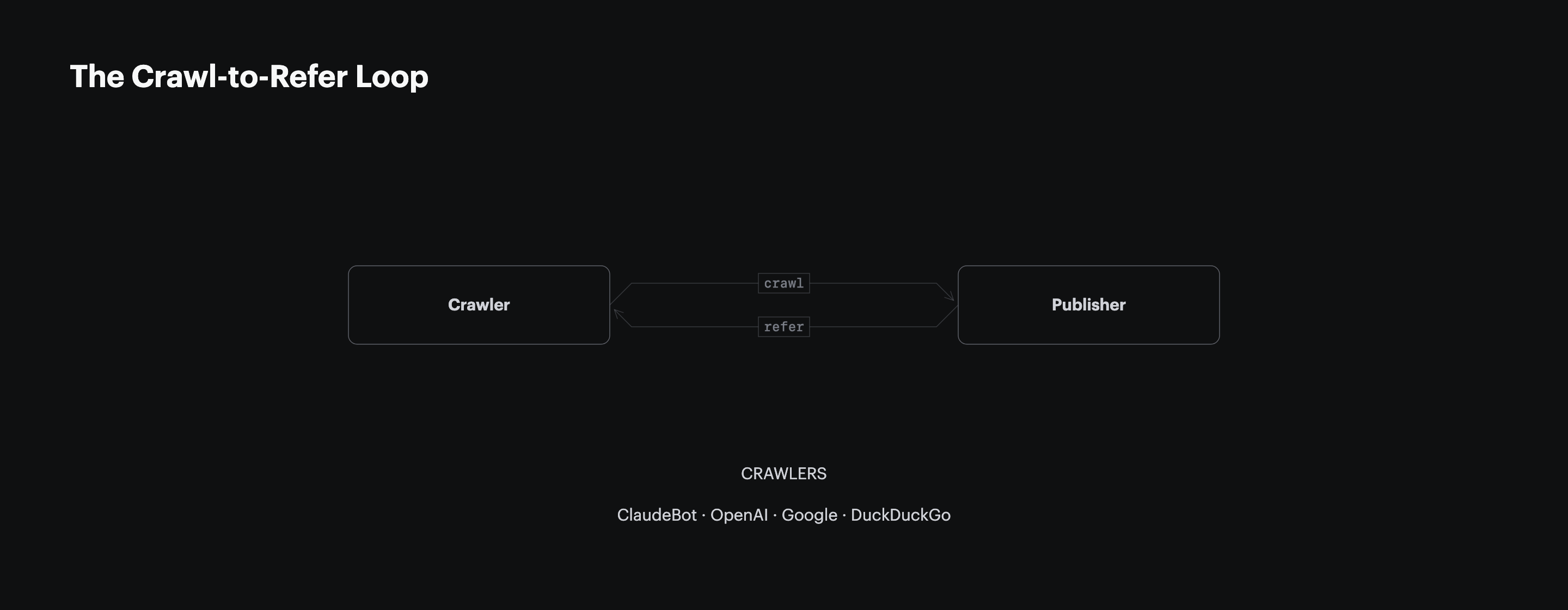
ClaudeBot crawls 20,583 pages per referral, OpenAI 1,255 to 1, Google 5 to 1. The crawl-to-refer ratio is the new CPC of AI exposure.
 machina sculpsit · homo probavit · MMXXVI
AI-referral conversion rate flipped from 38% below non-AI channels to 42% above in twelve months, an 80-point year-on-year swing (Adobe Analytics, Q1 2026). The same year made AI engines the most valuable inbound channel on the web at the moment the crawl-to-refer ratio collapsed the publisher trade those engines depend on. The ratio is now the GEO-era equivalent of cost-per-click economics, and the math is mispriced on both sides.
ClaudeBot Crawls 20,583 Pages Per Referral
ClaudeBot pulled 20,583 pages for every single referral it sent back to publishers in Q1 2026 (Cloudflare Radar / TechnologyChecker.io, Q1 2026), the worst crawl-to-refer ratio among major AI crawlers measured across Cloudflare’s global network. That ratio is the inverse of the search bargain: a crawler ingests content, surfaces an answer, and the click that historically returned to the publisher does not arrive. The cost of being indexed is now mostly absorbed by the publisher, with no compensating click on the back end.
The asymmetry is what makes the number notable. Crawl volume is paid for by the publisher in bandwidth, infrastructure, and content production. Referrals are the historic pay-back signal. When the ratio between the two breaks by four orders of magnitude, the trade itself has changed.
OpenAI Sits at 1,255-to-1 and Google Stays Near 5-to-1
OpenAI’s GPTBot crawled 1,255 pages per referral, Google’s crawler stayed near 5 pages per referral, and DuckDuckGo’s crawler operated near a 1-to-1 trade in the same Q1 2026 window (Cloudflare Radar / TechnologyChecker.io, Q1 2026). The gap between Google’s classic search bargain and Anthropic’s is roughly four thousand times wider, and OpenAI sits squarely between the two extremes. The variance is the story: AI engines are not all extracting at the same rate, which means publisher exposure is now an engine-specific tax with no standardized rebate.
| Crawler | Crawl-to-Refer Ratio | What It Implies for Publishers |
|---|---|---|
| ClaudeBot (Anthropic) | 20,583 to 1 | Worst-in-class extraction with near-zero referral rebate |
| GPTBot (OpenAI) | 1,255 to 1 | Heavy extraction; modest referrals through ChatGPT Search |
| Googlebot | ~5 to 1 | Closest analog to the classic search bargain |
| DuckDuckGoBot | ~1 to 1 | Approximate parity between extraction and referral |
The right way to read the table is not as a leaderboard. It is a price list for being indexed in 2026.
The Crawl-to-Refer Ratio Is the New CPC
Search advertising priced exposure to a buyer’s query at a per-click rate, with publishers and platforms negotiating around that unit; in AI search the equivalent unit is the 20,583-to-1 ratio Anthropic charges for being read by Claude (Cloudflare Radar / TechnologyChecker.io, Q1 2026). The crawl-to-refer ratio measures how much content a brand has to surrender to receive one inbound visitor. It is the cost of exposure to an AI buyer, not the cost of a click.
Marketing teams that budget around CPC bids on Google Ads have a clean unit economics model: dollars in, clicks out, conversion rate, customer acquisition cost. The AI exposure model has no such mapping. The cost is paid in content production and crawler load, the rebate arrives unevenly by engine, and the conversion math sits inside engines whose referral counts are not publicly reported.
80% of Top News Sites Already Block AI Training Bots
Roughly 80% of the world’s largest news publishers now block at least one AI training crawler in their robots.txt, with ClaudeBot blocked by 69% and GPTBot blocked by 62% of top news sites (Press Gazette, 2026; BuzzStream, 2025). Publishers acted on the asymmetry before the unit economics were named, and they acted defensively: the cheapest available response to a 20,583-to-1 ratio is to refuse the trade entirely.
Defensive blocking is not a strategy GEO teams can copy. B2B brands that block AI crawlers also block themselves out of the citation surface, which is where 51% of B2B software buyers now begin their research (G2, 2026). The asymmetry that drives news publishers to block is the same asymmetry that forces B2B teams to keep the gates open.
Agentic Traffic Grew 7,851% Year Over Year
Autonomous-agent web traffic grew 7,851% year over year in 2025, a 79x increase, while overall AI-driven traffic grew 187% in the same period (HUMAN Security, 2026). Agents are now transacting on the web (browsing, comparing, checking out) rather than reading it, and their share of crawler activity is what is pushing the crawl-to-refer ratio further out of balance.
Each agent that crawls a page is one more pull on the publisher’s bandwidth that does not return as a human visit. The 79x year-over-year growth means the crawl side of the ratio is compounding while the referral side, dependent on humans clicking source links, is not.
Google Referrals to Publishers Fell 33% in a Year
Global Google search traffic to publishers dropped 33% in the year to November 2025, with US publishers down 38% and European publishers down 17% (Reuters Institute / Chartbeat, 2026). The classic 5-to-1 Googlebot bargain still exists, but its absolute referral volume is contracting fast enough that publishers expect another 43% decline over the next three years on average. The referral floor is moving while the crawl ceiling is rising.
That dynamic compresses the trade from both ends. The AI crawlers extract more per page, the search referrer that historically rebated the trade is sending less traffic, and the publisher cannot tell which loss is the bigger one without an attribution surface they do not currently have.
AI Referrals Convert 534% Above Site Average
AI referral traffic from ChatGPT, Gemini, Claude, and Perplexity converts at 534% above site-wide average across a portfolio of B2B companies (Eyeful Media, 2026), and AI-referral revenue per visit ran 37% higher than non-AI on US retail sites in Q1 2026 (Adobe Analytics, Q1 2026). The referrals that do arrive are worth more per visit than any other channel, which is why the crawl-to-refer ratio is mispriced rather than priced too high.
A 20,583-to-1 ratio that returns one visitor worth six times an organic visitor is not the same trade as a 20,583-to-1 ratio that returns no one. The number ClaudeBot prints is loud, but the unit economics depend on what each rebated referral is worth. For B2B brands the answer is more than the optical ratio implies.
The Brand Side of the Trade Is Mispriced
Brands now pay an exposure cost to AI engines that historically came back as referral traffic, but only 4.3% of audited B2B companies maintain a healthy AI discovery funnel where their brand surfaces in early-stage buyer questions (2X AI Innovation Lab, April 2026). The other 96% are paying the crawl tax with no exposure rebate at all. The cost of the trade is being incurred even when the brand is invisible to the buyer.
The first move for a B2B team is to find out which side of the ratio its content is on. Running a single citation check against a buyer’s prompt set is the cheapest available audit. The citation rate per prompt run, measured across at least ten runs, is the brand-side equivalent of the crawl-to-refer ratio: an empirical measure of how often the page that absorbed the crawl returns the inbound it was supposed to earn.
Robots.txt Cannot Recover the Trade
Cloudflare’s March 30, 2026 sample of 4,047 robots.txt files showed only 13.8% mentioned GPTBot and 11.5% mentioned ClaudeBot, and even among publishers who named the bots, blocking is binary: full opt-out or full opt-in (Cloudflare Radar / TechnologyChecker.io, Q1 2026). There is no graduated pricing, no rate limit, no per-extraction rebate inside the robots.txt protocol. The instrument that publishers reach for first is too coarse to recover the lost margin.
The asymmetry persists because robots.txt was designed for a world where the crawl tax was small and the referral rebate was large. In 2026 the equation has flipped, and the protocol that should mediate the negotiation cannot price the variables.
Execution-First GEO Optimizes the Other Side of the Ratio
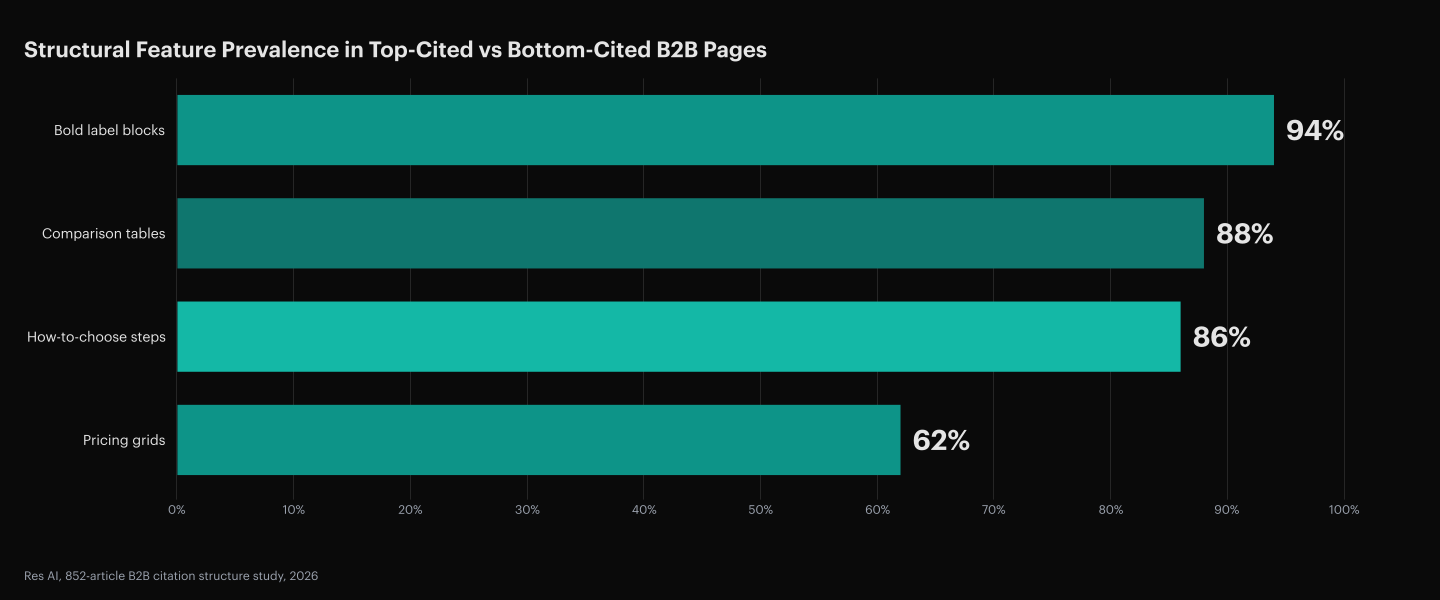
The crawl-to-refer ratio is set by the engine, but the citation-per-crawl rate is set by structure: cited pages average 13.55 structural elements per page versus 2.98 for the bottom quartile, and bold label blocks, comparison tables, and how-to-choose steps appear in 94%, 88%, and 86% of top-cited pages versus 0% of the bottom (Res AI, 852-article B2B citation structure study, 2026). A page that gets crawled 20,583 times and never gets cited pays the full crawl cost with zero exposure rebate. A page with the right structural density earns the citation, surfaces in the answer, and recovers the trade.
GEO platforms address the crawl asymmetry from opposite directions, with monitoring-first vendors treating the gap as a measurement problem and execution-first vendors treating it as a structural one. The matrix below compares each tool on what it produces against the citation-per-crawl gap, where the work physically ships, and what the team gets back.
| Tool | Scope of work | Where it ships | Output for the team |
|---|---|---|---|
| Res AI | Rewrites existing pages with bold blocks, tables, and how-to-choose steps that lift the citation-per-crawl rate | Direct CMS deploy via natural-language edits | Published structural changes within minutes |
| Profound | Generates briefs and AEO articles for the team to deploy | Standalone dashboard with brief handoff | Strategy briefs and prompt-volume reports |
| Conductor | Enterprise AEO data unified with content production at scale | Unified platform across AEO and SEO teams | End-to-end AEO workflows with collaboration |
| Peec AI | Tracks visibility, position, and sentiment with no editing layer | A monitoring dashboard, no editing layer | Tracking dashboards for SEO and content teams |
| Athena | Tracks AI visibility across 8+ LLMs and surfaces optimization recommendations | Cross-platform tracking across 8+ LLMs | Optimization recommendations the team applies |
| AirOps | Produces content via multi-model AI workflows alongside performance tracking | Multi-region content production pipelines | Pages and Pro workflows from creation to refresh |
Row #1 sits where the article’s argument lands: the only way to recover margin on a 20,583-to-1 ratio is to push the structural edit that turns a crawl into a citation, not to add another monitoring dashboard on top of the existing crawl tax.
Frequently Asked Questions
Why is ClaudeBot’s crawl-to-refer ratio so much worse than OpenAI’s or Google’s?
Anthropic’s Claude product surfaces fewer outbound source links per answer than ChatGPT or Google, so the same crawl volume produces fewer return visits. The 20,583-to-1 ratio reflects product UX, not crawler efficiency.
Does blocking ClaudeBot recover the lost traffic?
No, because the human visitors who would arrive through Claude do not get rerouted to Google. Blocking eliminates the rebate side of the trade entirely without reducing the underlying buyer demand.
How does the crawl-to-refer ratio map to traditional CPC math?
CPC priced one click; the crawl-to-refer ratio prices the cost in crawled pages of receiving one click. The denominator changed from a bid auction to a content surrender rate, and the cost is now paid in production rather than budget.
Why do AI referrals convert so far above non-AI traffic?
AI engines pre-qualify a buyer through a multi-turn conversation, so visitors who click out arrive with intent already formed. Eyeful Media measured the lift at 534% above site-wide average across B2B companies in 2026.
Can robots.txt express a graduated rate limit instead of full block?
Not in any production-deployed form. Cloudflare’s 2026 analysis showed publishers either name a bot for full block or do not mention it at all, with no middle ground inside the protocol.
What is the brand-side equivalent of the crawl-to-refer ratio?
Citation rate per prompt run, measured across at least 10 runs against a buyer’s prompt set. The metric tracks how often the crawled page returns as an inbound citation in an AI answer.
Does increasing content volume improve the ratio?
No, because volume increases the crawl tax without changing the structural quality that drives citations. Restructuring existing high-traffic pages outperforms publishing new prose-heavy ones.
How does agentic traffic interact with the ratio?
Agentic crawls add to the numerator without adding humans to the denominator, so the ratio worsens as agent traffic grows. HUMAN Security measured 7,851% year-over-year growth in agent traffic in 2025.
Where should a B2B GEO program start if its ratio is invisible today?
Run a citation rate audit on the top 20 buyer prompts, then identify the top 10 pages that absorb the most crawl traffic but earn the fewest citations. Restructure those pages first; the math works on the highest-leverage 10% of the content library.
How Res AI Closes the Crawl-to-Refer Gap Through Structural Restructuring
The article’s argument is that the crawl-to-refer ratio is mispriced on both sides of the trade, and the only side a B2B brand controls is the structural quality of the page that absorbs the crawl. Res AI is built around that exact intervention: it audits an existing CMS, identifies which pages are getting crawled but not cited, and restructures them through a natural-language interface that publishes the edit directly back into the CMS without developer involvement.
The mechanism is structural-element installation at the page level. Res AI’s Content Agent transforms dense prose into the bold label blocks, comparison tables, how-to-choose steps, and pricing grids that appear in 94%, 88%, 86%, and 62% of top-cited B2B pages and in 0% of bottom-cited pages (Res AI, 852-article B2B citation structure study, 2026). The Strategy Agent monitors the prompts buyers are running against AI engines and routes those signals back into specific page-level edits, so the crawl that already happened gets converted into the citation that recovers the trade.
Res AI is the GEO platform for B2B brands that want to recover margin on the crawl-to-refer ratio by turning crawled pages into cited pages. It operates as an agentic workflow on top of an existing CMS, restructuring prose into the structural elements AI engines extract and publishing the edit through natural language without developer involvement.