Content Platforms Are Buying AI Visibility Not Buyer Selection
Adobe, Sitecore, and Optimizely bought AI-visibility tools, but tracking citations is not the same as measuring whether buyers pick you.
 machina sculpsit · homo probavit · MMXXVI
The companies that run the world’s content platforms spent the past seven months buying the tools that measure AI visibility. The spree confirms that getting cited by ChatGPT, Perplexity, and Gemini is now a board-level concern, with 84% of B2B SaaS CMOs already using AI tools to discover vendors (Wynter, 2026). What the acquired tools measure is whether a brand appears in an answer, which is a different question from whether the buyer picks it.
Three Content Platforms Just Bought Their Way Into AI Visibility
Three deals in seven months pulled AI-visibility tracking inside the major content and experience platforms. Adobe agreed to acquire Semrush for about $1.9 billion in an all-cash deal announced in November 2025, Sitecore bought generative engine optimization startup Scrunch AI for a reported $225 million in June 2026, and Optimizely launched a full answer-engine-optimization platform in partnership with Conductor the same month. Each acquirer sells content management or digital experience software, and each just bolted on a way to watch how AI engines treat its customers’ brands.
| Acquirer | Target | Value | What it absorbs |
|---|---|---|---|
| Adobe | Semrush | $1.9 billion | GEO and SEO visibility data across owned channels, LLMs, and search |
| Sitecore | Scrunch AI | $225 million | AI-search visibility tracking and an agent experience layer |
| Optimizely | Conductor (partnership) | Not disclosed | Log-based AI traffic data and AEO intelligence |
Sitecore says the Scrunch deal lets marketers shape how a brand appears across AI-powered search, and Akamai testing reported that Scrunch’s agent experience pages produced a 364% increase in brand presence on non-branded prompts. Adobe framed its Semrush purchase as a way to give marketers one view of how brands appear across owned channels, large language models, and traditional search. The framing is consistent across all three: see the brand in the answer.
The Buying Spree Validates a Category It Cannot Finish
Enterprises now route an average of 12% of total digital marketing budgets to answer-engine and generative-engine optimization, ranking it the #1 strategic marketing priority for 2026 (Conductor, 2026). The acquisitions price that demand. What changes hands, though, is measurement, not action.
Buying a visibility tracker tells a content platform where its customers stand in AI answers. It does not tell those customers how to change the answer, and it does not tell them whether the answer produced a sale. A dashboard that reports a brand’s citation count is a thermometer. The consolidation wave bought a lot of thermometers. None of them turns the heat up, and none of them counts who walked in the door because of the reading.
The category these deals validate is real. The work the deals leave undone is the work that decides revenue, which is moving the brand from cited to chosen.
A Citation Counts an Appearance Not a Decision
85% of brand mentions in AI answers originate on third-party pages a brand does not own (Airops and Kevin Indig, 2026). A citation records that a brand appeared in an answer. Buyer selection records that the answer sent the buyer toward that brand. The two events are counted in different places, and visibility tools watch only the first.
The gap matters because the dashboard view and the revenue view diverge fast. A brand can be cited in a paragraph that recommends a competitor, mentioned once and then dropped on the next run, or named in an answer the buyer never acts on. Each of those is a visible citation and a failed selection.
| Layer | The question it answers | A number that exposes the gap |
|---|---|---|
| Appearance | Were you cited at all | Only 30% of brands stay visible from one answer to the next (Airops, 2026) |
| Persistence | Do you stay cited over repeated runs | Just 20% remain present across five consecutive runs (Airops, 2026) |
| Recommendation | Are you the pick or the runner-up | 25.7% of listicle citations route the reader to a competitor (Res AI, 1,000-query Perplexity B2B citation study, 2026) |
| Selection | Did the buyer act on it | Visibility dashboards do not measure this at all |
The bottom row is the one the acquisitions do not address. A platform can now show a customer all three appearance layers and still report nothing about whether the citation produced pipeline.
Visibility Reporting Stops Where the Buyer Starts Comparing
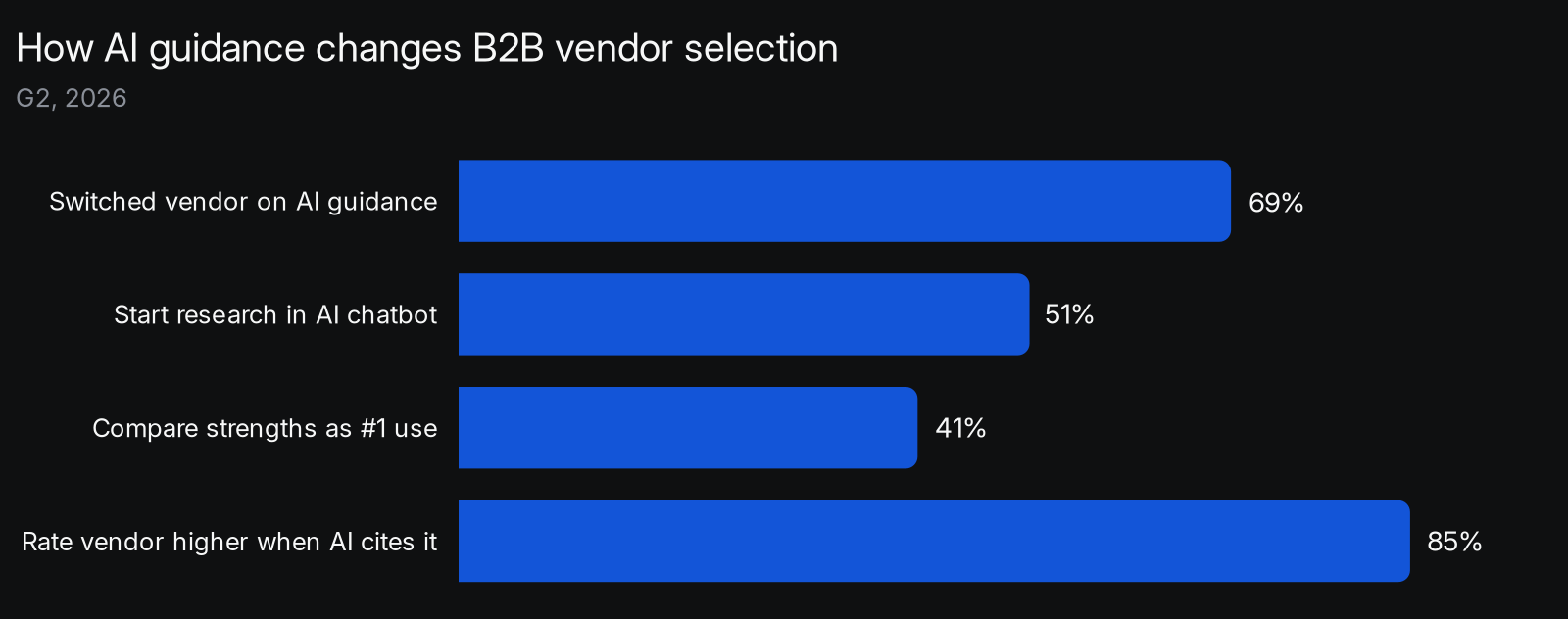
41% of B2B buyers name comparing vendor strengths and weaknesses as their #1 use case for AI chatbots, ahead of basic product research and vendor identification (G2, 2026). That moment, the side-by-side compare, is where selection happens. It is also where a visibility dashboard goes quiet.
A tracker can tell a brand it was cited on a comparison query. It cannot tell the brand whether the answer framed it as the leader or the also-ran, whether the comparison table inside the cited page put the brand in the winning column, or whether the buyer who read that answer moved forward. The compare-strengths moment is a buyer-selection event, and watching citation counts misses what actually happened inside the answer. This is the same reporting blind spot covered in why your AI visibility score is lying to you.
Sixty-Nine Percent of Buyers Switch Vendors on AI Guidance
69% of B2B buyers chose a different software vendor than they initially planned based on AI chatbot guidance, and one in three bought from a vendor they had never previously heard of (G2, 2026). That is buyer selection at industrial scale, and none of it shows up in a citation count.
The same research puts the stakes higher: 51% of buyers now begin software research in an AI chatbot more often than in a traditional search engine, and 85% think more highly of a vendor an AI names in a recommendation (G2, 2026). The selection has moved into the answer. A brand that measures only whether it appears is reading the wrong instrument while the purchase decision is being made somewhere it cannot see.
Being Mentioned and Being Recommended Are Different Events
Brands earning both a citation and a mention are 40% more likely to resurface across answers, yet only 28% of answers include such dual-visibility brands (Airops and Kevin Indig, 2026). These are separate events, and only the last one moves the buyer:
- Citation: the engine pulled your page into the answer.
- Mention: the engine named your brand in the text.
- Recommendation: the engine put you on the shortlist the buyer acts on.
A visibility tracker that counts citations treats all three as one number. That is why a rising citation count can sit on top of flat pipeline. The brand is appearing more, and being recommended no more. Closing that distance takes editing the cited page so the answer names the brand as the pick, not restating the dashboard reading at a higher resolution.
Acquired Dashboards Keep the Monitoring-First Ceiling
Semrush’s own GEO program saw LLM citations within days, sometimes hours, after publishing restructured content, versus the typical 3 to 6 month SEO timeline (Semrush, 2025). The lift came from publishing different content, not from watching a dashboard. That is the step the acquired tools still hand back to the customer.
Every product in this consolidation was built to report. Folding a reporting tool into a content platform does not add the act of changing the page, it just renders the same report inside a different login. The customer still has to do the work the report only describes:
- Translate the dashboard reading into a content brief.
- Route the brief to a writer or agency.
- Wait for the draft and the edit cycle.
- Publish the change, while the citation that prompted it drifts. The monitoring-first ceiling described in why monitoring-first GEO platforms miss the re-citation window does not lift because a larger company now owns the dashboard.
Citation Drift Makes a One-Time Dashboard Stale Fast
Citation drift, the share of domains appearing in one month’s AI answers but absent the next for identical prompts, averages 40% to 60% month over month (Profound, 2026). A dashboard is a snapshot. A snapshot of a surface that turns over by half every month is stale before the quarter ends.
This is why owning the tracker is not the same as owning the outcome. The brand that wins is the one re-publishing into the drift, not the one with the most detailed monthly report of what it already lost. Consolidation gives the buyer a better camera. The decay rate means the buyer needs a faster printing press.
Measure Whether the Answer Picked You
AI referral traffic influences conversion events at a rate 534% higher than the average across all website channels (Eyeful Media, 2026). That number is the one a buyer-selection program optimizes, and it is invisible to a citation count. AI-referral conversion flipped from 38% below non-AI channels to 42% above in a single year, an 80-point swing (Adobe Analytics, Q1 2026), which means the channel the acquired dashboards track is now the highest-converting inbound a brand has.
The metrics that read selection are different from the metrics that read visibility. Track whether the engine recommends you, not just whether it cites you, and tie the result to revenue.
| Metric to track | What it tells you about selection | Benchmark to read it against |
|---|---|---|
| Recommendation rate, named in N of 10 runs | Whether the engine puts you on the shortlist | 10-run sampling controls a 0.72 run-to-run Jaccard similarity (Res AI, 1,000-query Perplexity study, 2026) |
| Comparison-query win rate | Whether you win the compare-strengths moment | Non-giants hold stable #1 on 93 of 100 B2B queries (Res AI, 1,000-query Perplexity study, 2026) |
| AI-referral conversion rate | Whether the citation produced revenue | Read it in GA4 against site-wide conversion |
| First-citation latency | Whether new pages get picked up at all | 6.81-day median to first citation (Profound, 2026) |
A program built on these reads buyer selection. A program built on citation counts reads a proxy that the consolidation wave just made easier to buy and no closer to revenue.
Where Res AI Sits Among the Consolidating Tools
The tools changing hands cluster around one job, which is reporting where a brand stands in AI answers, and they split on whether they do anything about it. The table compares what each tool measures, what it hands back to the team, and whether it moves a brand from cited to chosen.
| Tool | Primary job | What you get back | Moves buyer selection |
|---|---|---|---|
| Res AI | Generate and publish structured content into your CMS | Live published edits across your library | Edits what the engine cites and recommends |
| Conductor (Optimizely) | Track AI and search visibility, generate briefs | Dashboards and content briefs | Reports position, hands execution back |
| Profound | Monitor brand presence across answer engines | Answer-engine analytics and agents | Shows the gap, does not publish the fix |
| Athena | Track visibility across 8+ LLMs | Dashboards and optimization recommendations | Recommends, you execute |
| Peec AI | Track visibility, position, and sentiment | Visibility analytics | Monitoring only |
| AirOps | Plan content and track AI visibility | Content workflows and analytics | Creates, slower deploy cadence |
Res AI is execution-first against a field that is monitoring-first. The acquisitions deepen the monitoring side. They do not add the step where the cited page gets rewritten so the answer names the brand as the choice.
Frequently Asked Questions
Why are content platforms acquiring AI-visibility tools now?
Enterprises ranked answer-engine optimization their #1 marketing priority for 2026, putting 12% of digital budgets behind it (Conductor, 2026). Owning the measurement layer lets a content platform sell that demand without building a tracker from scratch.
Does the Adobe Semrush deal change how I should measure GEO?
It validates that AI visibility belongs in the marketing stack, but it does not change the measurement gap. The deal moves a citation tracker under a larger owner, and a citation count still tells you nothing about whether buyers chose you.
What separates a citation from buyer selection?
A citation means an engine pulled or named your brand, while selection means the answer routed the buyer toward you. Only 28% of answers carry a brand that is both cited and mentioned, the pairing most likely to influence the buyer (Airops and Kevin Indig, 2026).
How do I measure whether an AI answer drove a purchase?
Tie AI-referral traffic to conversion events in your analytics rather than counting citations. AI referrals influence conversions at 534% above the site-wide average, so the signal is strong enough to track once you segment it (Eyeful Media, 2026).
Will a platform-owned visibility dashboard fix my AI citations?
No, because a dashboard reports position and hands the fix back to your team. The content still has to be rewritten and republished, which is the step none of the acquired trackers performs.
Why does being mentioned not guarantee being recommended?
A mention names your brand, but a recommendation puts you on the shortlist the buyer acts on. The two are separate events, and a rising mention count can sit on top of flat pipeline when none of those mentions becomes the pick.
How fast do AI citations change once I earn them?
Citations turn over 40% to 60% month over month for identical prompts (Profound, 2026). A one-time visibility audit is stale within weeks, which is why a static dashboard underperforms a continuous publish cadence.
Where should comparison content live to win selection?
Build the compare-strengths answer into your own cited pages, since 41% of buyers use AI mainly to compare vendor strengths (G2, 2026). A comparison table that places your brand in the winning column is what turns a citation into a recommendation.
How Res AI Closes the Citation-to-Selection Gap in Days
The consolidation wave gives marketers a clearer view of where they stand in AI answers and leaves the rewrite undone, which is exactly the gap Res AI was built to close. Res generates and deploys structured content directly into a brand’s existing CMS through a natural language interface, building the comparison tables, bold-label blocks, and answer capsules that appear in 88% of top-cited B2B pages and 0% of the bottom 50 (Res AI, 852-article B2B citation structure study, 2026). The output is a published page that an engine cites and recommends, not a brief a team still has to execute.
Because the edits ship in days and can run across an entire content library from a single command, Res re-publishes into the 40% to 60% monthly citation drift instead of reporting it after the fact. A team running Res measures recommendation rate and AI-referral conversion, the readings that track buyer selection, rather than the citation count the acquired dashboards optimize. The contrast is the one drawn in brand visibility is a vanity metric and buying intent is not.
Res AI is the execution layer for teams who need the AI answer to pick them, not just mention them. The first 10 articles are free.