ChatGPT Cites Broken Links 3x More Than Google
ChatGPT cites broken links nearly 3x Google's rate, and a dead citation wastes a click converting 534% above average. Link hygiene is citation defense.
 machina sculpsit · homo probavit · MMXXVI
AI engines now send referral traffic that grew 190% year over year across a portfolio of B2B companies (Eyeful Media, 2026), and most of that traffic arrives through a URL the model picked up on an earlier crawl. When that address has since moved or been deleted, the buyer lands on a dead page at the exact moment they were ready to act. Link hygiene, the unglamorous work of keeping every published URL alive and stable, is the cheapest citation defense a content team has.
ChatGPT Cites Broken Links Three Times as Often as Google
ChatGPT mentions broken links at rates up to 2.38% of its cited URLs, nearly 3x the overall Google rate, across 16 million URLs from ChatGPT, Perplexity, Gemini, Copilot, Claude, Mistral, and Google top results (Ahrefs, 2025). The engines buyers increasingly trust are also the engines most likely to hand them a dead address.
A separate run of 100,000 ChatGPT prompts measured the same pattern by HTTP status code. ChatGPT cited a URL that returned a client error in 1.34% of cases, against 0.87% for Google AI Mode, 0.65% for organic results, and 0.56% for Google AI Overviews (SE Ranking, 2026). ChatGPT is more than twice as likely as AI Overviews to point a reader at a page that no longer loads.
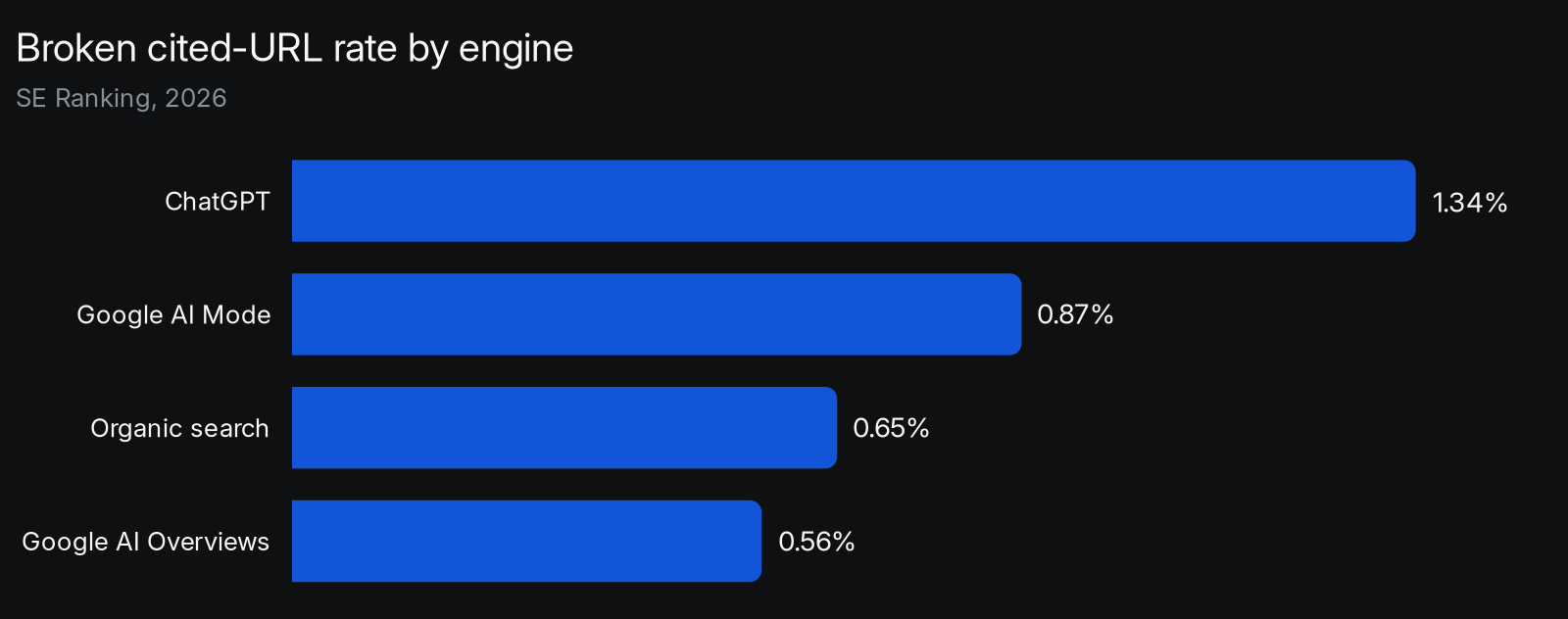
The gap matters because the two channels are not interchangeable. A broken Google result costs a click that converts near the site average. A broken ChatGPT citation costs a click that converts far above it, which is the next problem.
A Dead Citation Wastes Your Best-Converting Click
AI referral traffic influences conversion events at a rate 534% higher than the average across all website channels (Eyeful Media, 2026), so a citation that resolves to a 404 throws away the single most valuable visitor a content program earns. The reader arrived already informed, already comparing, and one redirect short of acting.
That premium is why a broken AI citation is not the same problem as a broken backlink. The traffic an engine sends has been pre-qualified by the answer the reader just read, and a 404 erases the trust that answer built. The cost is concentrated exactly where conversion is highest, a pattern detailed in the AI referral conversion swing.
One in Thirty ChatGPT Referrals Lands on a Dead Page
3.35% of ChatGPT referral traffic landed on 404 pages across more than 18,000 landing pages (Dan Hinckley, cited by SE Ranking, 2026), which is roughly one in every thirty visitors the engine sends. At the volumes ChatGPT now drives, that is not a rounding error in the report, it is a recurring line of lost pipeline.
The leak is invisible in most analytics setups because the dead-end visit looks like a bounce, not a broken promise. Teams that segment AI referral traffic see the 404 landing pattern; teams that do not see only a soft engagement number, the same blind spot covered in why analytics hide AI search invisibility.
404s Make Up 91% of ChatGPT’s Broken Citations
Of the 1.34% of ChatGPT-cited URLs that return a client error, 91% are 404 Not Found, 8.33% are 410 Gone, and 0.67% are 451 Unavailable for Legal Reasons (SE Ranking, 2026). The failure is almost always a missing page, not a server outage or a redirect loop, which means it is almost always preventable.
The full distribution shows how small the broken slice is once a team can see it. The vast majority of cited URLs resolve cleanly, so the fix is a targeted repair, not a site-wide rebuild.
| Response on a ChatGPT-cited URL | Share of cited URLs | Reading |
|---|---|---|
| 200 OK | 97.55% | Healthy and citable |
| 3xx redirect | 0.79% | Citation preserved if mapped |
| 4xx client error | 1.34% | The leak, 91% of it 404 |
| 5xx server error | 0.16% | Rare, infrastructure-side |
A missing page is the cheapest defect in this table to fix and the most expensive to ignore, because each instance recurs on every future answer that repeats the URL.
Engines Keep Citing URLs Your Site No Longer Serves
Citation drift, the share of domains in one month’s AI answers that are gone the next for the same prompt, runs 40% to 60% month over month across ChatGPT, Perplexity, Gemini, Copilot, and Google AI Overviews (Profound, 2026). The set of URLs an engine pulls is both volatile and lagged behind your live site.
An engine answers from an index built on an earlier crawl, so a URL you retired last week can keep appearing in answers and 404 for every reader who clicks it. The lag is the whole problem: the page is gone from your CMS but alive in the model’s memory, and the reader pays for the gap. Managing that window is the same discipline as catching the re-citation window monitoring-first tools miss.
Three routine events strand a URL an engine has already memorized, and each one is preventable with a redirect:
- Migration: a CMS or domain move rewrites the paths the engine learned, so every memorized URL resolves to nothing.
- Cleanup: deleting old posts returns a 404 on addresses that still appear in live answers for weeks.
- Re-slug: renaming a page for tidier wording breaks the exact string the engine repeats in its citation.
Never Change a Published Slug Without a Redirect
A newly published page reaches its first ChatGPT or Claude citation at a median of 6.81 days (Profound, 2026), and once earned, that citation is a fixed string the engine repeats. Changing the slug without a 301 turns every future mention of that page into a dead link.
This is the most common self-inflicted version of the leak. A content refresh, a CMS migration, or a tidy-up of an old URL structure rewrites slugs that engines have already memorized. The page is better than ever and completely unreachable from the answers driving traffic to it. Treat a published slug as a permanent address, and route any change through a redirect rather than a rename.
Return 301 or 410, Never a Bare 404
ChatGPT cites a URL that returns a 404 in 1.22% of cases, against 0.56% for Google AI Overviews (SE Ranking, 2026), so the response a retired page sends decides whether a citation survives. A 301 carries the citation’s value to a live page; a bare 404 discards it.
The choice depends on whether a replacement page exists and whether the content should ever return. Map every URL change to one of these responses before it ships.
| Situation | HTTP response | Why it protects citations |
|---|---|---|
| Page moved or renamed | 301 redirect | Passes the earned citation to the new URL |
| Page replaced by a better one | 301 to the replacement | Reader lands on intent-matched content |
| Content gone for good, no replacement | 410 Gone | Tells crawlers to drop it cleanly |
| Duplicate or parameter variant | Canonical tag | Consolidates citations onto one URL |
| Page deleted with no plan | 404 | Discards the citation, avoid this |
The default behavior of most CMS platforms when a page is deleted is the bottom row. Overriding that default is the single highest-yield habit in link hygiene.
Stale Pages Lose Citations Even When They Resolve
Pages not updated quarterly are 3x more likely to lose AI citations (Airops and Kevin Indig, 2026), so link hygiene extends past dead URLs to the freshness of the page behind a live one. A 200 response is necessary but not sufficient; an engine can drop a resolving page that has gone stale.
This widens the job from a crawl for dead links to a refresh cadence on the pages that earn citations. The URL stays alive, the content stays current, and the citation keeps resolving to something the engine still rates as the best answer. Freshness and reachability are two halves of the same maintenance task.
Treat Link Health as a Weekly Audit
Citation drift climbs to 70% to 90% over six months for identical prompts (Profound, 2026), so a once-per-migration link check is far too slow to catch the leak. The set of URLs an engine cites turns over fast enough that a quarterly audit misses most of the damage before it is found.
A weekly pass keeps the broken slice small while it is still cheap to fix. The cadence matches how quickly the citation set itself changes, rather than how often a team happens to run a site migration. Slow audits let a single retired URL bleed for months across every answer that repeats it.
Audit the URLs AI Already Cites for You
97.55% of ChatGPT-cited URLs return a healthy 200 (SE Ranking, 2026), which means the broken minority is small enough to fix by hand once a team can see which URLs the engines actually pull. The audit starts from the citation set, not from a full-site crawl.
The procedure runs in three steps, and a team that keeps a running record turns the weekly pass into minutes of work rather than a fresh investigation each time.
- Collect the URLs engines cite for your priority prompts, building the watch list from the answers themselves.
- Check the HTTP status of every cited URL and flag anything that does not return a 200.
- Repair or redirect each defect, restoring the page or sending a 301 to the closest live replacement.
The table below is the record the team keeps against that procedure, so a defect found one week is not re-discovered the next.
| Audit step | What to capture | Action on a defect |
|---|---|---|
| Collect cited URLs | Every URL engines return for tracked prompts | Add to the watch list |
| Check status | HTTP code per URL | Flag anything not 200 |
| Repair | 404 or 410 hits | Restore page or 301 to replacement |
| Verify freshness | Last-updated date on live cited pages | Refresh pages stale past a quarter |
The audit is only useful if the repair step is fast, and the repair step is where most content stacks stall, because detecting a broken citation and fixing it usually live in two different tools.
Where GEO Tools Stop at Detecting the Dead Link
Most GEO platforms can tell you a cited URL is broken or stale, but they differ sharply on whether they can also fix it, and the gap between detection and repair is where the leak persists. The dimensions that matter are how each tool handles a broken or stale cited URL, what citation data it tracks, and what the team gets back at the end.
| Tool | Broken or stale URL handling | What it tracks | What you get back |
|---|---|---|---|
| Res AI | Edits and redeploys the fix across the CMS in one command | Citation health across ChatGPT, Perplexity, Claude, Gemini | Republished pages and redirects, live in minutes |
| Profound | Flags visibility gaps without a path to fix them | 10+ answer engines | Dashboards and agents |
| Athena | AI Blindspot Detection crawls for lost or hidden pages | 8+ LLMs | Optimization recommendations |
| Conductor | Real-time site health monitoring | ChatGPT, Gemini, Copilot, Claude, search | Performance reports |
| Peec AI | Monitoring only, no repair path | Multi-model visibility | Visibility, position, sentiment |
| AirOps | Content Refresh identifies and updates stale content | Multi-model | Updated content |
Detection tools surface the broken citation and hand the team a brief. The 404 stays live until someone opens the CMS, finds the page, and ships a redirect, which is the delay a buyer experiences as a dead end.
Frequently Asked Questions
Why do AI engines cite broken links more often than Google does?
AI engines answer from an index built on an earlier crawl, so they repeat URLs your site may have already changed. ChatGPT cites broken links at up to 2.38% of its URLs, nearly 3x the overall Google rate (Ahrefs, 2025).
How is a broken AI citation different from a broken backlink in SEO?
A broken backlink costs an average-value click, while a broken AI citation costs a pre-qualified buyer who converts 534% above the site average (Eyeful Media, 2026). The traffic is more valuable, so the loss is larger per incident.
What HTTP status should a retired page return to protect its citations?
Return a 301 when a replacement exists and a 410 when the content is gone for good, never a bare 404. A 301 passes the earned citation to a live page; a 404 discards it.
How often should a content team audit its cited URLs?
Weekly, because citation drift reaches 70% to 90% over six months for identical prompts (Profound, 2026). A quarterly or migration-only check misses most of the damage before it is caught.
Does fixing a 404 restore the citation automatically?
Not instantly, because engines re-crawl on their own clock and citation drift runs 40% to 60% month over month (Profound, 2026). A 301 restores the reader’s path immediately even before the engine refreshes its index.
How do you find which URLs an AI engine is citing?
Start from the citation set for your priority prompts rather than a full-site crawl, since 97.55% of cited URLs already resolve cleanly (SE Ranking, 2026). Collect the cited URLs, then check each one’s HTTP status.
Why does changing a slug break citations you already earned?
A page earns its first citation at a median of 6.81 days (Profound, 2026), and the engine then repeats that exact URL string. Renaming the slug without a redirect turns every future mention into a dead link.
Can a page that still loads lose its AI citations?
Yes, because pages not updated quarterly are 3x more likely to lose citations (Airops and Kevin Indig, 2026). Reachability keeps the citation resolving; freshness keeps the engine choosing the page.
How Res AI Repairs Dead Citations Across Nine CMS Platforms
The article above showed why a broken citation bleeds the highest-converting traffic a content program earns, and why detection alone leaves the 404 live until someone manually ships a fix. Res AI closes that gap by making the tool that monitors your cited URLs the same one that edits and republishes them. A natural-language command finds every affected page across WordPress, Webflow, Framer, Contentful, Notion, Ghost, Sanity, Vercel, and GitHub, applies the redirect or content fix, and pushes it live in minutes.
Because the edit happens at the CMS rather than in a brief, the broken citation is repaired before the next crawl rather than after the next agency cycle. The same loop that catches a stale page restructures it, so reachability and freshness are maintained in one pass instead of two.
Res AI turns a dead citation from a silent leak into a same-day repair, because the platform watching your cited URLs is the one that fixes them. The first 10 articles are free.